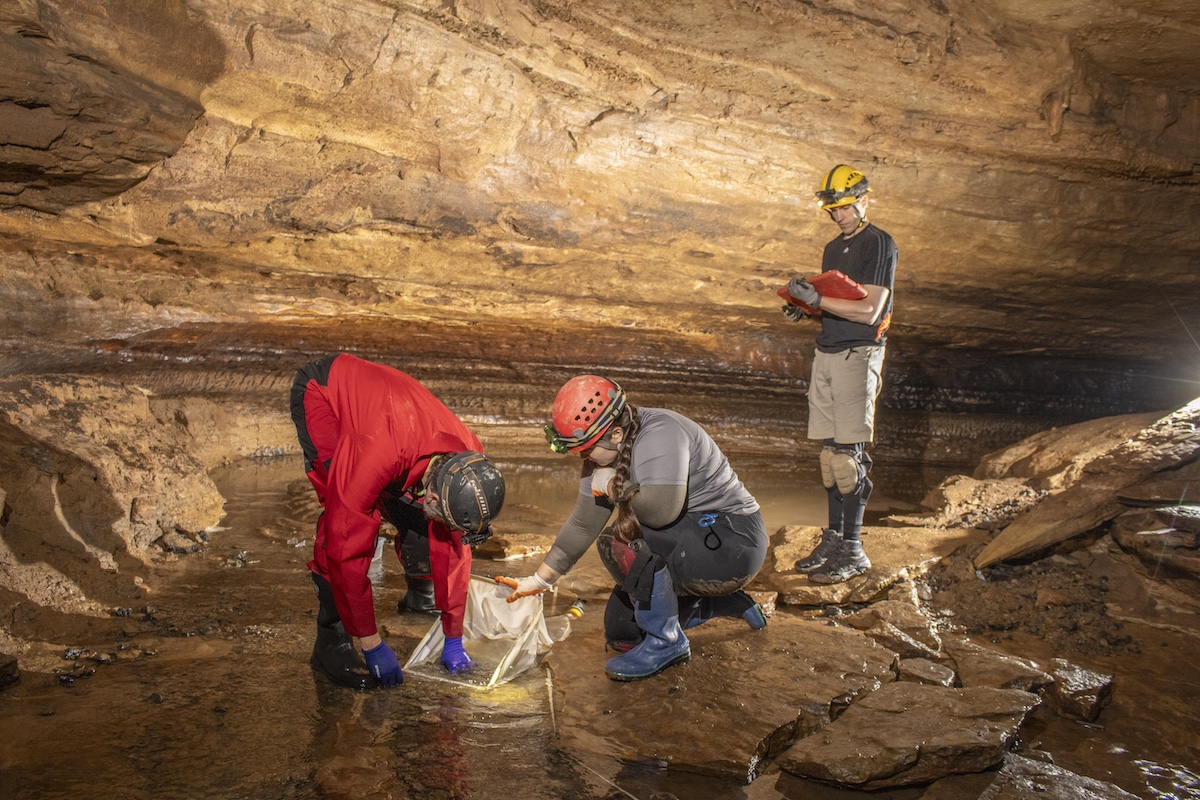
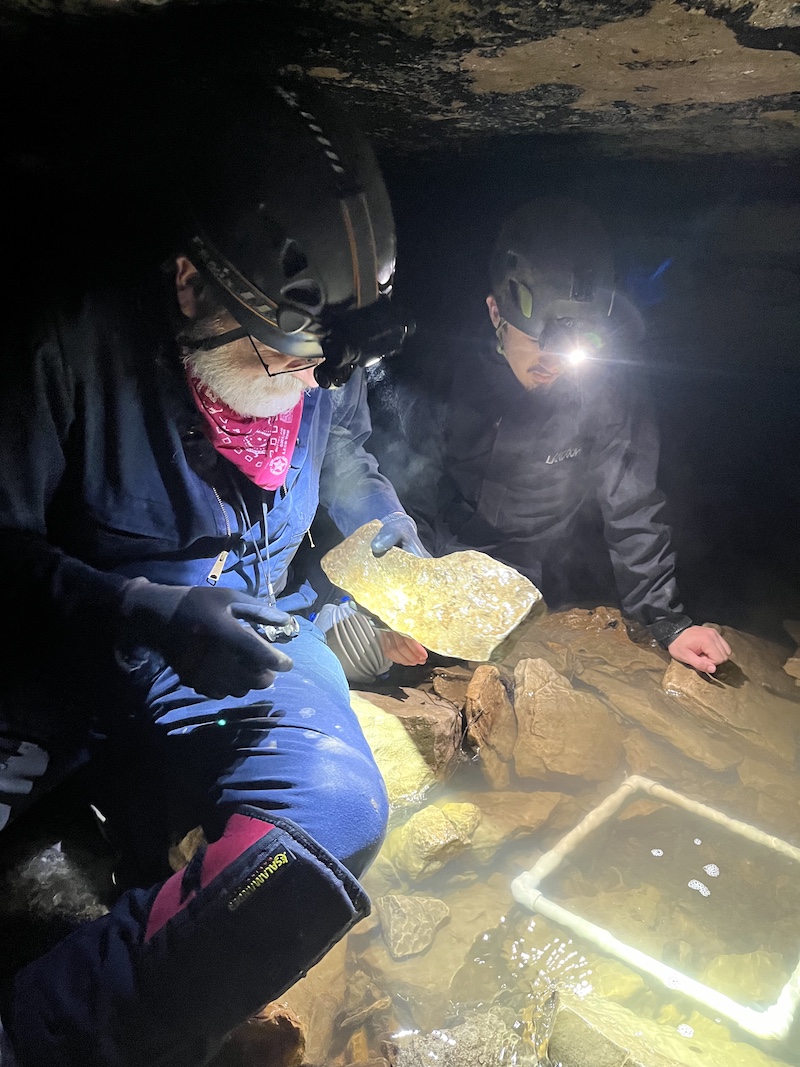
Research team sampling a stream section for the federally endangered Illinois Cave Amphipod in Illinois Caverns. Bob Weck (left) with University of Missouri at St.Louis biology students Andersen Patty-G’Sell and Soren Johnson. Photo by Derik Holtmann.
“I visited the cave [Illinois Caverns] on a very memorable high school Earth Science field trip back in 1979,” wrote Bob Weck in his “Searching for a Rare Amphipod in Illinois Caverns” (Caver, The Meramec Valley Grotto, July 2025). Into the dark recesses of the earth goes a student and what emerges is a spelunker. Then, voilà! That cave-exploring enthusiast, mesmerized by a cave’s natural community, becomes a serious scientist – in other words – a speleologist!
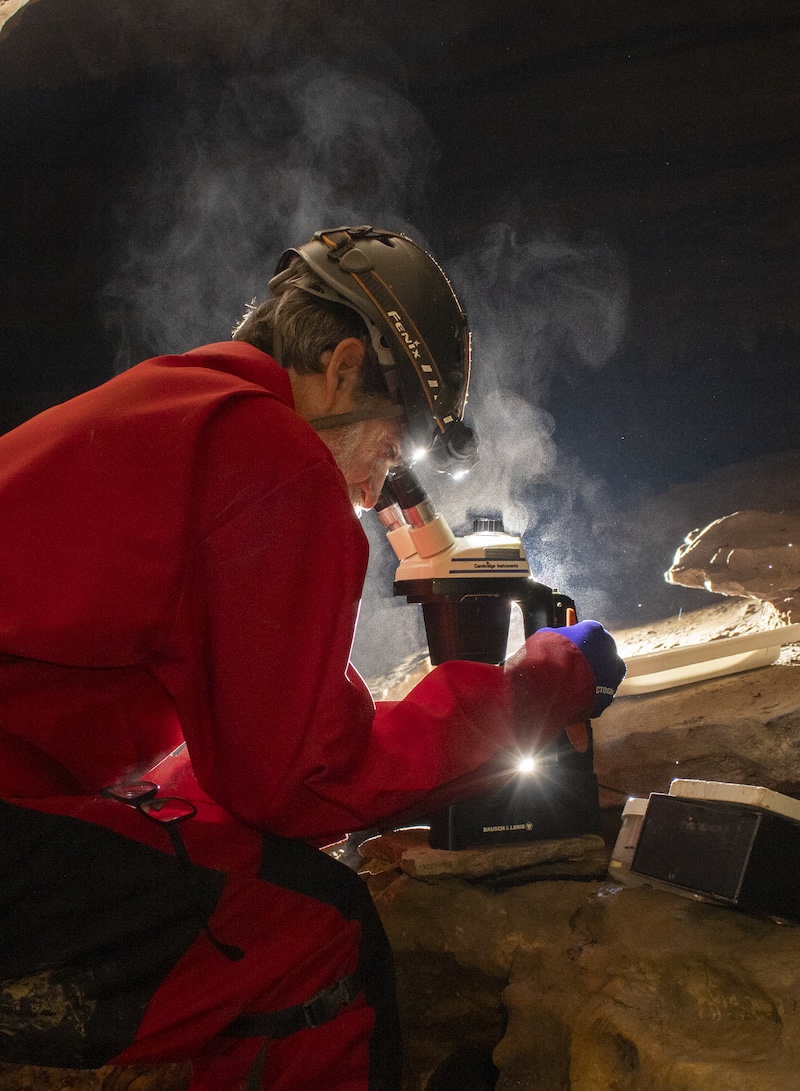
Bob Weck examining stygobionts under a microscope in Illinois Caverns. Photo by Derik Holtmann.
Within the Stemler Karst Illinois Natural Areas Inventory site exists a property owned by Bob Weck and his wife. That property is a dedicated Illinois Nature Preserve beneath which lies a section of Stemler Cave passage and upon which exists the primary entrance to the cave and its surrounding wooded sinkhole.
I read in one of Weck’s speleological research papers the word: stygobiont. Just for fun, I asked my 12-year-old grandson what that word meant. He knew that “bio” is a root meaning life. Then he recalled that “Styx” in Greek mythology refers to a river in the underworld. “An animal living in the underworld, oh, in a cave,” he speculated. Right!
A stygobitic community is composed of creatures that are adapted to aquatic habitats such as cave streams and seep springs. A stygobiont might typically live at the interface between subterranean and surface ecosystems. So, what creature did he study? An enigmatic cavesnail.
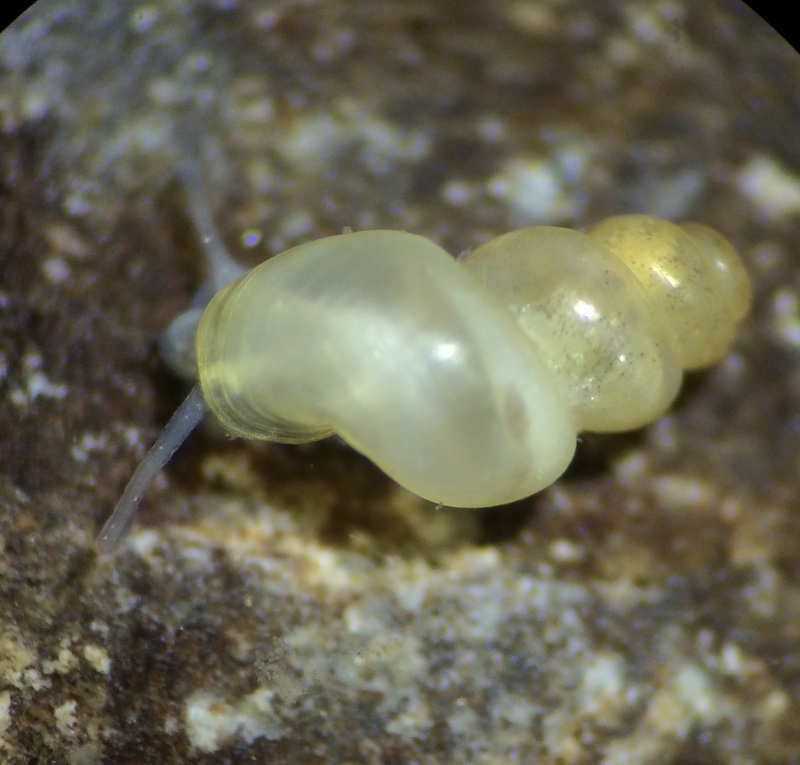
Adult enigmatic cavesnail, Fontigens antroecetes, an Illinois State Endangered Species from Stemler Cave. Photo by Bob Weck.
Yes, a snail, a gastropod with scientific name of Fontigens antroecetes, was the object of Weck’s study, described in an article published in Subterranean Biology in August 2022. He conducted captive breeding of the enigmatic cavesnail under simulated cave conditions.
Why in the underworld would he do that? One reason was to discover the usefulness of such in studying the life history and reproductive biology of this snail which is listed as an endangered species in Illinois. Another was to determine the potential of captive propagation as a means by which snails could be reared for reintroduction efforts if isolated populations declined drastically.
When I read “syntopic” in another of Weck’s publications, I went straight to an internet search engine. The word refers to species that co-exist and occupy the same habitat and that interact directly. “In Stemler Cave Physa acuta is syntopic with the Illinois endangered enigmatic cavesnail …” This statement struck me as a forewarning. Sure enough! Weck’s research was initiated because cave streams and groundwater of the sinkhole plains karst region of southwestern Illinois have become increasingly contaminated by pollutants, resulting in nutrient-enriched waters promoting biofilm growth on cave strata. Obligate cave-dwelling species (stygobiont) could be out-competed by species surviving both in cave and surface environments (troglophilic) and by aquatic species thriving in surface habitats. Competitors: Fontigens antroecetes (the very rare enigmatic cavesnail) and Physa acuta (the quite common bladder snail). Weck researched the fecundity and growth rates of bladder snails reared in waters of varying nutrient-richness in simulated habitats.
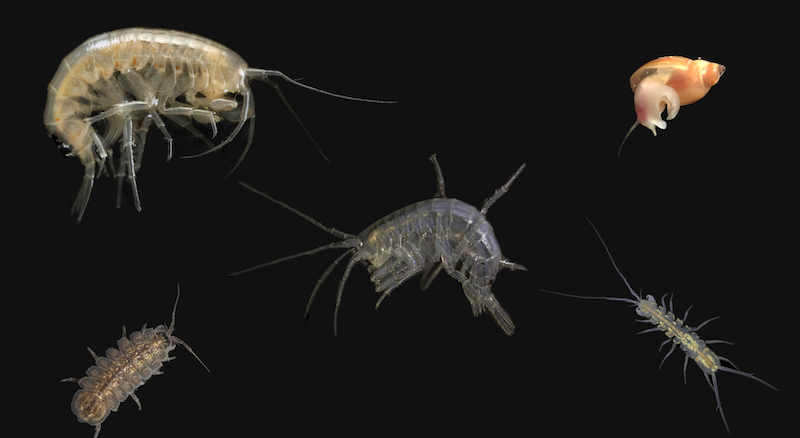
Composite image of some aquatic invertebrates in Illinois Caverns, featuring a subadult specimen of the Illinois Cave Amphipod in center. Photo by Justin Elden.
Have you ever heard of an amphipod? It is a sideways-flattened crustacean, not a shrimp, but sometimes called a freshwater shrimp. Preceding the reopening of Illinois Caverns in the year 2021, after the cave’s closure in 2010, the Illinois Department of Natural Resources sought Weck’s involvement in a bio-inventory of aquatic invertebrates especially focused on quantifying the population of a rare and endangered cave-dwelling creature, the Illinois cave amphipod. The inventory, conducted by Weck and other speleologists, reinforced the realization that aquatic troglobitic animals are sensitive to low oxygen levels. Organic pollutants serve as food for bacteria and that allows the bacteria to reproduce rapidly; that quick increase in population is called bacterial bloom. The bacteria use the saturated oxygen in the cave water which results in less oxygen for other organisms.
Featured above Bob Weck (left) and Nathan Curran conducting a census for the Illinois state endangered enigmatic cavesnail in Stemler Cave. Photo by Dani Lotz.
Weck completed a study of herpetological diversity in Stemler Cave Nature Preserve; his findings were based on ten years of observation. Now Professor Emeritus Bob Weck (Southwestern Illinois College) works as an active volunteer and serves as a board member for Clifftop, an organization founded in 2006 with the mission of promoting conservation, preservation and protection of a section of the Mississippi bluff corridor. The organization created the Paul Wightman Subterranean Nature Preserve (535 acres) within the watershed of Fogelpole Cave, which is Illinois’ largest cave with over 15 miles of known passage. Clifftop manages the nature preserve to support biodiversity by assuring high-quality habitat for both surface-dwellers and cave-dwellers.
Let this be a forewarning: those individuals who dare to explore the depths – spelunking at Illinois Caverns, visiting the Paul Wightman Subterranean Nature Preserve, or just delving into karst ecology – will emerge, having gained an appreciation for the importance of biodiversity.
For years, Patty Gillespie shared her enthusiasm for language and nature and got paid for it at a public school and at a nature center. Now she plays outdoors as often as she can and writes for the sheer joy of it.







Submit a question for the author