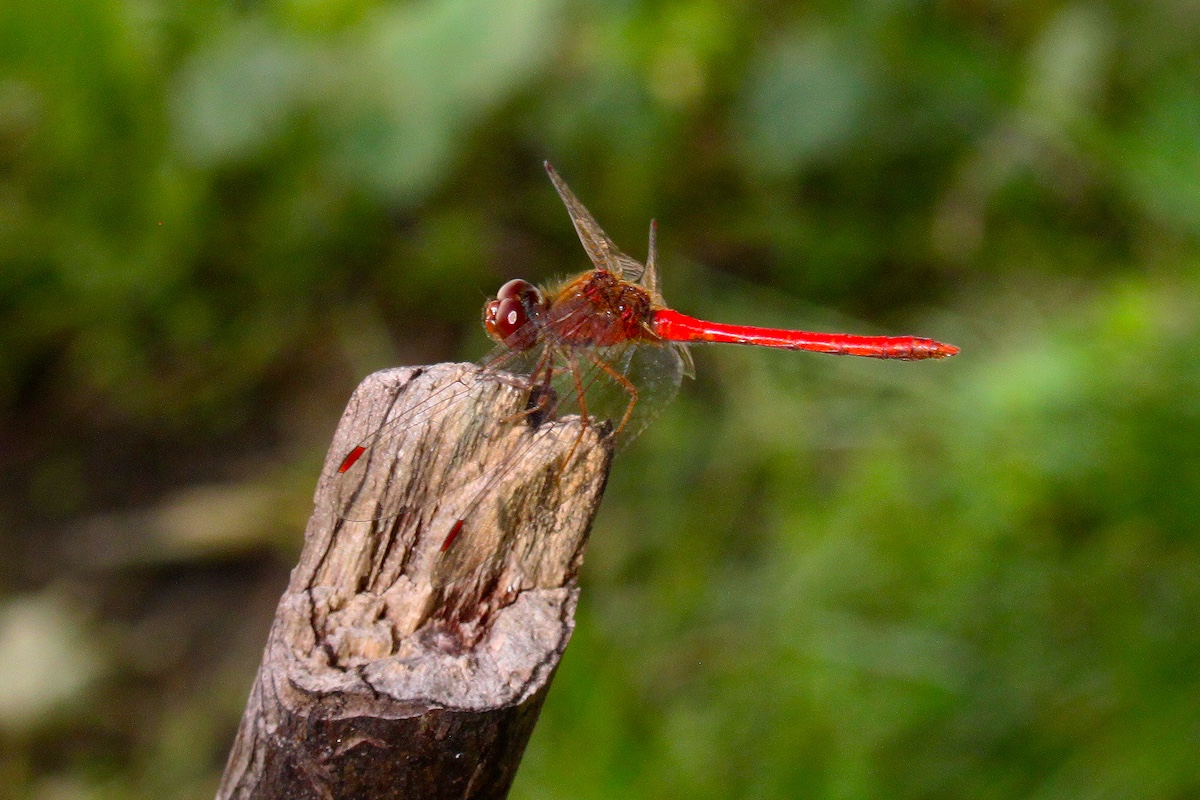
A male autumn meadowhawk. All photos by Steven D. Bailey.

Watching Dragons and Damsels
| May 1, 2026 | Aquatic Organisms
Surveying odonates contributes to science and makes for a great summertime adventure.
A decade ago I didn’t know what the word odonate meant, nor that I could find these insects in my back yard. I also did not know that documenting them for the Illinois Odonate Survey would become one of my favorite summer activities.
Odonate refers to damselfly and dragonfly species. The term Odonata means toothed one and refers to the toothed jaws that these insects have that enable them to eat insects, including mosquitoes. They do not bite humans.
Adults appear in late spring when most of the colorful migratory warblers are gone. Then you can segue right into odonates, which are just as colorful and sometimes even more difficult to identify in their immature (called teneral) stages. As with warbler species, many female odonates look a lot different from their male counterparts.
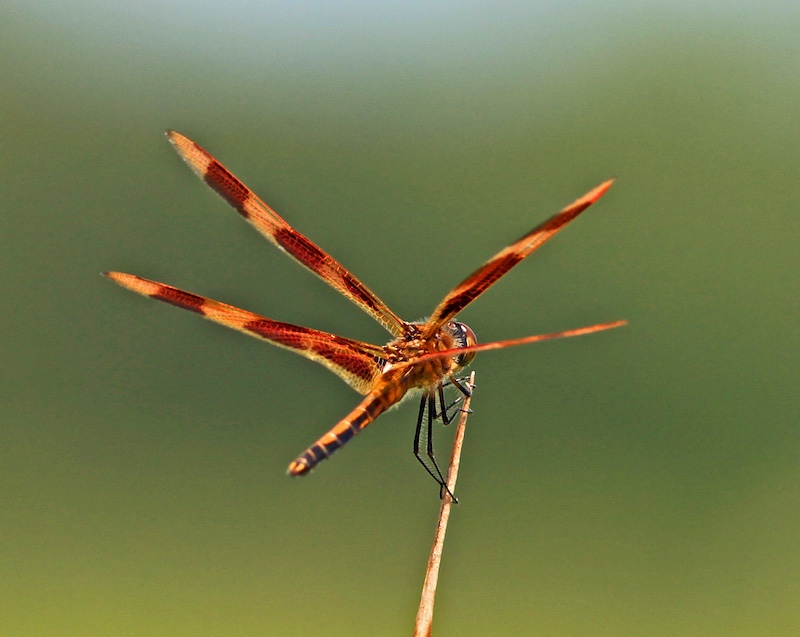
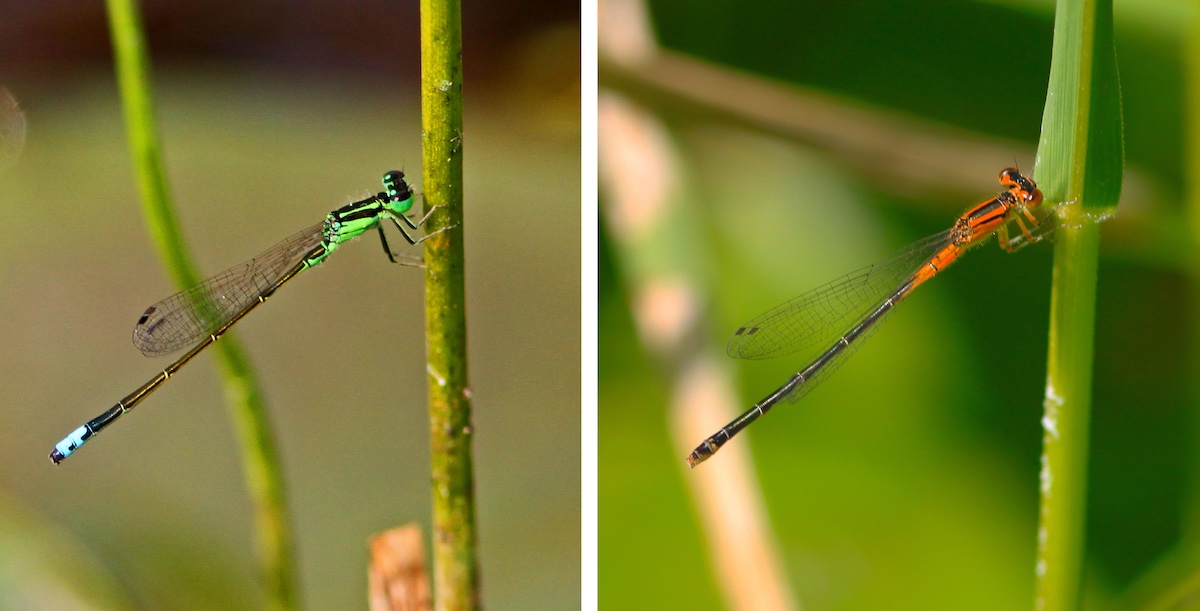
There’s the male eastern forktail, a damselfly with black and green near the head and powder blue at the end of the abdomen; the Halloween pennant, a large dragonfly with orange and black wings; and, an autumn meadowhawk dragonfly with ruby red body and yellow legs. These are some of the odonates I can identify in northern Illinois and have reported online since volunteering in 2019. Each season, I record sightings six times from late May to early October at Community Park Pond in Mundelein, Lake County, and six times at Lake Defiance, Moraine Hills State Park in McHenry County. The report includes time, date, wind conditions, temperature and sky conditions and number of each species. Data are entered into the PollardBase, where butterfly and dragonfly sightings from Illinois and other states are also kept.
Scientists are also collecting odonates in adult and larval stages in Illinois to determine which species are still present. Amy Janik, research specialist at the National Great Rivers Research and Education Center, a unit of Lewis and Clark Community College in East Alton, is leading such a project. For more, see this article in OutdoorIllinois Journal.
“Odonates can be barometers of ecosystem health,” said Ashley Portala, assistant manager of living collections at the Peggy Notebeart Nature Museum/Chicago Academy of Sciences. The Academy is in charge of the Illinois Odonate Survey.
“Odonates are predators which represent an important part of the food chain,” Portala said.
Life Cycle
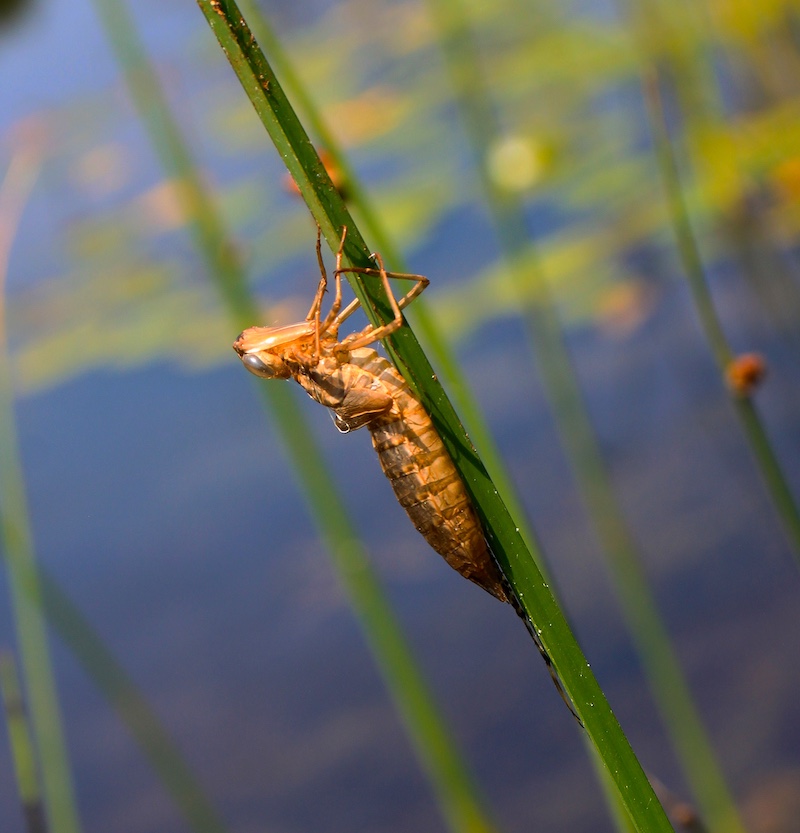
Though it seems adult odonates are flying all spring through fall, individual adults live only a week or two, spending their short life eating and mating. Odonates spend more of their lifetime beneath the water. Adult females lay eggs in water or on aquatic plants. Eggs hatch into larvae or nymphs and remain underwater for a month to years, depending on the species. Fish and other aquatic organisms eat odonate eggs and nymphs. The nymphs eat mosquito larvae and other aquatic organisms. Eventually the nymph climbs up vegetation and turns into a winged adult. The process can take a half an hour or longer, at which time they are vulnerable to predators. A cast skin called an exuvia is left behind on the vegetation.
Adult odonates are carnivorous and eat mosquitoes, other insects and each other. Those squeamish about seeing a Cooper’s hawk eat a goldfinch might also be squeamish about watching a green darner dragonfly devour a blue dasher dragonfly. In return, odonates may be eaten by birds such as flycatchers and swallows.
Declining Numbers
Though data have only been gathered for the Illinois Odonate Survey since 2003, “preliminary analysis suggests we are seeing declines in odonates in Illinois, just as with many other insect species,” Portala said. In addition, the Xercis Society reports that at least 20 percent of North America’s odonate species are at risk. In Illinois, the elfin skimmer (Nannothemis bella) is an endangered species and the Hines emerald dragonfly (Somatochlora hineana) is endangered at the federal and state level.
I’ve surveyed birds for many years, then got hooked on odonates after accompanying volunteer monitor Janet Haugen at Reed Turner Woodlands in Long Grove. There she showed me a sparkling jewel with glowing green abdomen and black wings dancing along a meandering creek. It is called an ebony jewelwing, and is just as beautiful as any warbler.
Damsels vs. Dragons
The ebony jewelwing is a damselfly, not a dragonfly. Dragonflies are larger and hold their wings out when perched. Damselflies are smaller and typically fold their wings in when perched, except for some called spreadwing damselflies. Overall, damselflies don’t fly quite as well as their larger cousins, and often are found hugging vegetation close to shore. Dragonfly eyes appear to be touching, while damselflies often have a gap between the eyes. These compound eyes allow odonates to see almost 360 degrees while flying. They just can’t see what’s directly behind them.
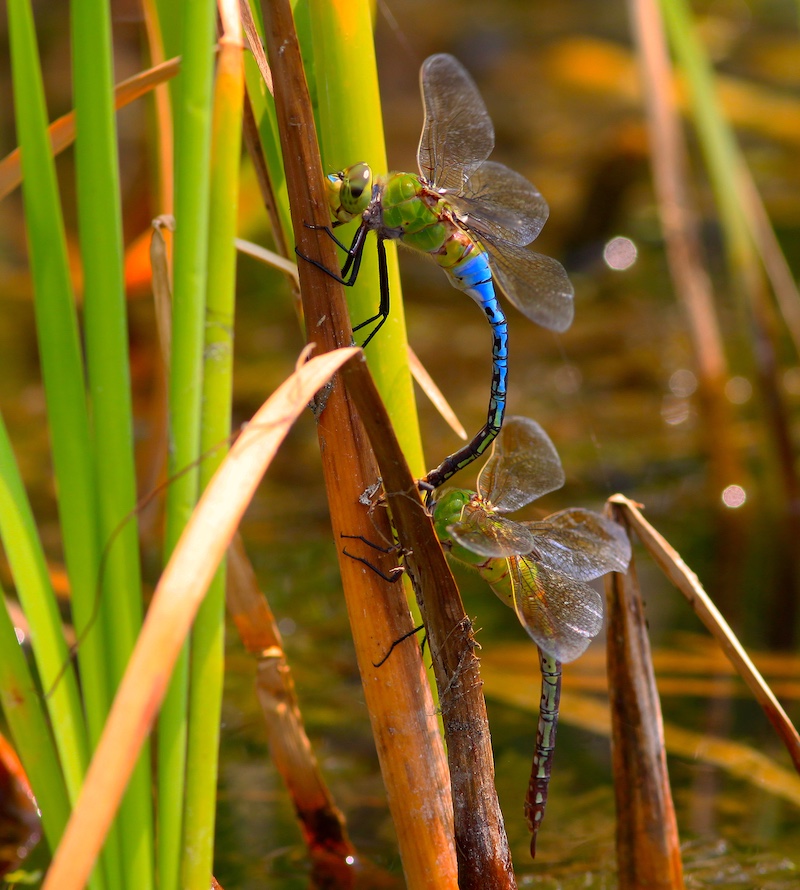
Odonate anatomy is intriguing. What looks like a long tail is called the abdomen, which has 10 segments, some of which have varying colors, which aid in identification. The abdomen is attached to the thorax, which has its own unique colors and patterns. The thorax is attached to the head, where eye color can point to various species.
Some odonates need to be examined with a magnifying glass for accurate identification. For example, observers may look at the shape and size of the male’s claspers used to hold the female’s head during mating. Claspers sometimes allow the viewer to hone the identification to the exact species.
Monitors only indicate the name of a species if they are certain. Plenty of times I have documented unidentified dragonfly species or unidentified damselfy species. That data is important, too. As Portal told me, monitors improve their skill each season, as I did when I learned that the male eastern forktail has a green thorax and blue at the end of its abdomen, while females can be orange or powdery blue depending on age.
Flight Times
As with some warbler species, odonates have flight times. The yellow-rumped warbler, for example, is among the first warblers to appear in Illinois in spring, and the adult green darner is one of the earliest odonates to appear. It’s one of few dragonflies that migrate.
An early dragonfly I’ve seen at Lake Defiance at Moraine Hills is a dot-tailed whiteface. They’re gone by late June when the eastern amberwings, small copper-colored dragonflies, have emerged.
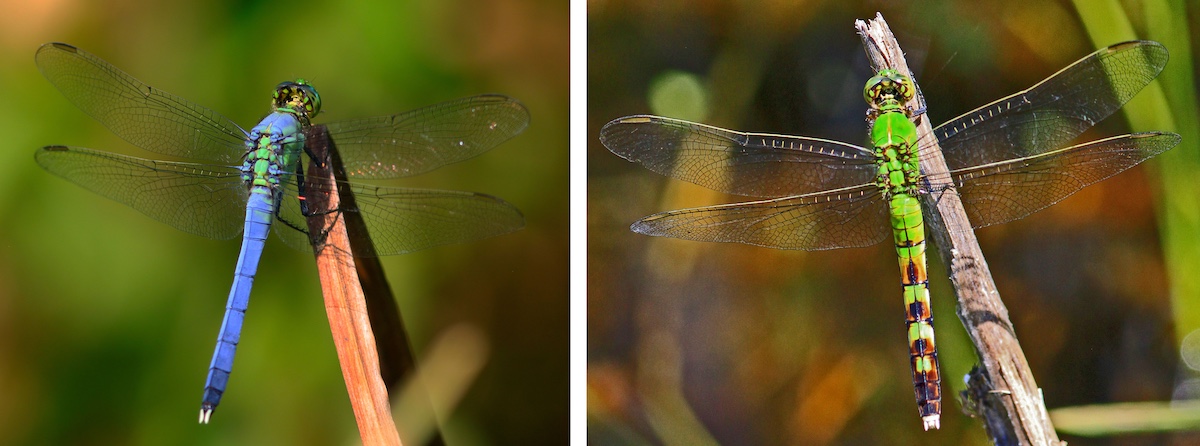
On a warm early July day at Lake Defiance, I can observe mating Halloween pennants in their unique heart formation near the small boat launch. Blue dashers and eastern pondhawks land on lily pads, fly about and chase one another while a female twelve-spotted skimmer lays eggs, her mate nearby. In the shallows, I’ll see eastern forktails and skimming bluet damselflies like tiny Tinkerbells or ornaments perched on the vegetation. It’s quite stunning to see all the color and activity on the wing in one spot.
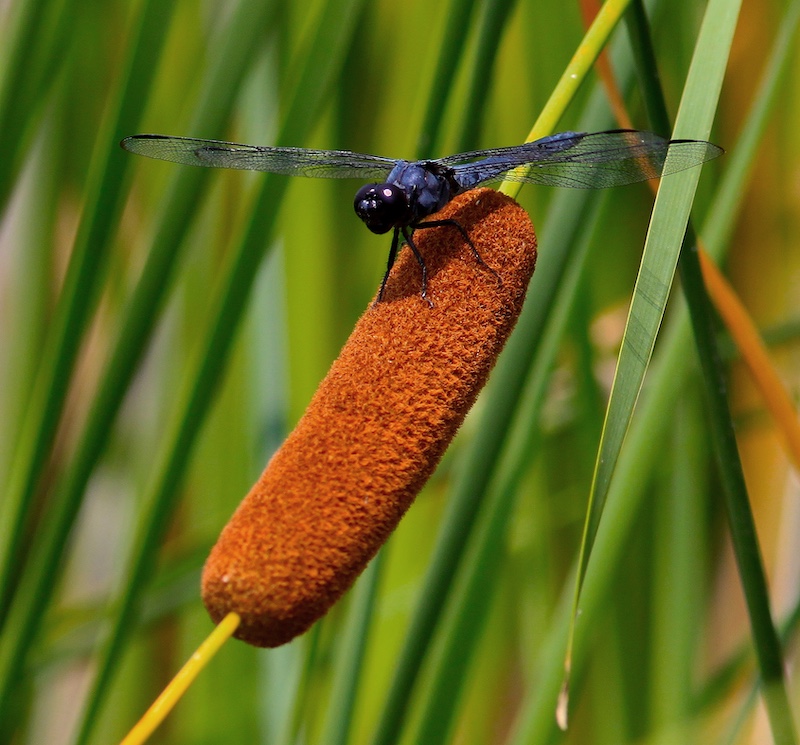
In 2021, I added slaty skimmer to my Lake Defiance list. This species was considered rare in northern Illinois, but as I perused the observations of other monitors on the database, I realized folks were seeing even more slaty skimmers than I was, both in northern and southern Illinois.
I asked Portala what might be causing the increase in slaty skimmers in northern Illinois.
“With the data we have we cannot attribute this observation to climate change,” she told me. “However, it is certainly possible that the rise in slaty skimmer observations is a result of expanded search effort. Sometimes we are unaware of how abundant a species is in an area until we have monitors there to observe them.”
Even in Your Back Yard
As with bird watching, you never know what you’ll find in the field or even in your own backyard when observing odonates.
“Dragonflies are found virtually anywhere that water occurs, including artificial water sources, like cattle troughs and stormwater ponds,” said Jason Bried, ecologist for the Illinois Natural History Survey. “Even the most temporary sites, like woodland vernal pools and water-filled tree holes, are bound to have a dragonfly or two lurking about,” Bried said in an article published online by the Illinois Natural History Survey.
Bried has co-authored “Towards Global Volunteer Monitoring of Odonate Abundance,” published in the journal Bioscience, as well as several books on odonates.
I live near a lake and a creek and have some bird baths in the yard. Several damselfly and dragonfly species including blue dasher, autumn meadowhawk and twelve-spotted skimmer, have graced my yard annually, perching on flower pots, vegetation and bird baths.
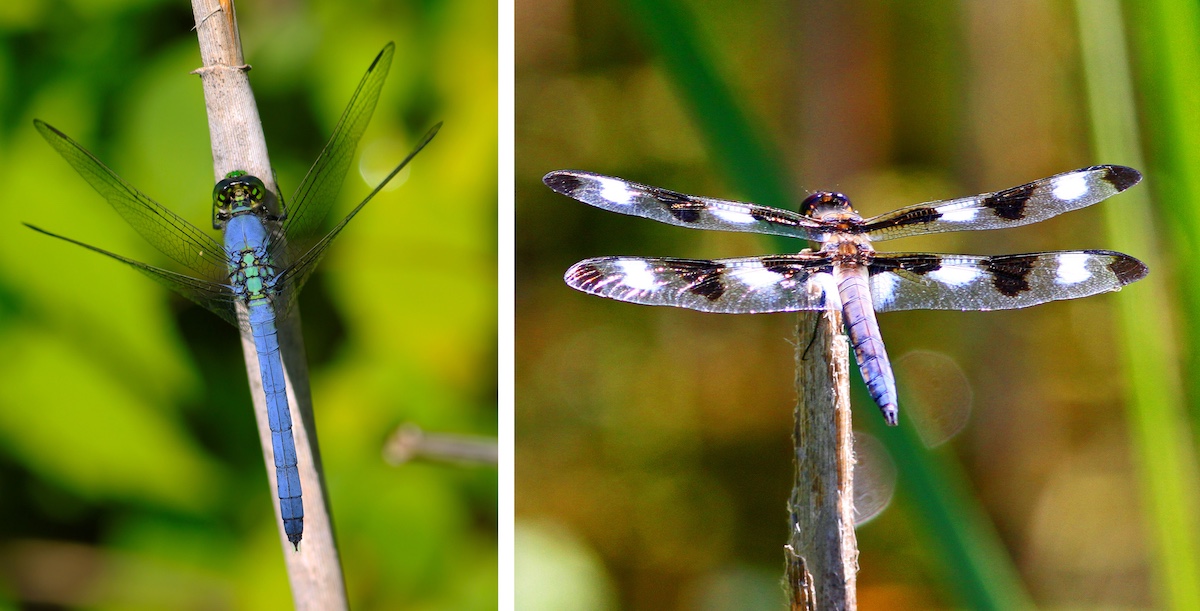
At first, watching odonates helped me get over the sadness of missing so many warbler species after spring. But now I look forward to what odonates I’ll see in summer, and I understand even more now how important it is to document wildlife, including insects. Many years of data are needed to make conclusions about population patterns. So I’ll be out in McHenry County and Lake County again this summer documenting odonates.
Those interested in volunteering or wanting to learn more about identifying these aquatic creatures can visit illinoisodes.org. Then get out near a wet area and start looking. As Portala told me, “The best way to improve your identification skills is to practice in the field.”
Sheryl DeVore writes environment and nature pieces for regional and national publications and has had several books published, including “Birds of Illinois” co-authored with her husband, Steven D. Bailey.
Submit a question for the author
Question: Today, 9/2/26 I have a damselfly I guess in my yard. It’s tiny. It has a green head, the body is red and black striped horizontally, and the wings are clear with black lines running thru them. Not phone camera isn’t taking a clear picture of it I guess because of the size. I only see one red damselfly in this area but it is not striped or have a green head like the one I am seeing. It’s tiny.. maybe an inch and a half long.
Question: can you show a picture of all the colorings
Question: A facebook post mentioned “molting” dragonflies. I had never heard of that. Have you? Excellent article I am going to print!
Subscribe to our Newsletter
Explore Our Family of Websites
Similar Reads
How Archery Hunters Can Help Track Wildlife Populations
August 3, 2026 by Max Allen
What’s for Dinner, Bobcat?
May 1, 2026 by Kathan Bandyopadhyay
Fisheries, Aquaculture and Aquatic Sciences Celebrate 75 Years at Southern Illinois University Carbondale
May 1, 2026 by Jim Garvey
Humans, Deer and Shrublands: The secret to mammal diversity in Illinois
May 1, 2026 by Nathan Proudman
From Spelunker To Speleologist
May 1, 2026 by Patty Gillespie
Using Long-term Data to Improve Sportfish Monitoring in Illinois Rivers
November 3, 2025 by Robert Mooney, Michael Spear, Brian Ickes, Andrya L. Whitten Harris, Jason A. DeBoer, David Glover, James T. Lamer
Caught on Camera
November 3, 2025 by Sheryl DeVore
The Sport Fish Restoration Act Has Been Supporting Fisheries Management for 75 Years: Part 1
November 3, 2025 by Vic Santucci
Living with Wildlife in Chicago’s Backyard: What 25 Years of Research Tells Us
August 1, 2025 by Samantha G. Pallazza, Craig Miller