
Photos by Justin J. Shew.

Photos by Justin J. Shew.
Justin J. Shew and Addison Moore recently published results of a study in the Natural Areas Journal that provides a different approach to honeysuckle management and woodland restoration, which reduces back-breaking work and may help prevent reinvasions into the future. Read here a first-hand account of the study to learn a new way of tackling honeysuckle to restore your forested and woodland habitats.
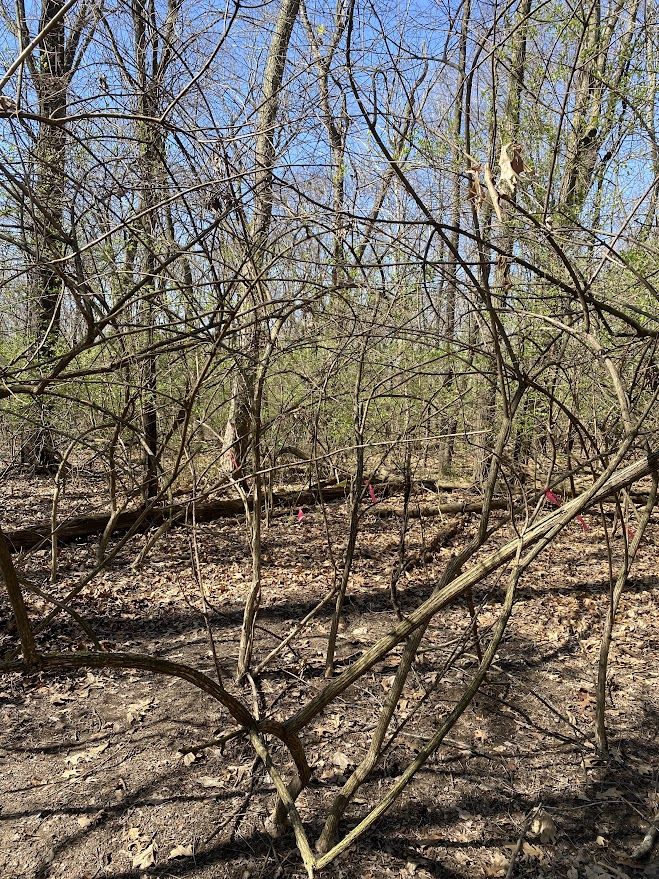
Controlling invasions of Amur honeysuckle (Lonicera maackii; aka bush honeysuckle) has been a constant battle many midwestern private landowners, habitat strike teams and state conservation agencies fight. This shrubby invasive species outcompetes many natives and quickly degrades woodlands and forest habitat for wildlife and hunters. Controlling honeysuckle is often back-breaking in nature when utilizing mechanical techniques such as handsaws, chainsaws (make sure you have training and personal protective equipment or PPE), and loppers. If you employ these techniques don’t forget to apply your herbicide to the stumps SOON after cutting! Also, you often have to haul or stack the honeysuckle debris after cutting – visually satisfying but also MUCH more work. Outside of these techniques, larger scale prescribed fire and aerial herbicide spraying, using helicopters, planes and drones, are also possible but require training/specialized equipment and often a substantial investment just to get the aerial contractor working at your site. Pesticide applications, such as backpack spraying, can have their issues with user exposure to chemicals and over spraying along with drift that kills non-target native species.
In addition, after removal of honeysuckle, other non-natives such as garlic mustard (Alliaria petiolata) can take advantage of the habitat opening. Most of the time we are simply focused on controlling the honeysuckle infestation when possibly we should have better focus on a long-term view of the restoration. Maybe there could be a better way to approach a restoration based on the scale and maturity of your honeysuckle problem?
We recently published our study “Herbicide Injection and Native Seeding Recharges Restoration of Invaded Amur Honeysuckle (Locnicera maackii) Woodlands” in the practitioner friendly Natural Areas Journal. Our study on honeysuckle control and plant species community documents a new technique using a rarely utilized control tool with a simple fall seeding mix. We hope to offer a more accessible and successful technique many landowners and volunteer restoration groups could consider when working on woodlands infested by honeysuckle. At the very least, a novel method to consider within the restoration toolbox.
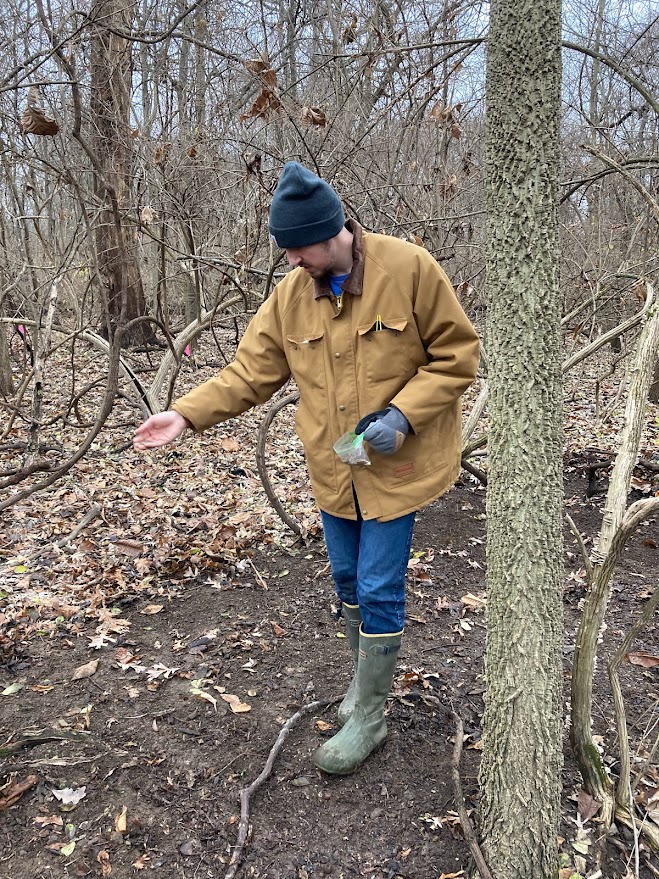
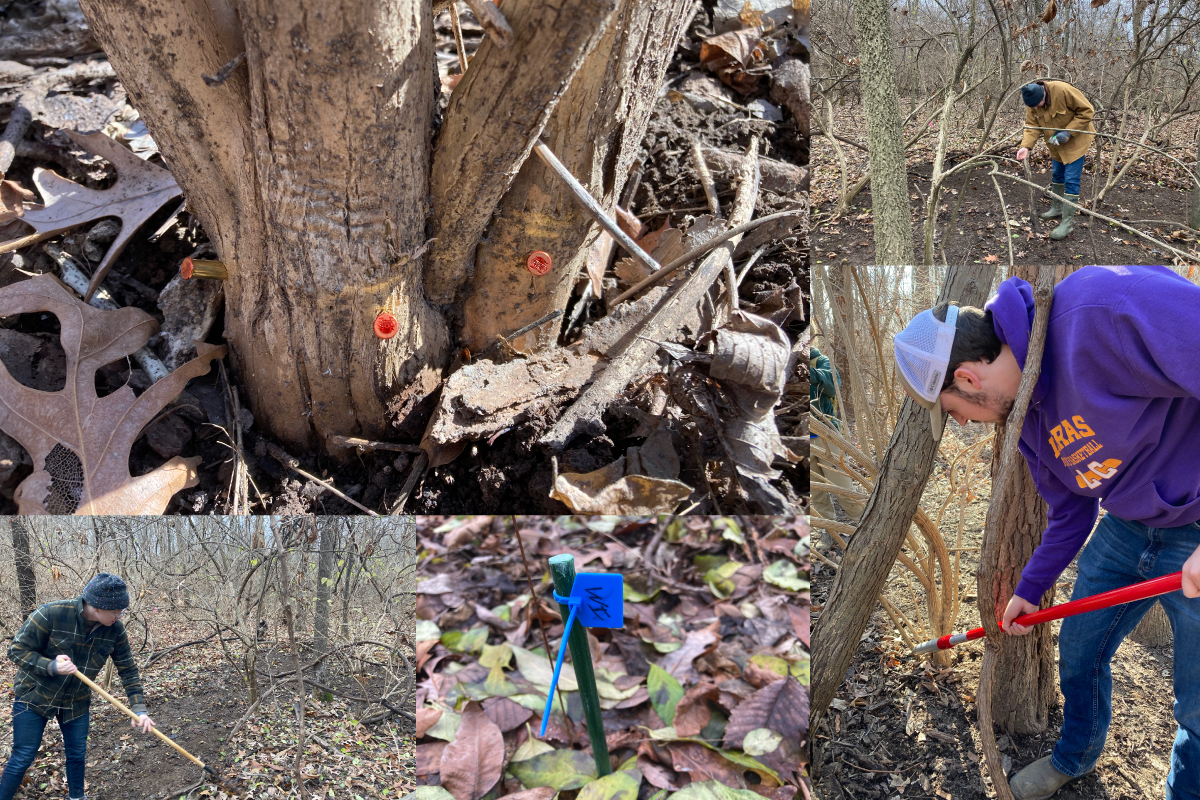
Highlighted in a previous article, we utilized a dry herbicide glyphosate capsule injector in the winter, our winter injection treatment group, to control a mature honeysuckle stand following the manufacture’s recommendation. Injectors, although a bit pricey, do have many benefits that may outweigh the initial sticker shock such as reducing back-breaking fatigue, lack of non-target species effects (i.e. no over spraying), limited chemical exposure to users (no chemical mixing or spraying), and their use does not require chainsaw chaps/helmet or specialized training. We found that injecting during winter could be quite comfortable if the sun was out and temperatures were above freezing – no humidity, insects or ticks and better visibility with leaf off conditions.
In addition, we added a fall seeding treatment where we raked the leaf litter and hand-sowed black-eyed Susan (Rudbeckia hirta), inland river oats (Chasmanthium latifolium) and northern spicebush (Lindera benzoin) at double the suppliers recommended rate. We wanted to test a simple mix that was inexpensive but functionally diverse with a native wildflower, grass and shrub.
Our study had four possible treatments: control (did nothing), winter honeysuckle injection, fall seeding and combined winter injection with fall seeding. Replicates were made for each treatment using 5- by 5-meter plots.
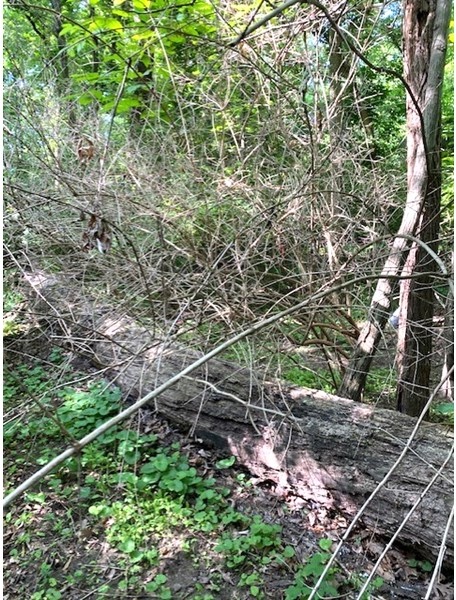
The injections during the winter were highly effective! They reduced honeysuckle foliar cover by 97 percent. Additionally, 97.5 percent of all injected honeysuckle plants were killed or severely injured. We did notice that utilizing the injector in areas where you can easily walk around, such as in relatively mature honeysuckle stands is likely most ideal. Also, the honeysuckle stem needs to be thick enough to provide resistance to injection pressure from the user. As the honeysuckle decreases in size other techniques are likely more appropriate, such as backpack spraying or cut-stump. We do, however, think this would work well if you are able to find and inject a root wad/ball of a smaller honeysuckle plant, that can provide injector resistance. We realize injecting might not be as visually or psychologically gratifying as cut-stump methods, as injection is more of a slow death over months, but this technique is documented to be 43 percent faster than cut-stump treatments. Think about the ground you or a team of volunteers could cover and not worry about hauling/stacking honeysuckle debris. One aesthetic disadvantage to the injections is the metal capsule that is left behind, which will eventually fall off the shrub.
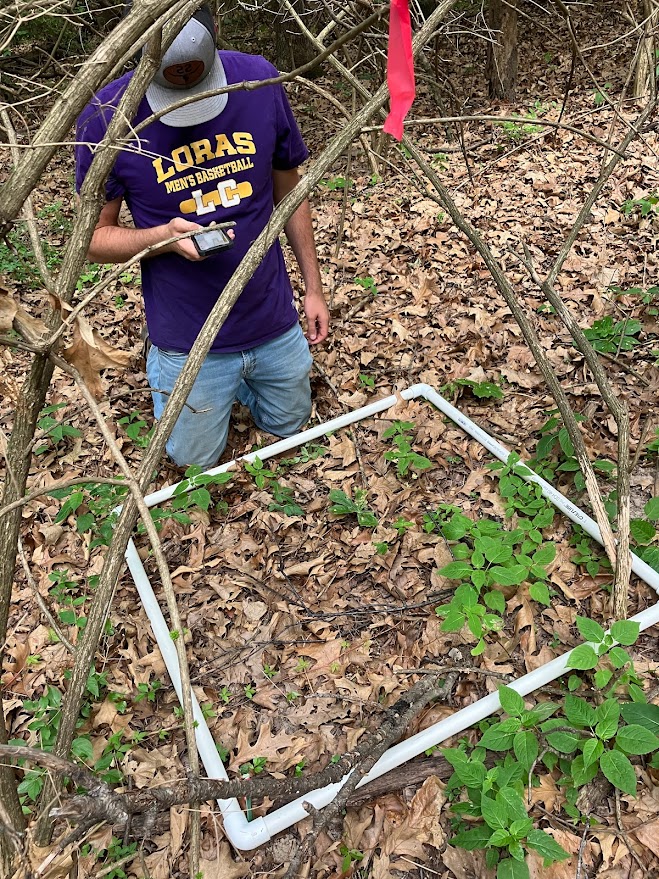
That said, we found that the combined treatment of injection and seeding produced double the number species relative the control treatments. As suspected, some of the additional species were invasives, such as garlic mustard, possibly resulting from increased sunlight reaching the woodland floor due to the dead honeysuckle. Black-eyed Susan and inland river wood oats, from the seed mix, were establishing in these injected plots best, probably from increased sunlight reaching the forest floor as well. Overall, these seeded plots had a 43 percent higher floristic quality index, so generally seeded plots were of better floristic quality compared with controls. Our intention was that these seeded species could help the restoration process by resisting reinvasion of honeysuckle or other invasives, such as garlic mustard. While this study needs more follow-up over the long term to help answer these questions, other research points to the benefits of native seeding or sapling planting to provide reinvasion resistance. Black-eyed Susan was chosen for the study due to its accessibility in being commonly available and relatively cheap, but other species are likely more suitable. Other research suggests that seeding grasses such as inland river oats, hairy woodland brome (Bromus pubescens), bottlebrush grass (Elymus hystrix) and stout wood reed (Cinna arundinacea) maybe even better than forbs at quickly establishing ground cover to resist and suppress future invasives (A. Kaul personal communication). However, all grasses and forbs that can be sown at higher rates tend to have the best success.
Future work must investigate which seed mixes offer the best bang-for-the-buck in terms of long-term plant species community and invasion resistance, and also determine the cost-benefit relationship between seeding and not seeding in honeysuckle control restorations.
Hartman, Kurt M., and Brian C. McCarthy. “Restoration of a forest understory after the removal of an invasive shrub, Amur honeysuckle (i).” Restoration Ecology 12.2 (2004): 154-165.
Kaul, Andrew D., et al. “High‐diversity seed additions promote herb‐layer recovery during restoration of degraded oak woodland.” Ecological Solutions and Evidence 4.1 (2023): e12202.
Moore, Addison, and Justin J. Shew. “Herbicide Injection and Native Seeding Recharges Restoration of Invaded Amur Honeysuckle (Lonicera maackii) Woodlands.” Natural Areas Journal 45.4 (2025): 260-268.
Schuster, Michael J., et al. “Revegetation of Elymus grasses suppresses invasive Rhamnus cathartica in deciduous forest understories.” Ecological Engineering 210 (2025): 107438.
Management Resources
DeVillez, Z. and C. Evans. 2021. Basic Control Techniques for Woody Invasive Plants. University of Illinois: Extension Forestry.
Evans, C. 2024. Individual Plant Treatments to Control Woody Invasive Plants. University of Illinois: Extension Forestry.
Bethke, T., Evans, C. and K. Gage. 2025. Management of Invasive Plants and Pets of Illinois.
Dr. Justin J. Shew is the Conservation Program Manager for the National Great Rivers Research and Education Center (NGRREC) of Lewis and Clark Community College (Godfrey). He is past president of the Illinois Chapter of the Wildlife Society and holds an adjunct professor and research mentor position with Webster University (St. Louis, MO). He manages the NGRREC’s Land Conservation Specialist Program and Habitat Strike Team and has the privilege of mentoring students on research projects connected to restoration and wildlife ecology. Contact Shew (jshew@lc.edu) with any questions or for additional inquiries regarding the research.
Addis Moore received an AS and BS in Environmental Science at Lewis and Clark Community College (Godfrey, IL) and Southern Illinois University Edwardsville (Edwardsville, IL), respectively. He was a research intern at The National Great Rivers Research and Education Center and is currently a program analyst for the U.S. Department of Agriculture’s Farm Service Agency. He gained valuable experience as a research intern at the National Great Rivers Research and Education Center, where he led and contributed to multiple projects focused on ecology and conservation.





Submit a question for the author
Question: Great article! My husband & I are site stewards at an INP in So IL. We manage a small section of the large nature preserve that includes a remnant hill prairie and an oak/hickory woodland bordering the hill prairie. There is SO much invasive bush honeysuckle in the woods. We’ve managed to get it out of the prairie, thank goodness. But I can’t even guess at the number of volunteer work hours and hard work it will take to get the woods under control. Would you please email me a specific procedure to use to try on some of the honeysuckle? I can create a grid test plot to do a trial of the injection method. I love being a “citizen scientist” and running my own little tests. Thank so much!