
Light blue and lavender blossoms of wild lupines glow in the sun. All photos by Sima Shah unless otherwise noted.

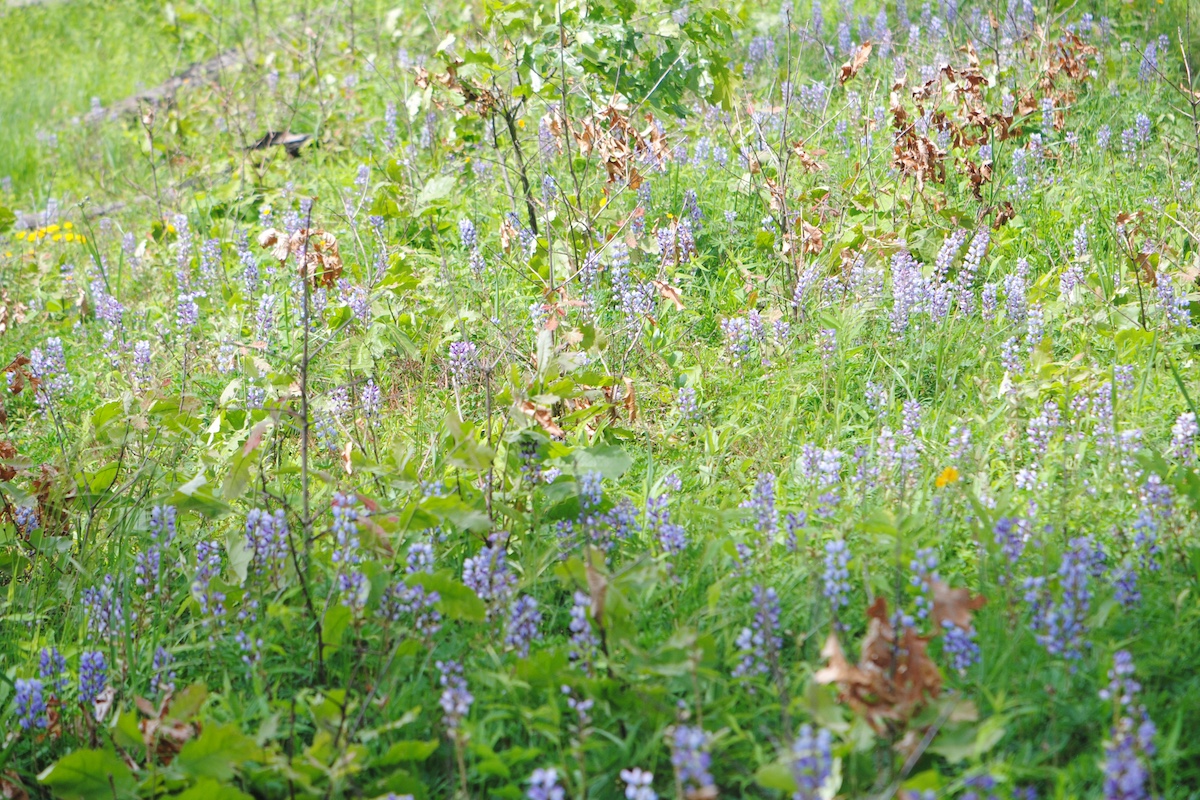
Light blue and lavender blossoms of wild lupines glow in the sun. All photos by Sima Shah unless otherwise noted.
Somewhere in the Midwest, in the middle of nowhere between private and public lands, my hiking partner and I walked on a sandy trail. We were enjoying a beautiful July day by visiting a sandy oak savanna where blooming prairie forbs intersected with oak trees. Suddenly we were surrounded by a tiny blue storm.
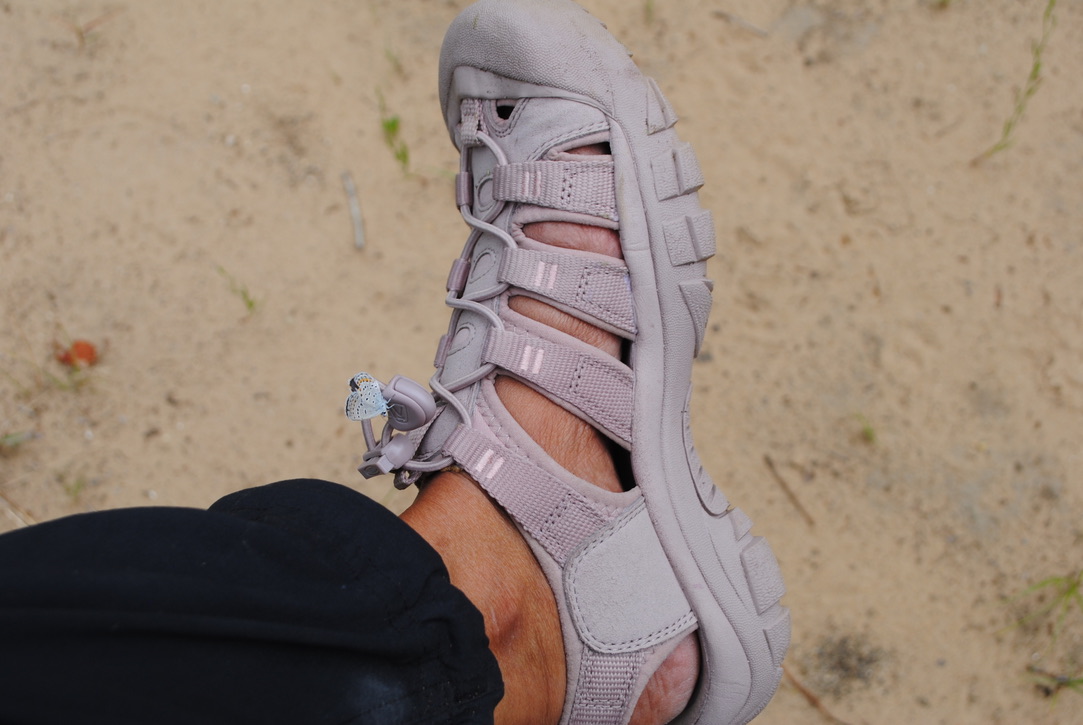
I sat down to revel in the magical and surreal moment and watched as a federally endangered Karner blue butterfly landed on my hiking shoe. I had previously read about these butterflies and understood how rare and special this moment was.
The story of the Karner blue, as told by humans, begins in 1943 with self-trained lepidopterist and well-known Russian author Vladimir Nabokov.1 It was during his time as the lepidoptera curator at Harvard that he provided the taxonomy for the Karner blue.1, 2
The name “Karner” came from a tiny hamlet near Albany in upstate New York, where Nabokov observed countless Karner blues in the wilds of the pine barrens.3 After Nabokov’s discovery, this tiny blue butterfly would remain shrouded in mystery for several more decades.3, 4, 5, 6 During his lifetime there was no indication that Karner’s population would decline, that an Endangered Species Act would be enacted in 1973 and that in 1992 the Karner blue butterfly would be identified as a federally endangered species.
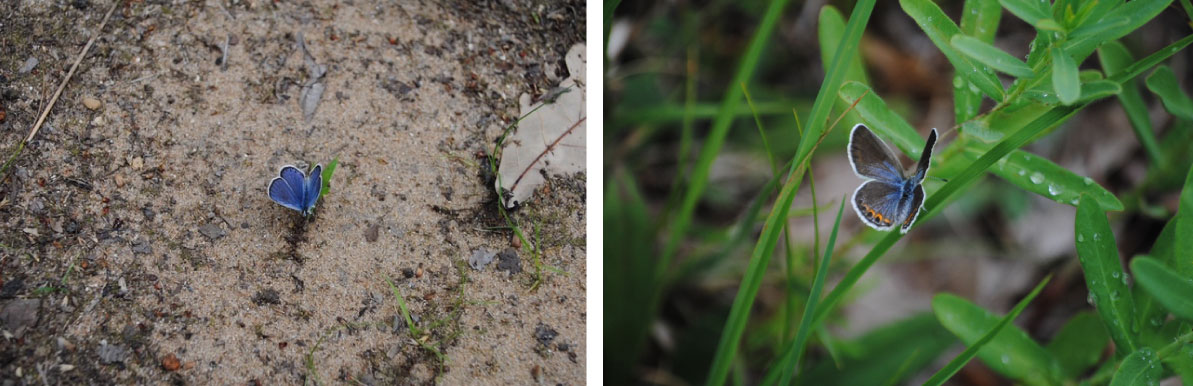
To the lay person, myself included, butterflies in the family of blues all look alike. It is hard to distinguish a Karner blue from a spring azure, eastern tailed-blue or Melissa blue due to their size and similar markings.7
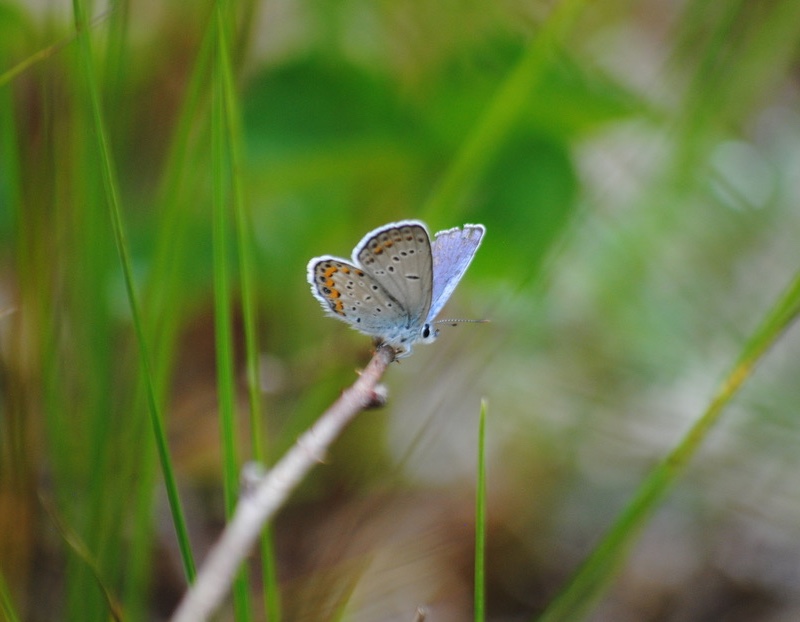
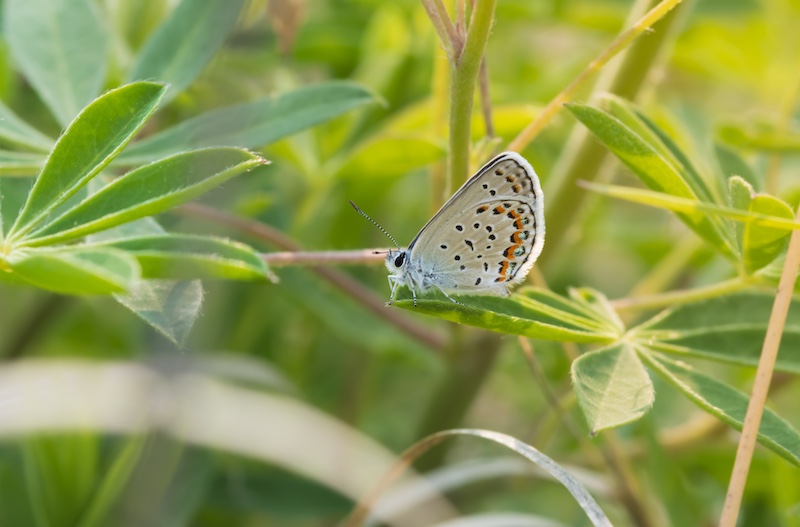
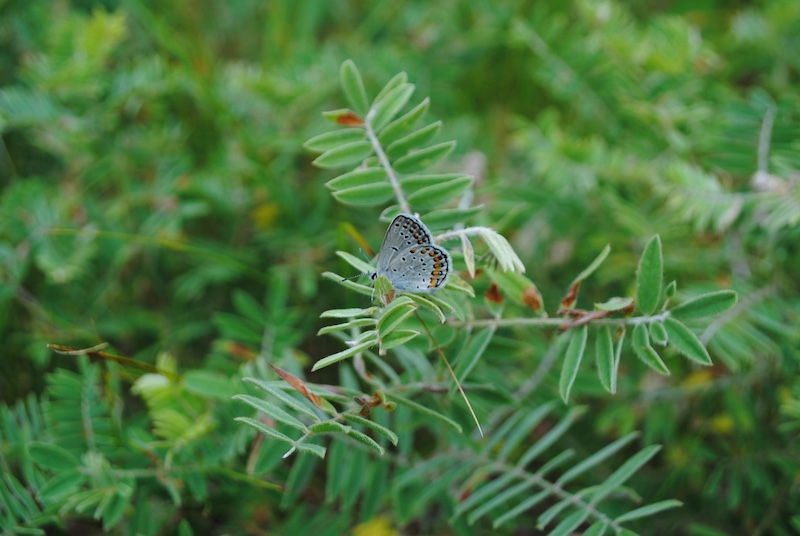
A Karner blue butterfly is the size of a quarter and about one-fourth the size of a monarch.8 The one-inch wingspan is framed with a white fringe border and the eunderside is faded periwinkle blue with scattered black spots enclosed in a white band and orange crescents.
The dorsal wings for the male and female have a narrow black margin but otherwise are distinct from each other. The male has a lavender-violet color that transitions into a soft cobalt blue towards the wing base. Females are a smoky brown-gray that shifts to that same cobalt and have an irregular scattered band of black spots and orange crescents along the margin of the hindwing.8
The blue we perceive is not from pigment. A microscopic view would reveal scales that layer upon each other. It is this structural arrangement that reflects the blue wavelength.3
The Karner blue has evolved to form remarkable relationships that highlight the interconnectedness between land and species.
The wild lupine is the host plant for Karner blue larvae.9 Female Karner blues lay two generations of eggs each year near or on a host plant, preferring lupines located in shaded areas. Overwintered eggs hatch in April to form the first brood, which become adult butterflies in early June. This first generation will mate to lay eggs for the second brood, which become adult butterflies in mid-August. The eggs from the second brood do not hatch until the following spring.9
Lupines must be available from when the first brood of eggs hatch to when the adult females of second generation lay their eggs.10
Additionally, ants seem to have a protective influence on Karner blue caterpillars. Larvae nurtured by ants have a higher survival rate compared to those not nurtured by the ants. In exchange, caterpillars secrete a liquid that is used as food by the ants.9
Adult Karner blues require different nectar sources9 and usually live their short lives within 300 to 600 feet from where they hatched.8
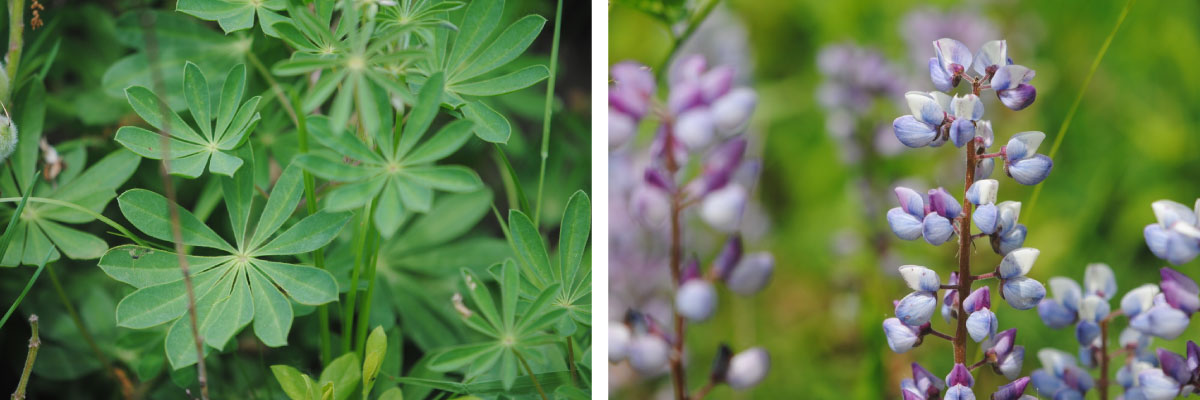
Lupine perennis is a member of the pea family.11 Leaves are arranged in 7-11 leaflets that form a large disc that spirals out of the base. Blooms occur from May to June.12
In bloom, lupines are a spectacular sight. As far as the eye can see at Miller Woods in Indiana Dunes National Park the land possesses a gradient of colors ranging from a deep blue to violet to pink to white and everything in between. Up close, the arrangement of the pea-like flowers on a single stalk looks like the answer to a math equation with a beautiful symmetry to its structure.
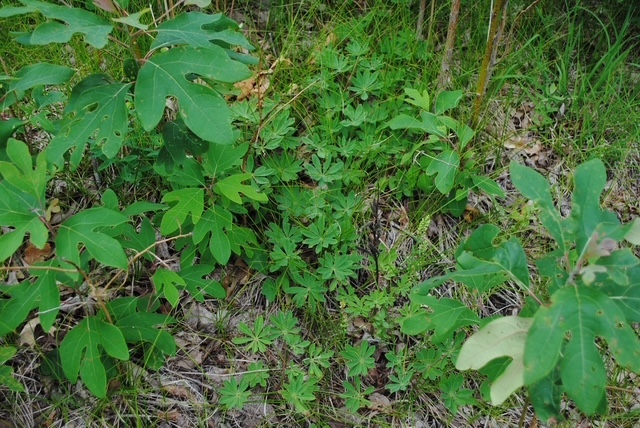
Wild lupines are found in the sandy conditions of the savannas and pine barrens. Soils in these habitats lack important nutrients that many plants need, yet the wild lupine thrives. As a nitrogen fixing plant, lupines provide nutrients to the soil while their long taproots help stabilize the soil.11
The wild lupine is a finicky plant. It is sensitive to too much heat or too much shade. These are not easy plants to transplant and they benefit from prescribed burns, which prevent oaks from taking over and shading them out.11, 9
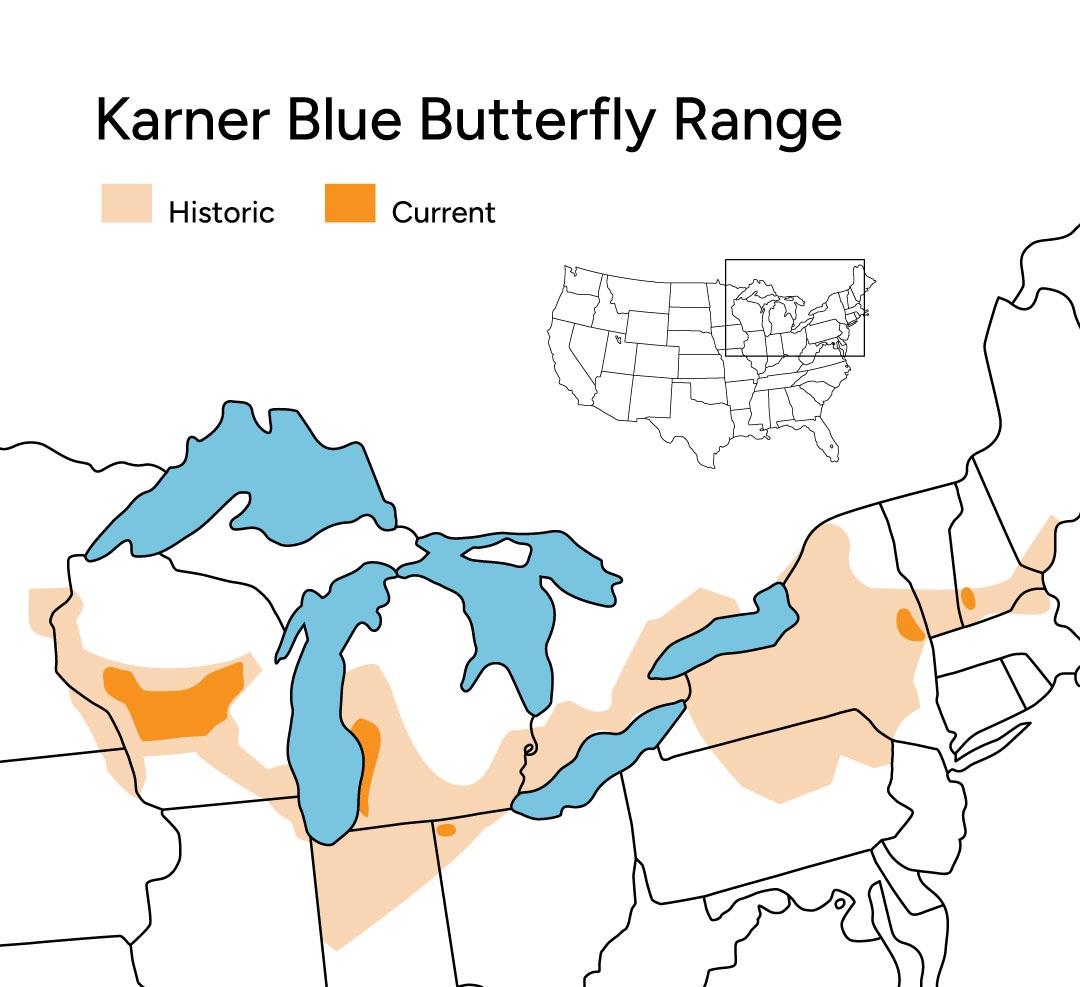
The Karner blue was once found in 12 states of the northeast United States and Ontario, following along the Great Lakes, and nowhere else in the world.8, 9, 13 Their population existed along a habitat band that followed the sandy pine barrens and oak savannas.13 This contiguous band was important because these butterflies are not mobile over long distances. If, for some reason, any single population “winked out,” a nearby population would fly in and take over.14 Now only small, isolated populations exist across the historical boundary lines where they are no longer able to reestablish.
The last sighting of a Karner blue butterfly in Illinois—and the only known location within the state—was at Illinois Beach State Park (IBSP) in 1992.15
Throughout the 1970s and 1980s the population of Karner blues suffered a significant decline, largely due to habitat loss and lack of land management. Development and farming swept through, and today less than 0.02 percent of the original Midwest oak savanna remains. This habitat type is considered one of the most threatened on the planet.16, 17
During the 1990s, compared to subsequent years, higher populations of Karner blues existed across a fragmented landscape within Indiana Dunes National Park. Ralph Grundel, a research ecologist for the U.S. Geological Survey, and his team were tasked with conducting habitat requirement studies which lead to recommendations for evidenced-based best practices on differences in habitat requirements that accounted for all life stages of the Karner blue. Recommendations included having a variety of shading conditions in repeating units across the landscape and using prescribed burning to help maintain that structure.10
Across the states with Karner blue populations there were consistent observations that shade heterogeneity could be valuable for these butterflies.
Yet by the early 2000s the butterfly numbers started to decline. This was not completely isolated to Indiana Dunes; a decline was also observed in other locations.
The earliest spring on record for most of the continental United States since 1900 occurred in 2012 when unexpectedly high temperatures occurred in February that remained through March.
That year, Dr. Grundel and his Indiana team were tracking Karner blue eggs. The first brood of eggs hatched in mid-March, a month earlier than expected, whereas most of the wild lupines emerged after the eggs had hatched. This out of sync mismatch meant that the lupines were not available for the Karner blue eggs.
A similar outcome was seen with the second brood. The host plant could not tolerate the high temperatures which continued throughout the summer and did not last long enough throughout the caterpillar life stage to complete feeding. Many Karner blue eggs died. Tree shading did come into play as eggs that hatched on shaded wild lupines lived a little longer. Grundel’s key findings documented the consequences of extreme weather on Karner blues.10 By 2014 Karner blues were extirpated from Indiana.
At Three Rivers Parks, a park district in Minnesota that oversees 27 parks and more than 27,000 acres, a collaborative team of park staff and external experts are working to bring back the Karner blue butterflies. The wildlife crew are creating a mosaic of habitats throughout the savanna to provide transitions between shade and sun. They have mapped the lupines and strategically planted lupine seeds on the shade edges. This area falls outside the original remnant bounds and is a novel initiative that removes constraints of fragmentation and land loss that currently affects Karner blues.18
In upstate New York, Albany Pine Bush Preserve is a 3,408-acre urban preserve comprised of a remnant northeastern interior pine barren that is managed by the Albany Pine Bush Commission. Management and restoration began in 1991. Around that time, Neil Gifford, Conservation Director, would count a few hundred Karner blues across the site. Today, surveying 10 to 13 percent of the habitat annually reveals an average of 10,000 Karner blues per year—which most likely is an underestimation. There, lupines that have undergone prescribed fire regimens tend to be of higher quality and survive longer, which has had a positive impact on the Karner blue population.19, 20
Little did Nabokov know in 1943 how significant his work with the blues would be and the interconnections between Karner blues, wild lupines, ants and the land.4 While we will never know for sure, he may have saved the Karner blue from extinction and contributed to their existence today.3
S.D. Shah is an illustrator, printmaker and nature journalist. She resides in Chicago. In 2020, Shah received her certificate in Traditional Botanical Art from the Chicago Botanic Garden. She is a novice but avid birdwatcher, hiker and native plant enthusiast. You can learn more about Sima and her work on her website.





Submit a question for the author