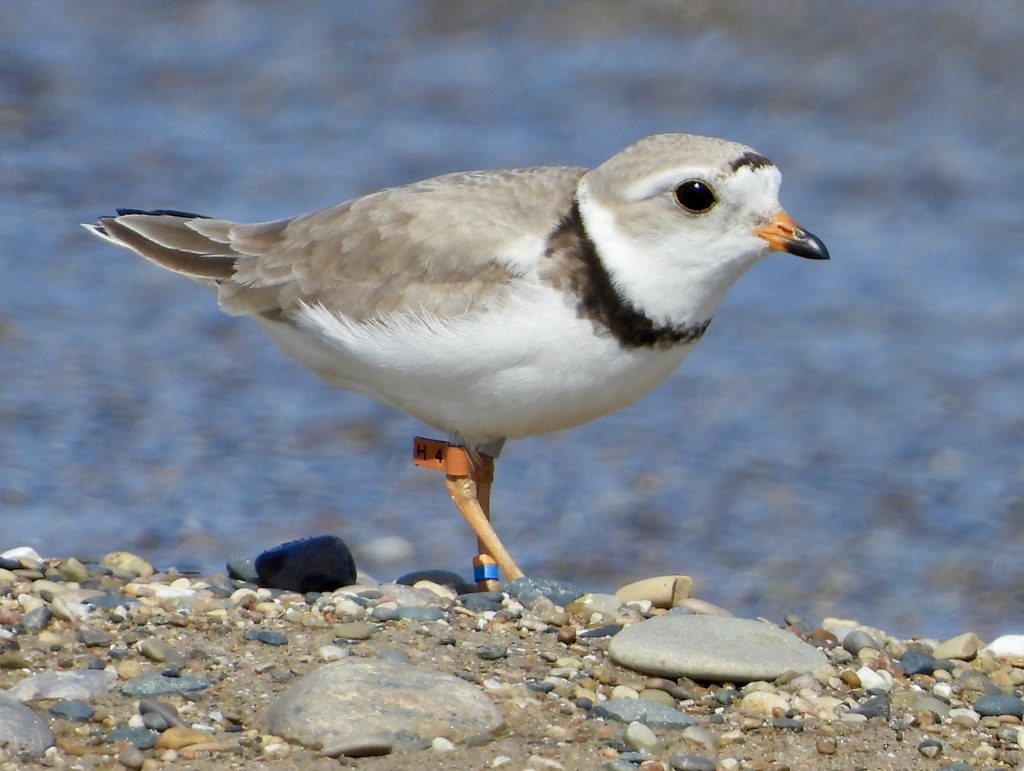
Blaze is a famous female piping plover that divides her time between her Illinois nesting ground and her winter home in North Carolina. Her H4 flag and leg bands uniquely identify her. Photo by Carolyn Lueck, Lake County Audubon

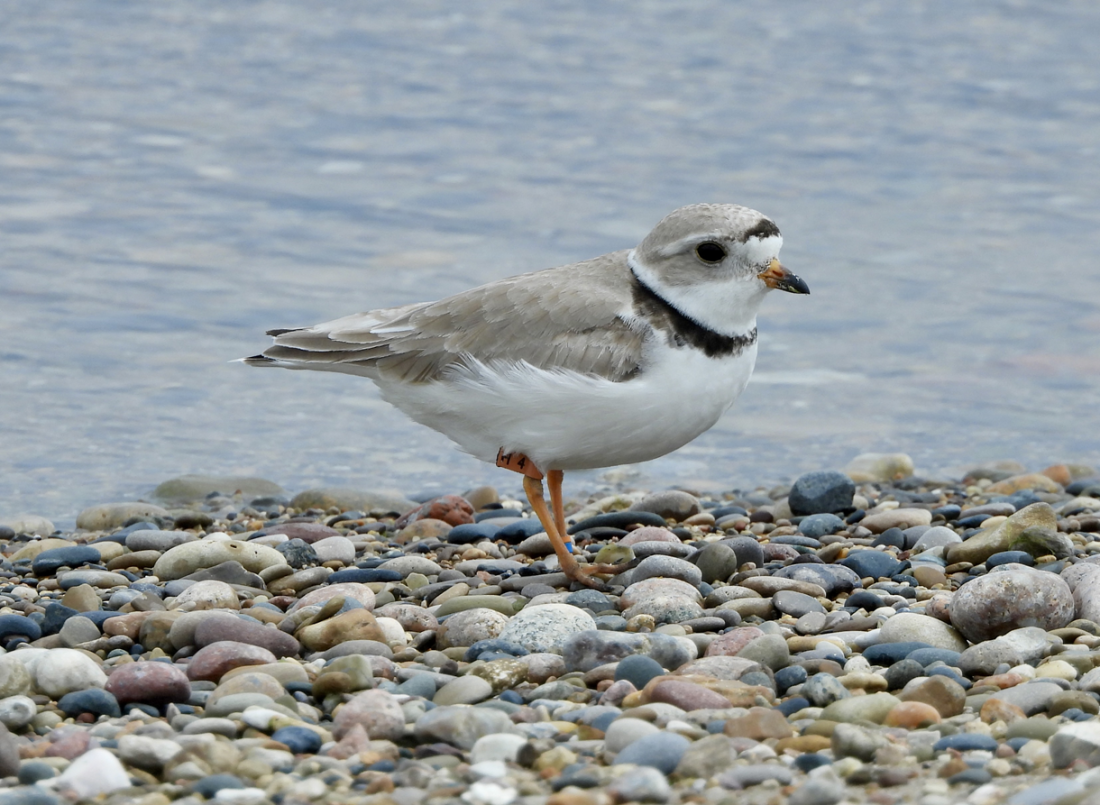
Blaze is a famous female piping plover that divides her time between her Illinois nesting ground and her winter home in North Carolina. Her H4 flag and leg bands uniquely identify her. Photo by Carolyn Lueck, Lake County Audubon
When I started learning about piping plovers, I quickly found out how ridiculously easy it is to become obsessed with them. I’m not alone. Do a quick social media search and you’ll find more plover photos than you’ll know what to do with! Some of my favorite photos come from Carolyn Lueck, Lake County Audubon Society, who I interviewed earlier this year about her trip to see Pepper in Florida.
Carolyn recently met up with Lindsay Addison for a springtime adventure to find Pepper’s mate Blaze, who overwinters around Masonboro Island, a 4,831 acre barrier island in North Carolina.
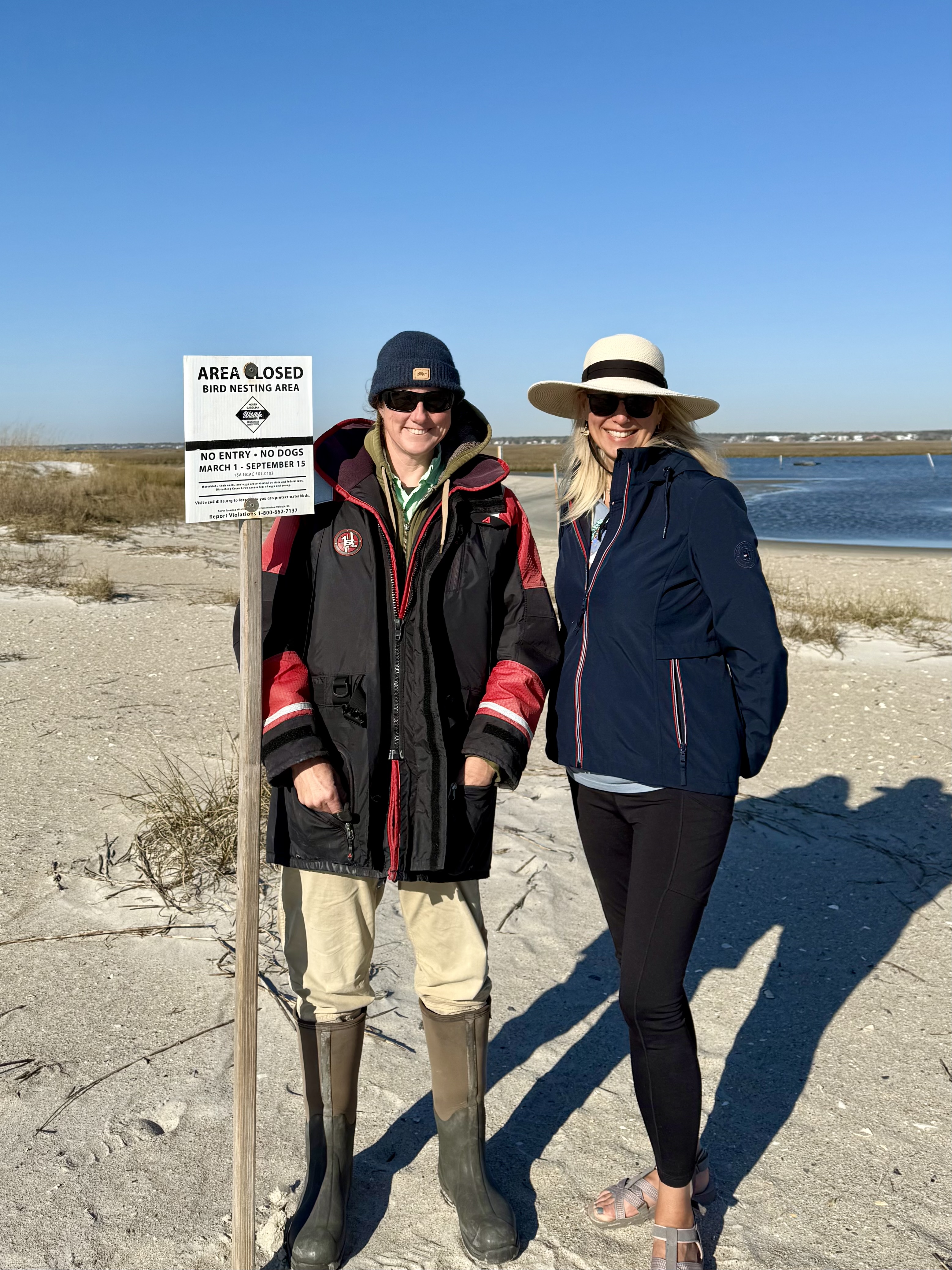
I recently got a chance to interview Carolyn and Lindsay about how the trip went. Happily, with some searching they were able to spot Blaze in one of her usual winter roost spots.
I could appreciate their excitement about seeing Blaze—that part of the trip was clearly a highlight—but what struck me as I chatted with Lindsay and Carolyn is how this small bird has unknowingly helped to forge a bond between people.
Lindsay had this to say, “Meeting someone working not only with the same species, but the same individual plover was an incredible experience. Carolyn’s trip was an unusual opportunity to meet a far-flung colleague in person, and we really hit it off. We had so many stories to share!”
Carolyn chimed in, “My work with the Lake County Audubon Society’s Sharing Our Shore-Waukegan initiative (SOS-W) has really broadened my understanding of how critical it is to connect with people, both in Illinois and where our piping plovers winter. Our team works so hard to protect the plovers during the 3-4 months they spend with us each summer. Meeting the people who are doing the same at the wintering grounds has been amazing!”
She went on to say, “Lindsey was so gracious during my visit, allowing me to tag along on volunteer days to help install nesting signage on barrier islands. She also shared her personal time to meet for breakfast (and again for ice cream!) where we traded stories about our work and also the species that call North Carolina home. I was so humbled to see how vast the area is that Lindsey and her team protect. Being able to come home to Illinois and share this connection with our SOS-W volunteers helped to reinforce that we’re not just a small team on a beach in Waukegan. We’re part of a larger effort to protect the plovers and all the other flora and fauna that share their habitats. Through Blaze I’ve met someone I consider not just a colleague but a great friend!”
Laura Kammin is a Natural Resources Specialist with the National Great Rivers Research and Education Center. She formerly held positions at Illinois-Indiana Sea Grant, University of Illinois Extension, Prairie Rivers Network and the Illinois Natural History Survey. She received her master’s degree in wildlife ecology from the University of Illinois, Urbana-Champaign.


Submit a question for the author