
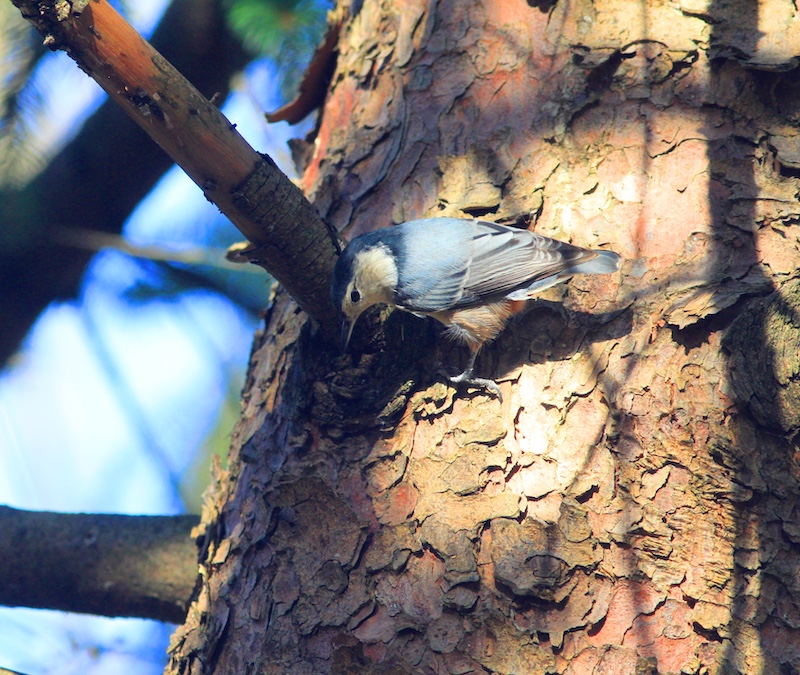
White-breasted nuthatch brings food to young in a tree cavity in northern Illinois. Photo by Steven D. Bailey.

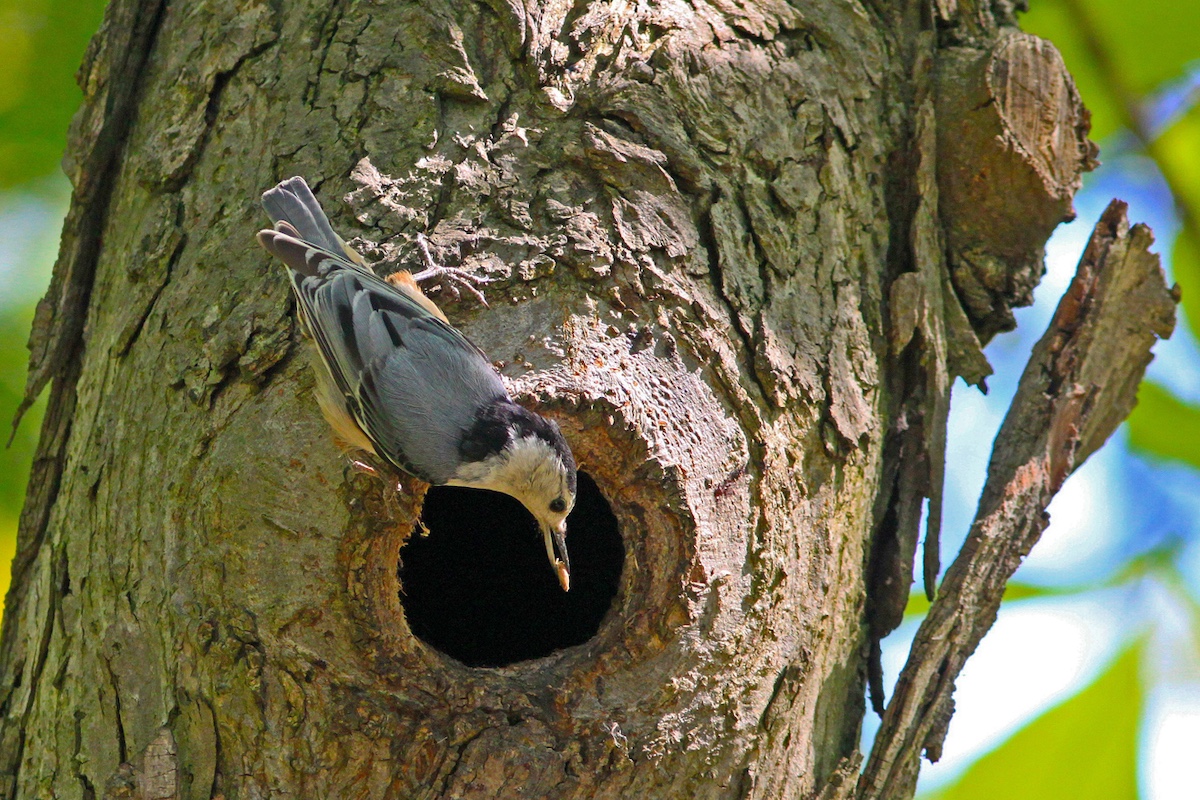
White-breasted nuthatch brings food to young in a tree cavity in northern Illinois. Photo by Steven D. Bailey.
Two Illinois bird species behave like woodpeckers as they cling to tree trunks and branches seeking food hidden within the bark. But these species also descend trees with heads facing downward, and they land on feeders upside down. They’re called nuthatches.
The name fits perfectly. A nuthatch “hatches” or hammers on nuts or seeds to crack them open to get at the protein-rich food inside. Hatch is a middle English word meaning “to pound.” The term “hatch” might also refer to the act of storing seeds into crevices, such as tree bark, moss and needles, as the birds prepare for winter. Nuthatch species have long toes with sharp claws enabling them to cling upside down on tree trunks and descend while hopping.
One species, the white-breasted nuthatch, is common year-round in Illinois, visiting feeders and nesting in wooded areas. The other, the red-breasted nuthatch, mostly visits Illinois in fall and winter, though it occasionally nests here. A third species, the brown-headed nuthatch, which inhabits mature pine forests in southeastern United States, was documented once in Illinois in 2001 at Illinois Beach State Park in Zion. Only one other nuthatch species lives in the United States, the pygmy nuthatch, and is similar to the brown-headed nuthatch but tied to long-needled pine forests in western North America.
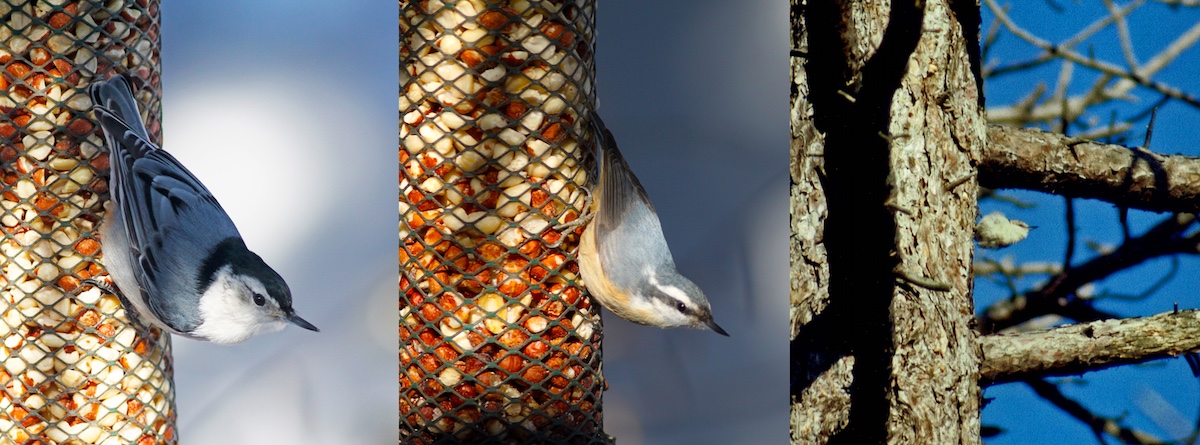
Nuthatches don’t tap on wood to communicate with their brethren like woodpeckers do. Instead they make unusual sounds that alert you to their presence, but are really meant to communicate with other birds. The white-breasted nuthatch calls a loud, “yank, yank, yank” year-round and a faster courtship song in spring and summer, while the red-breasted nuthatch call has been likened to the sound of repeated pitches on a tin horn. It also gives scolding sounds and high-pitched chatters. Listen here to the sounds of the white-breasted and red-breasted nuthatches.
The red-breasted nuthatch nests in northern coniferous forests of spruce, fir, pine, hemlock, larch and red cedar, and also in mixed forest that include deciduous species such as aspen, birch and oak. The female excavates a cavity or selects an old woodpecker hole in which to place bark shreds, grasses and fur for a nest. Both male and female use their beaks to smear pine and spruce tar on bark near the nest entrance, likely to deter ants and other intruders. Five to six eggs hatch in 12 days and the young leave the nest within 14 more days. They are fed beetles, caterpillars, ants and other insects as well as spiders, the same food the adults eat in summer.
In winter, the red-breasted adds to its diet the seeds from the cones of spruce, fir, pine and hemlock. But these trees don’t produce abundant cones each year, and when the crop is low, the nuthatches have to move on in what’s called an irruption, which typically happens once every few years. If the nuthatches find a good food source in winter, for example several large spruces or a yard with peanuts and suet in feeders, they may remain there all winter until it’s time to fly back north to breed.
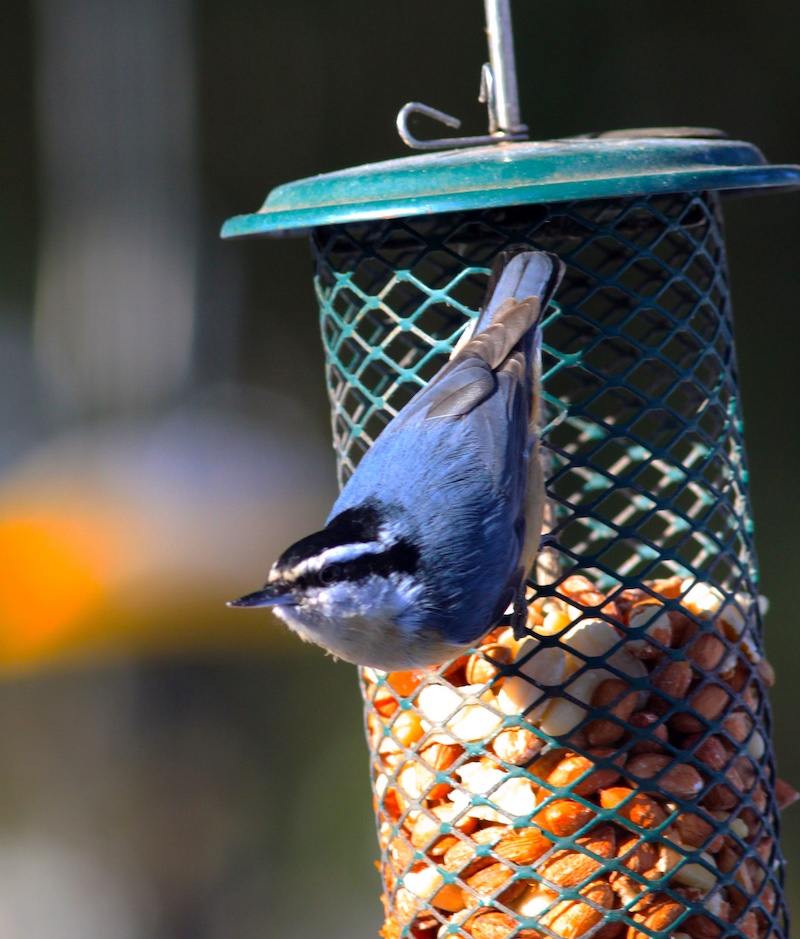
During irruptive winters, nuthatches not only can be found in conifer stands and at backyard feeders, but also in orchards, parks and plantations. They are considered by humans to be gregarious and fearless. In February 2025, Lauren Myers photographed a red-breasted nuthatch close-up when it landed on top of the fence near the balcony at her home in Harvard.
“It is not at all afraid to have me standing within a few inches of it when it lands on the peanut dish,” she said.
This 2025-2026 winter season, at least three different red-breasted nuthatches flitted between the author’s four 70-foot-tall Norway spruces and feeders full of peanut pieces, suet and sunflowers. At times, the nuthatches chattered softly and flew after one another even though there seemed to be plenty of room for them to grab food and stash it for later retrieval. All winter long, we enjoy the comings and goings of these birds, though they’re not here every year. Just in case a pair decides to nest here, we’ll listen later on in winter for the male’s melodic courtship call that’s quite different from its tin horn sound.
Several years ago in May, Illinois Department of Natural Resources Environmental Educator Stacy Iwanicki watched a female excavating a hole in a snag at Ryder’s Woods in Woodstock. “I enjoy their little tin horn calls which are higher pitched and tinnier than our more common (in northern Illinois) white-breasted nuthatches,” she said.
Steven D. Bailey, the photographer, has documented red-breasted nuthatches in June while doing a USGS breeding bird survey route in a rural area with large pines in McHenry County.
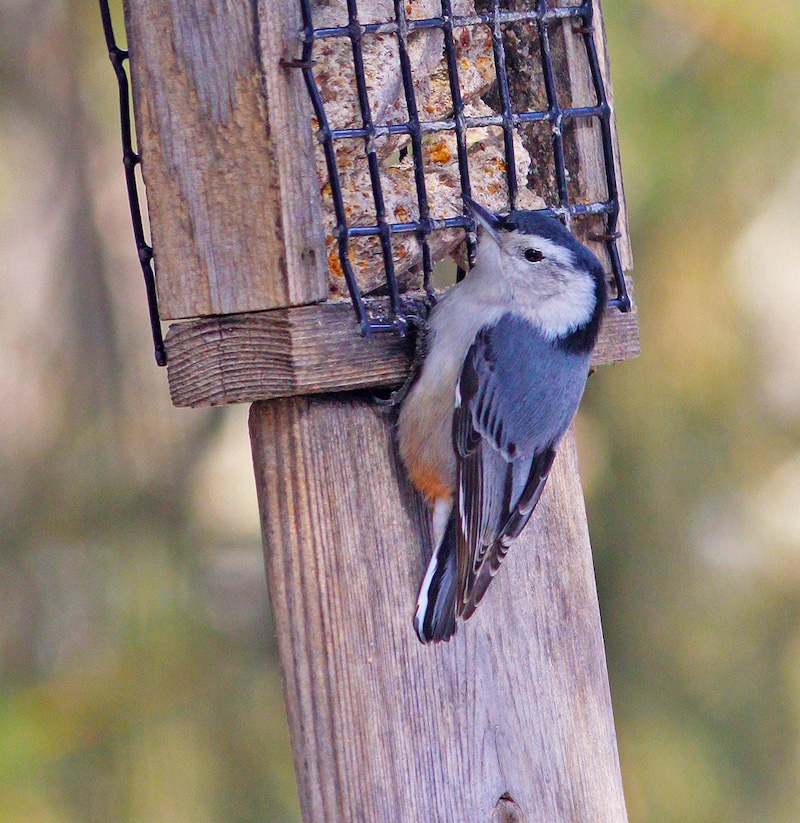
White-breasted nuthatches have similar behaviors compared with their cousins. But they don’t migrate, and pairs may bond for life. They mainly use natural cavities or old woodpecker holes for nesting in both deciduous and coniferous trees. They rarely may use human-made boxes. They line the cavity with bark, grass and fur. The white-breasted may not spread pine tar near its nest like the red-breasted does, but it may spread crushed insects near its nest entrance, likely to keep squirrels away. It often chooses certain types of beetles, which become oily and strong-smelling when crushed. Five to nine white eggs hatch in 12-14 days and the young fly about 14 to 26 days later. The white-breasted nuthatch eats, and feeds to its young, copious insects including larvae such as leaf beetles, tree hoppers and other insects and their larvae. Like the red-breasted nuthatch, it adds much more plant matter, including seeds, to its diet in winter.
Finding a white-breasted nuthatch nest is not easy, but occasionally while walking through the woods in late spring, you might hear its loud “yank, yank, yank,” spot the bird and watch as it flies into a tree hole. The author spotted this species bringing food to its young in a tree hole at a northern Illinois woodland one summer. While doing a breeding bird atlas survey, the author also followed a pair flying back and forth, likely taking nesting material to a tree cavity.
Watching both nuthatch species at feeders can be rewarding, especially on a cold winter day. At the feeder, you might notice how two white-breasted nuthatches will each grab a peanut piece, then fly in opposite directions so as not to reveal where they’re stashing their pantry for later meals. That doesn’t mean, however, that another sneaky nuthatch might not be lurking around watching and knowing where to get a free peanut. Both species eat peanut pieces, suet and sunflowers at feeders.
Illinois has had its share of rarities, and one of them was a brown-headed nuthatch discovered by Illinois Department of Natural Resources Endangered Species Recovery Specialist Brad Semel on July 11 in 2001. He saw it in some pines at Illinois Beach State Park and noted through binoculars its chocolate brown cap, an hour-glass-shaped white marking on its nape, rufous brown primaries, a white breast with slight buff under the throat and a turquoise lower mandible. Semel also heard its distinctive squeaky toy call that “sounded nothing like that of the other nuthatches inhabiting the region,” he wrote in Meadowlark: A Journal of Illinois Birds. The Illinois Ornithological Records committee accepted this as the first state record of a brown-headed nuthatch. Many Illinois birders continued to observe it until sometime in December of 2001.
The northern range of the brown-headed nuthatch runs through northeastern Texas, middle Tennessee, and eastward into far southern Pennsylvania. Semel wrote that the brown-headed nuthatch was observed carrying a piece of bark in its bill to use as a tool to expose hidden prey on a tree.
No wonder nuthatches have come to symbolize resourcefulness, and that certainly seems true for the nuthatches we see in Illinois.
Sheryl DeVore writes environment and nature pieces for regional and national publications and has had several books published, including “Birds of Illinois” co-authored with her husband, Steven D. Bailey.





Submit a question for the author