
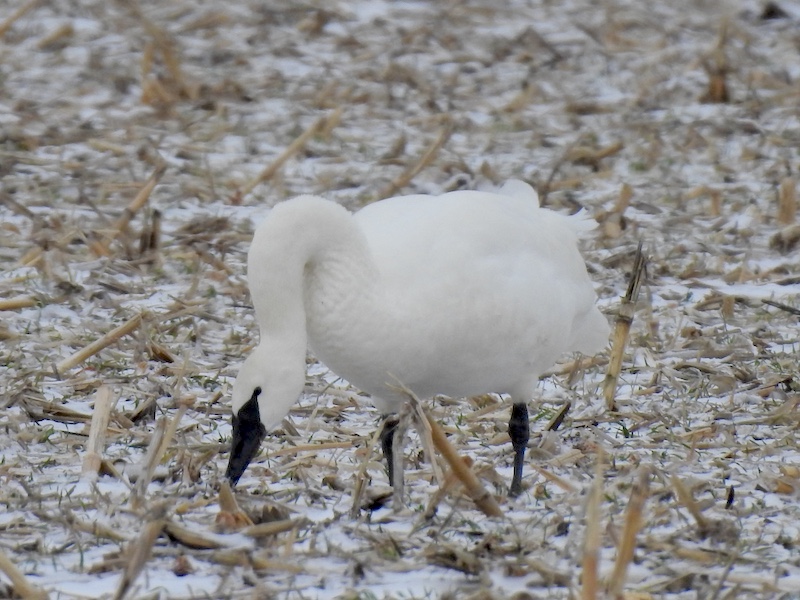
Trumpeter swan. Photo by Leroy Harrison.

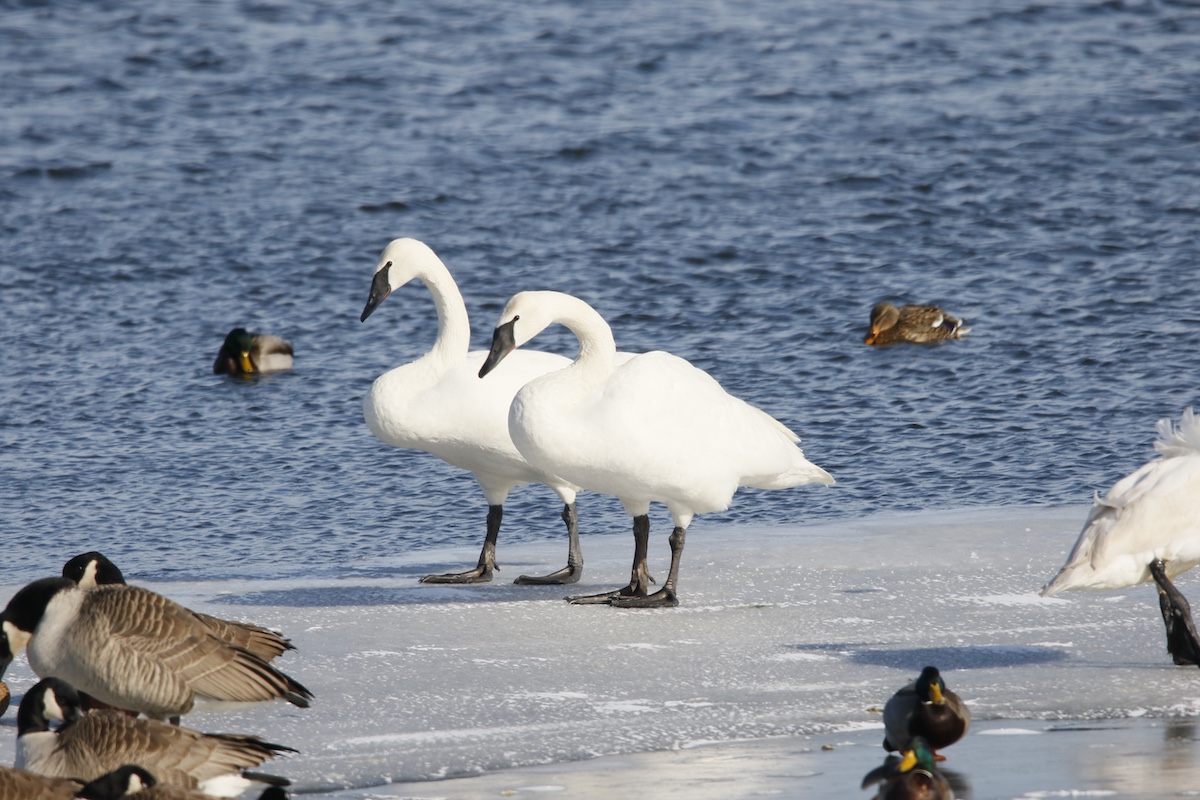
Trumpeter swan. Photo by Leroy Harrison.
“This mid-winter survey, held annually on the first full week of January, is my favorite,” announced Bryan Eubanks, a district wildlife biologist with the Illinois Department of Natural Resource (IDNR). I decided to guess why rather than ask. I was in a truck driven by Eubanks and was accompanied also by two retired IDNR personnel, Doug Brown and Jim Gillespie. We were travelling the roads near the county line between Cumberland and Coles in east-central Illinois when we spotted swans, our first for the day. Trumpeter swans (Cygnus buccinator)!
Like an artist’s study in black and white, the birds’ bodies were remarkably pure white, white as snow. Their long white necks were stretched tall and straight. Vivid black bills and black facial skin created a striking contrast. A twinkle of an eye, coal black, indicated to us that one swan was giving us the once-over, as our eyes peered through truck windows. That swan led the others, smoothly gliding on the water toward far end of the pond. So that’s why Bryan likes this survey the most, I thought; he admires the beauty of the swan.
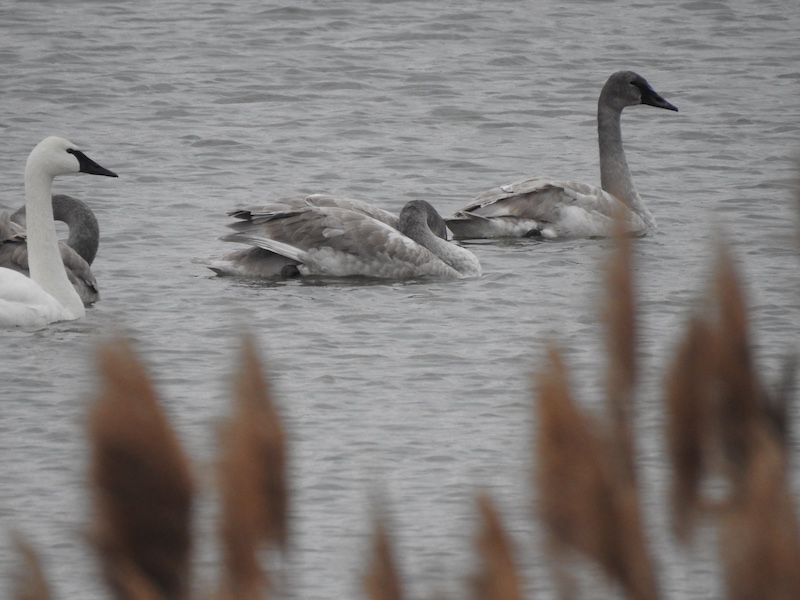
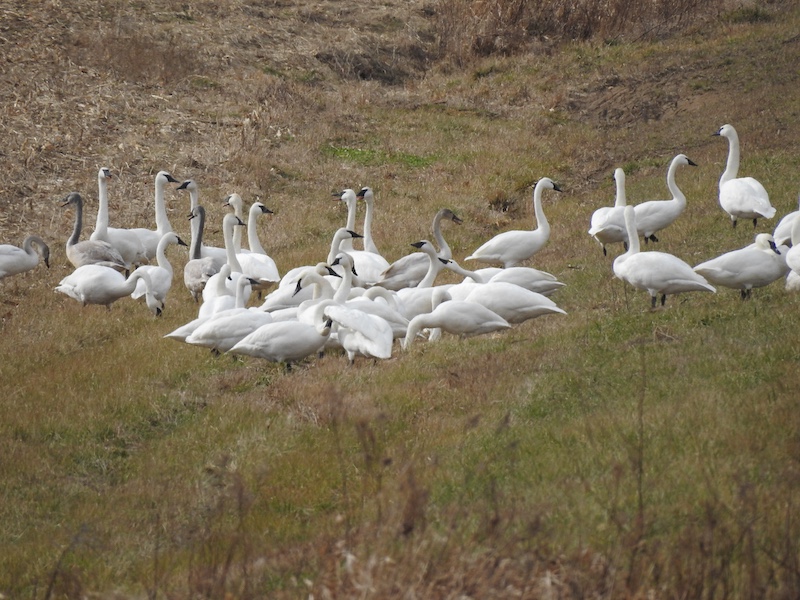
Accompanying the white beauties were swans in gray plumage. “Those gray ones are cygnets. It takes about a year for the youngsters to lose that ugly duckling look.” explained Eubanks. His witty allusion to the fairy tale made me chuckle.
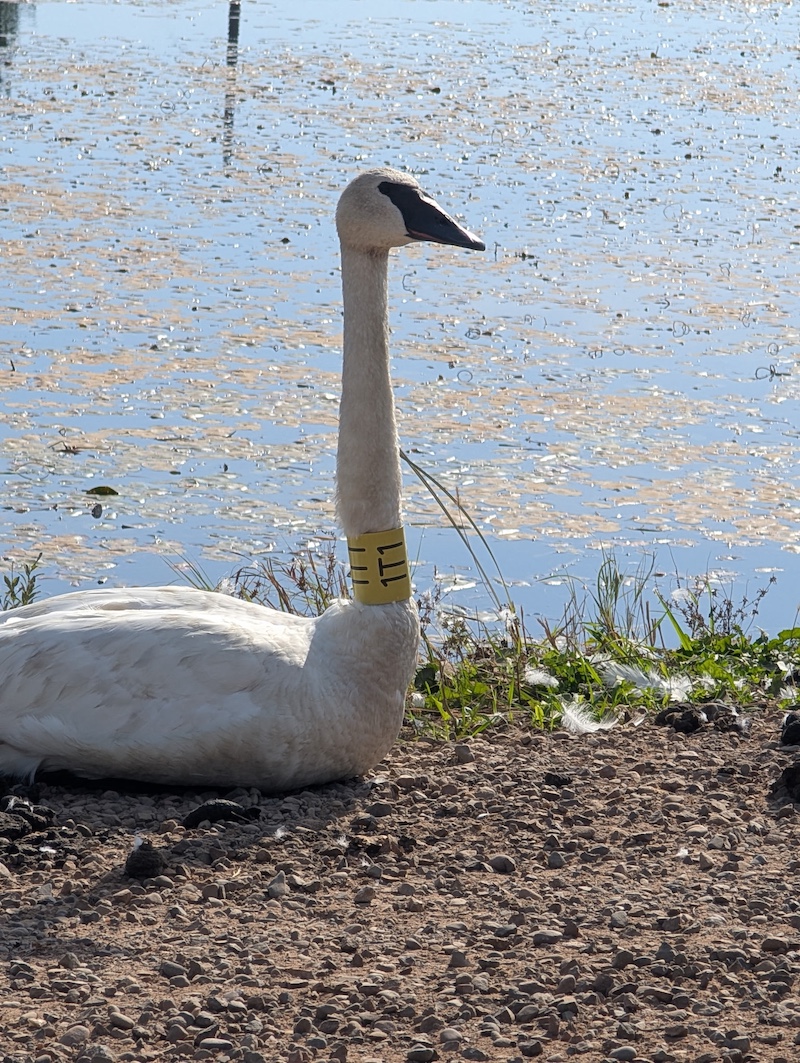
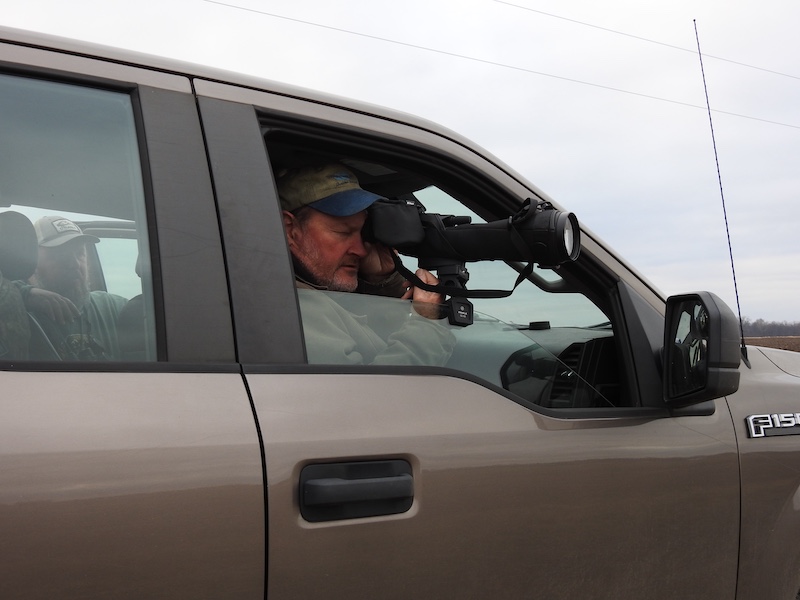
Utilizing the GPS on his cellphone, Eubanks noted our location while Brown utilized a spotting scope to check for neck collars. The symbols appearing on the plastic collar would make it possible to identify a particular individual. Records of sightings of a collar-adorned swan along with its locations would allow scientists to trace the swan’s movements and age. Gillespie and I counted 4 adults and 5 cygnets. No neck collars.
From more than a mile away, we spotted swans, big birds! Trumpeter swans are our nation’s biggest native waterfowl, up to 6 feet in length and 25 pounds in weight. As we neared their location, an agricultural field, I noticed that they were congregated in separate groups ranging from 5 members to 30. I knew them to be gregarious birds, flocking together as a bevy on water or land and a wedge when in flight. Eubanks and I discussed the groupings and speculated that those containing cygnets and adults were family clusters (parents and offspring). “Perhaps the larger sets include in-laws and aunts and uncles and cousins,” I quipped. A large group, distancing itself up on a knoll, may have been non-breeding adults or pairs which were unsuccessful in reproduction for that year.
The swans appeared to be merrily foraging, probably eating waste grain or small winter-hardy annuals or grasses. Quietly and stealthily, I stepped out of the truck, raised my camera shakily due to nervous anticipation and buffeting wind; and “ching” went the camera noisily. Luckily the swans did not flush. I feared that I had invaded their personal space, but they seemed rather nonchalant about being watched by us who had parked about 100 yards away. “So, that is why Bryan likes this survey, swans are easy to count,” I rolled my eyes at my silly cynical thought and hopped back into the warm interior of the truck. We counted a total of 73 trumpeters at that stop.
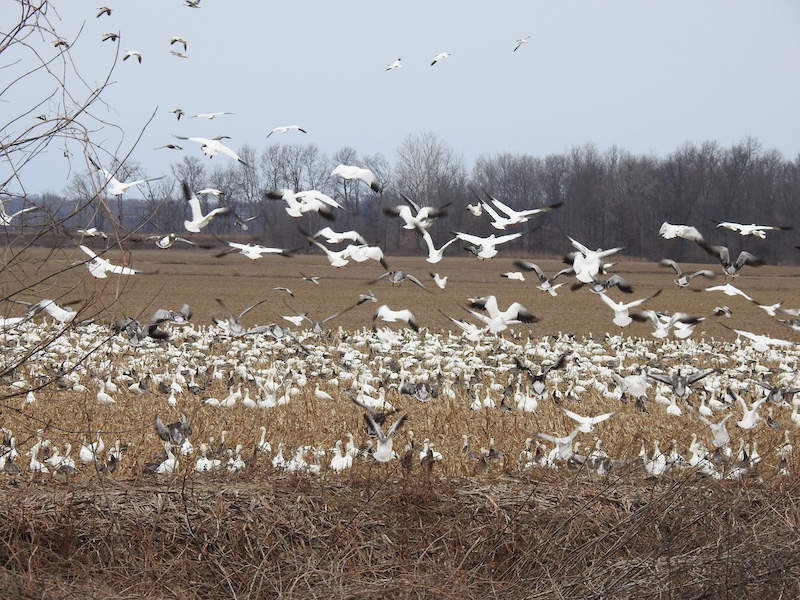
We travelled northeast, soon arriving at a reclaimed surface-mined area consisting of ag fields and final-cut lakes. The abundance of waterfowl was striking. Thousands of snow geese! As gravel crunched beneath the truck tires, geese lifted off and flew momentarily beside us and then away to light farther off. “Like glitter in the sky,” commented Brown as hundreds of wingbeats glinted in sunlight and created geometric patterns of white and black and gray. We stopped to listen to the chatter of the waterfowl and heard cacophony: squeaks, quonks, quacks and honks all in various high pitches. A flock of greater white-fronted geese – Eubanks called them “specs” (speckled bellies being an alternate name) – flew over. Their high-pitched yelping calls, of two or three notes, sounded a bit like laughter.
Upon a lake near the Indiana-Illinois state line loafed several trumpeter swans, in the company of black ducks, mallards, ringed-necks, green-winged teal and probably some other species of dabblers and divers. Maybe it was seeing all the various waterfowl in abundance that tickled Eubank’s fancy.
As we drove along, repeatedly spotting gatherings of swans, the biologists in the truck filled me in on some particulars. “When seen in the Midwest, the migratory trumpeters have likely followed the Mississippi flyway. Observations in the states of Michigan, Minnesota, Iowa, Ohio, and Wisconsin have documented the presence of nesting populations in the Midwest. Yet, it is feared that direct competition with nonnative mute swans may be limiting the expansion of nesting grounds in several Midwestern states, including Illinois. Like other waterfowl, trumpeter swans are protected by the Migratory Bird Treaty Act and the Illinois Wildlife Code.
“It was back in 1991 when I was called upon to rescue a swan,” said Brown as he began a story about a Wisconsin DNR’s project. “I flung myself upon the huge bird’s back and pinned its wings, but I had to do so as gently as possible. The trumpeter swan population was really low. The project had been designed to boost numbers by encouraging swans to migrate to newly established good habitat. That radio-collared swan, which I wrestled to a carrier to be transported back to Wisconsin, had been located through telemetry. It had been staying near Illinois’ Lake Decatur, seemingly having fallen out of migration. Later I was informed that my rescued swan had suffered from lead poisoning and that the project’s scientists had been able to treat it and then release the recovered swan back into the wild,” Brown completed his story on a high note.
When I asked how extremely rare the trumpeter swans were back then, Eubanks pulled up a webpage on his cellphone screen and paraphrased: “In the 1960s, the Midwestern breeding population, often referred to as the Interior Population, was estimated at less than 3,800 individuals. In Illinois, trumpeter swans were considered extirpated. Trumpeters became protected under the Endangered Species Act, and reintroduction efforts were initiated.”
There we were marveling at the lovely sight and sound of trumpeter swans spread across 8 acres near Lincoln Trail State Park.
“The recovery of trumpeter swans is one of the greatest success stories for wildlife organizations,” commented Eubanks. And, that was when I knew why the mid-winter waterfowl survey was his favorite.
For years, Patty Gillespie shared her enthusiasm for language and nature and got paid for it at a public school and at a nature center. Now she plays outdoors as often as she can and writes for the sheer joy of it.





Submit a question for the author