
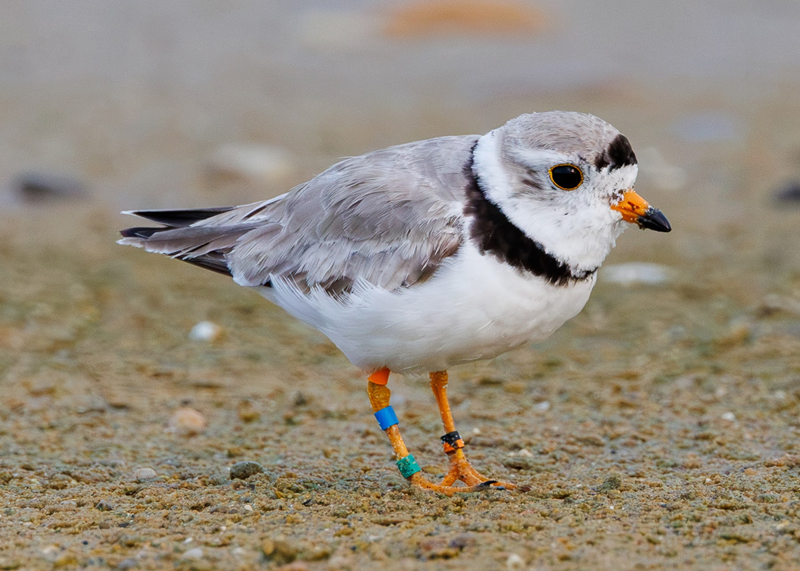
A young piping plover chick at Waukegan in summer 2026. Photo by Oliver Slater

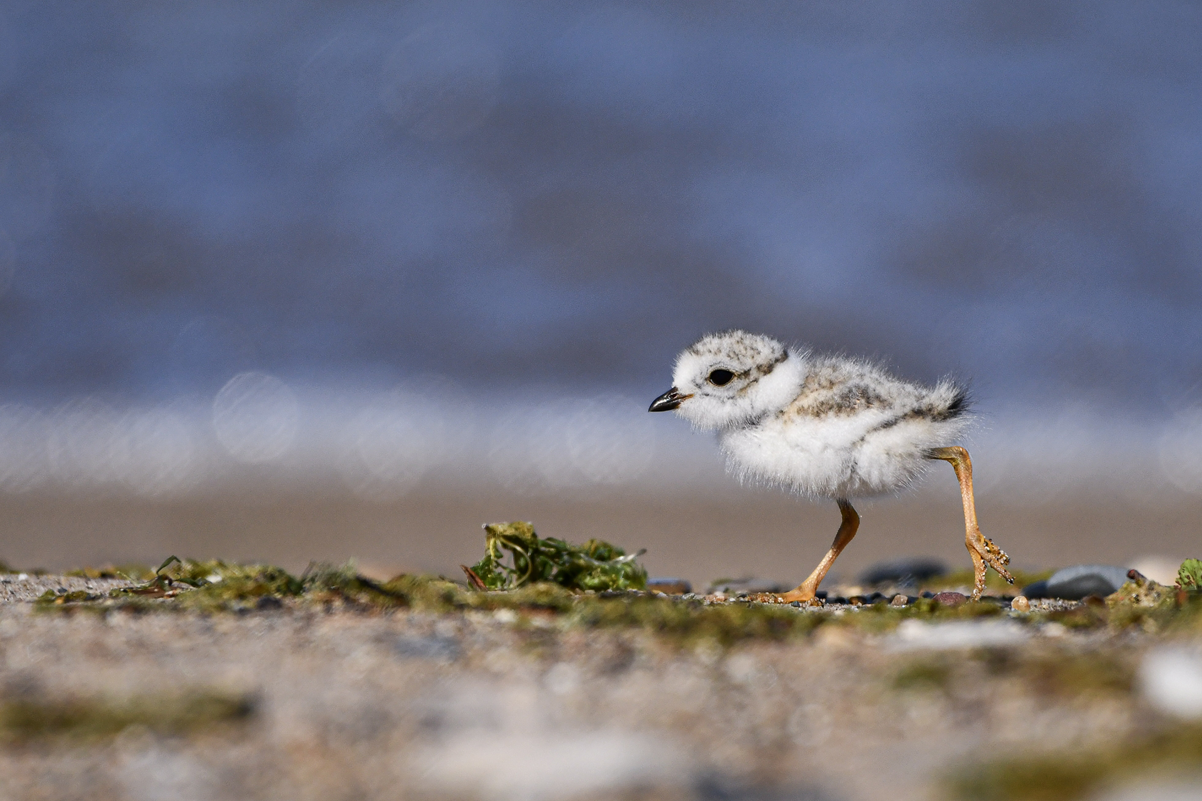
A young piping plover chick at Waukegan in summer 2026. Photo by Oliver Slater
The Great Lakes piping plovers are back on their southern wintering grounds now, spending the next several months in warmer places like Florida, Georgia, Texas and the Caribbean. This year saw record numbers for the Great Lakes piping plover population: 99 breeding pairs produced 160 wild-raised and 24 captive-reared fully fledged chicks. That’s good news for these federally endangered shorebirds.
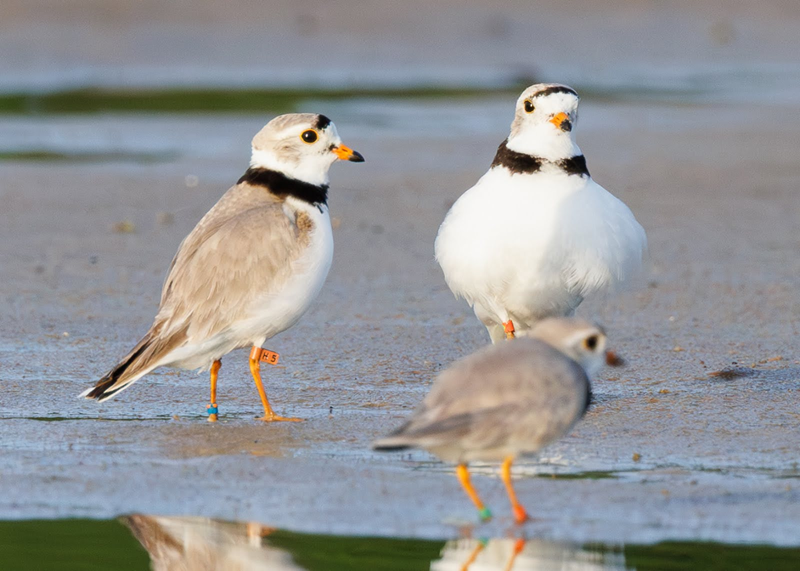
Piping plover fans in Illinois will be watching social media over the next five months for winter sightings, and when the weather warms, will eagerly anticipate the return of the birds, especially those from Montrose Beach and Waukegan.
We know that once the plovers migrate back next spring, volunteers at both sites will closely monitor the beach nesting areas and provide updates on the plovers’ status—from the time the first bird arrives in April until the last one starts its southward migration in August (or spoiler alert: September).
There will be a rapt audience for all the updates: the 2026 breeding season had more plot twists than a soap opera! While we wait to see what next year’s breeding season has in store, let’s look back at the highs and lows of the 2026 season.
On April 13, males Pippin and Imani both safely returned to Montrose Beach. Pippin, who lost his right foot last year after an injury, was born in 2023 to Violet and Obie, the “royal couple” of Cat Island in Green Bay, Wisconsin. Imani, hatched by the famous pair Monty and Rose in 2021, is lovingly known as “sweet prince” and has successfully raised several chicks at Montrose over the years.
After spending time at Montrose, Pipin ultimately decided to head to Waukegan for the 2026 breeding season and arrived on May 3. He had company when he got there, as Pepper, who survived his third annual migration, had returned to Waukegan with much fanfare on April 27.
The plover ladies started arriving in Illinois in May. Sage, hatched by Pepper and Blaze in 2024, returned to Waukegan on May 2, but soon decided to continue her spring migration further north to the shores of Michigan. Later in the summer she and her partner reared three chicks on North Manitou Island at Sleeping Bear, Michigan.
Blaze returned to Waukegan from her winter spot in North Carolina. On May 5, Sea Rocket returned to her partner Imani at Montrose Beach. With previously successful couples reunited at both locations, hope was high that nesting would soon begin, but the weather failed to cooperate. Cold and windy weather stalled nesting efforts until mid-May.
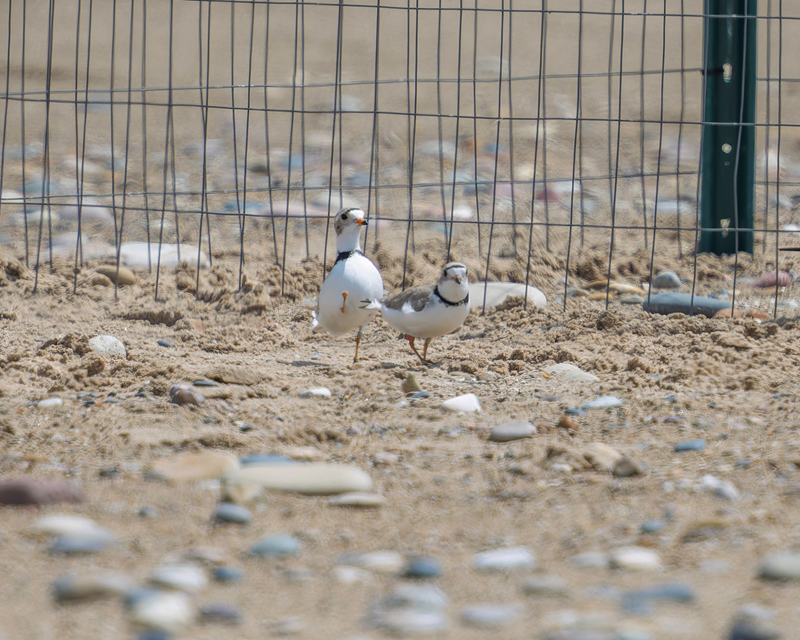
After the delayed start, the breeding season really got rolling. By May 16, Sea Rocket and Imani’s first egg was laid at Montrose, and in Waukegan, Blaze had a nest with two eggs— and a plot twist!
While Blaze had successfully nested in 2024 and 2025 with Pepper, this year she chose instead to breed with formerly odd-man-out Pippin. Beating out the competition, successfully breeding and producing a four-egg clutch is quite an accomplishment. And Pippin did it with only one foot!
Piping plovers do not always reunite with the same partner each year. The new pairing this spring brought joy to Pippin’s fans, who were glad to see the bachelor finally make a match. It also brought the possibility of increased genetic diversity for the Illinois plovers.
By June, nesting and chick-rearing were in full swing, but more plot twists were on the horizon. Up north at Waukegan, the news was not good. Blaze and Pippin’s nest suffered a seemingly catastrophic loss overnight on June 11. All four eggs were washed out of the nest during an exceptionally severe storm, possibly a seiche event. Scattered along the shoreline, the eggs went nearly 14 hours without incubation—exposed to the weather and predators.
The next morning, volunteers went from despair to hope when they were miraculously able to find all four eggs further up the shore from the nest site. The delicate eggs were carefully collected and rushed to Lincoln Park Zoo for stabilization before being transferred to the Detroit Zoo. With luck and the skill of the rescuers, all four chicks successfully hatched on June 16 and were raised at the University of Michigan Biological Station for later release. Somehow, against all the odds, the Blaze and Pippin’s four chicks had survived.
Back at Montrose, Sea Rocket and Imani, parents of Nagamo (2024) and Ferris, El and Bean (2025), successfully hatched the last of their four new chicks on June 16. That day a chick naming contest was announced, and for several weeks volunteers and fans avidly monitored the chicks’ daily progress.
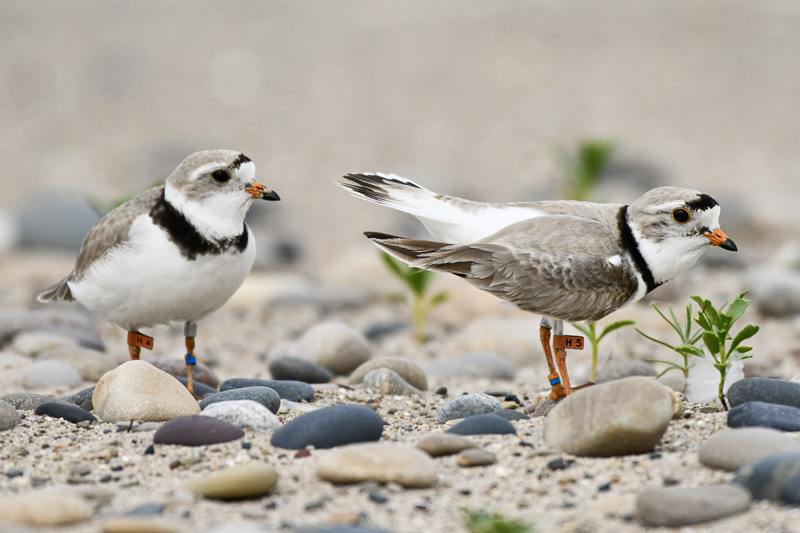
On June 29, Sea Rocket and Imani’s four fluffy chicks received their unique leg bands and were officially named Buddy, Frankie, Mavis and Tweedy after famous local musicians. Great Lakes piping plover chicks are fitted with a brood-marker combination of colored plastic leg bands and a federal aluminum band that allow researchers to identify where and when the birds hatched.
Piping plovers often renest after the loss of a nest. Unsurprisingly, Blaze renested again but—another twist—not with Pippin. For her second attempt she paired with Pepper, her partner from 2024 and 2025. By June 23, their nest had four eggs and excitement was brewing again in Waukegan.
The joy there was tempered by sad news from Montrose on June 30: Mavis, the yellow star combination band chick, had died.
July would prove to be a continuation of the emotional roller coaster for volunteers and plover fans. On July 5, Chicago Piping Plovers reported with profound sadness the loss of a second chick at Montrose. This time it was Tweedy, the chick banded with the green star. It is thought that intense weather conditions, which had been challenging throughout the season and especially so around that time, may have played a role in the loss.
On July 12, Montrose announced that Sea Rocket had not been seen since Friday evening and it was presumed that she had started her migration south. That was not of concern as female piping plovers typically leave for their wintering grounds before the males. Imani stayed behind, as piping plover dads do, to watch over their remaining chicks Buddy and Frankie.
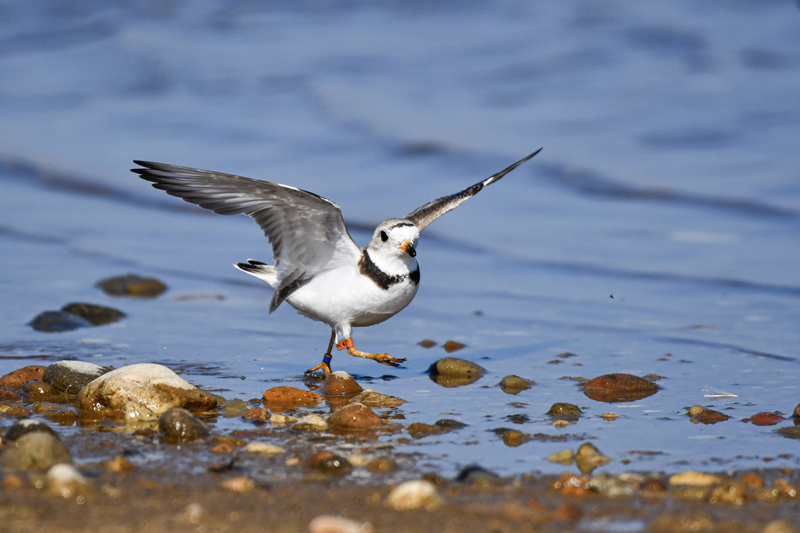
On July 16, Lake County Audubon announced that two of Blaze and Pippin’s captive-raised chicks had been successfully released at Cat Island on the same beach where their papa had hatched. And they noted that the Cat Island “495” male also spent considerable time at Waukegan, another reminder of just how connected the Great Lakes piping plover population has become.
More good news followed from Waukegan on July 18 with the announcement that three of Blaze and Pepper’s chicks had hatched, with the fourth hatching the morning of July 19. These little ones hatched on a beach closed to public access, affording them protection from unleashed dogs and people venturing too closely. A storm came in on July 21, but all the chicks survived. Then on July 26, one chick went missing.
Further north, at a site near Pointe Aux Chenes in the Upper Peninsula of Michigan two of Pippin and Blaze’s captive-reared chicks, both females, known as “AN bON” and “AC bOO”, names based on their leg bands, were last observed there on July 27. Whether they had left for their first migration or had met their end in the mouth of a predator was not known.
Piping plovers are beach hoppers, and August is when the adult males and the season’s fledglings start to get serious about starting their migrations down to their varying wintering grounds. Some shorter flights are in order first though, to build stamina and confidence. Buddy flew north and arrived in Waukegan on July 29, exploring the area and hanging out with the other plovers.
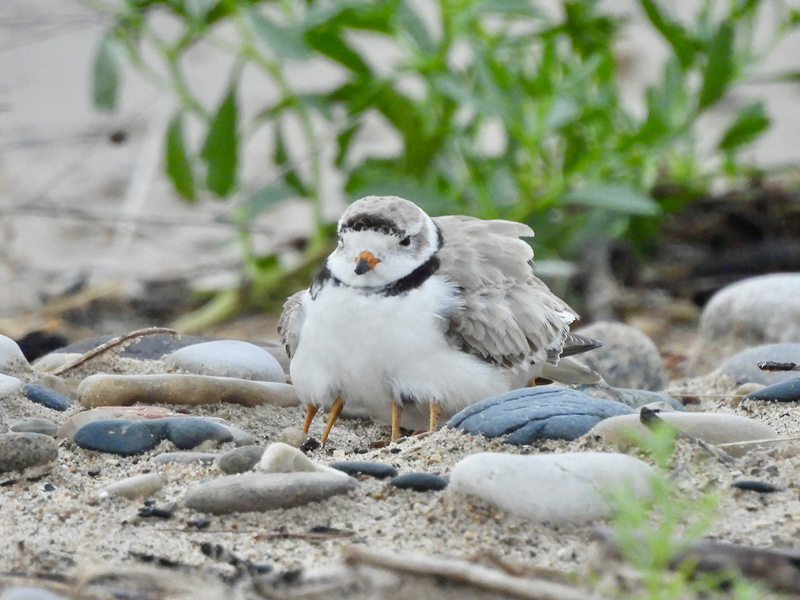
On Tuesday, August 4, the three Waukegan chicks hit a big milestone: banding and naming day. They were banded by members of the Great Lakes Piping Plover Conservation Team with staff from the Illinois Department of Natural Resources, the U.S. Fish and Wildlife Service and local volunteers from the Sharing Our Shore –Waukegan program attending. The little plovers’ names were given in keeping with the Waukegan tradition of naming chicks after features of the local coastal habitat (and as a nod to their own unique behaviors). Dune—named for the sand dunes. Pebbles—for the colorful stones that adorn the shoreline. Drifter—for driftwood as well as its proclivity to wander off on its own.
That day held a double dose of exciting moments as three captive-reared Great Lakes piping plovers, with Pokémon inspired names, were released into the wild at Waukegan. The chicks, named Amaura, Archen and Anorith, came from a nest near Brevort in Michigan’s Upper Peninsula.
Meanwhile, Frankie was busy exploring. He left his home beach at Montrose and joined his brother Buddy in Waukegan on August 7.
The joy of having so many piping plover chicks at Waukegan was ended by a heartbreaking message of loss just days later. Over the weekend of August 8 and 9, Dune, Pebbles and Drifter all perished. They did not live long enough to be declared officially fledged. It is not known whether these were predation events or due to some other cause but given the timing of the disappearances predation seems likely.
While the adult females head south in July, the adult males and the young of the year hang out in Illinois a few weeks longer. On August 8, “AN bON” was sighted in Manistee, Michigan on a stop during her first migration south. Buddy started his migration on August 15. Frankie spent about two weeks in Waukegan but also ventured north to check out the North Unit of Illinois Beach State Park and was spotted back in Chicago on August 20 before continuing his first migration south.
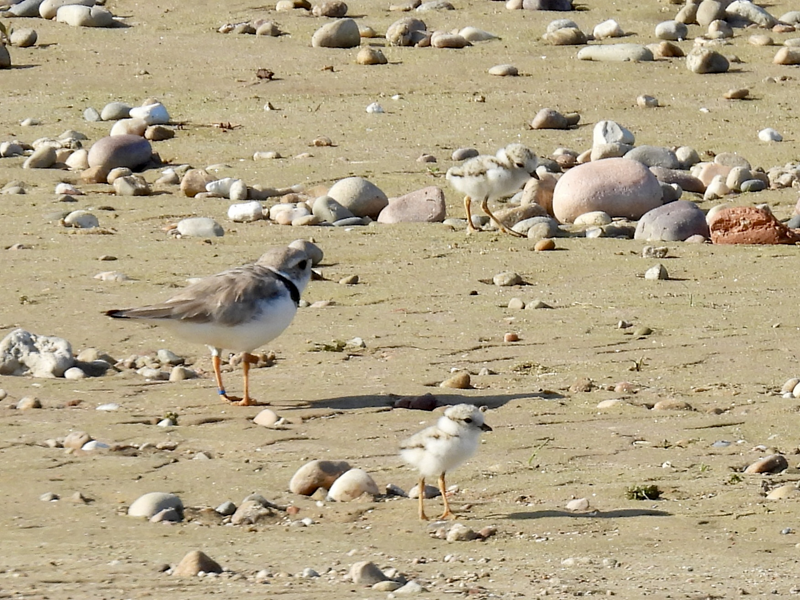
Meanwhile, fledgling females Amaura and Anorith and their brother Archen, were still in Waukegan, spending their days foraging, napping and building their small wing muscles in preparation of their long journeys to come. Lake County Audubon reported on September 3 that the A-Team, as this trio is lovingly known, seem to have all started migration after three and half weeks in Waukegan.
As the birds left Illinois, fans hoped for news of safe arrivals from friends down south. Most of the plovers fly more than 1,200 miles before arriving on their chosen wintering grounds.
On August 22, Cheri Hollis, a volunteer with Sanibel-Captiva Conservation Foundation who first spotted Pepper in Florida in 2023, shared that he had once again made it back to San Carlos Bay – Bunche Beach in Fort Myers, Florida.
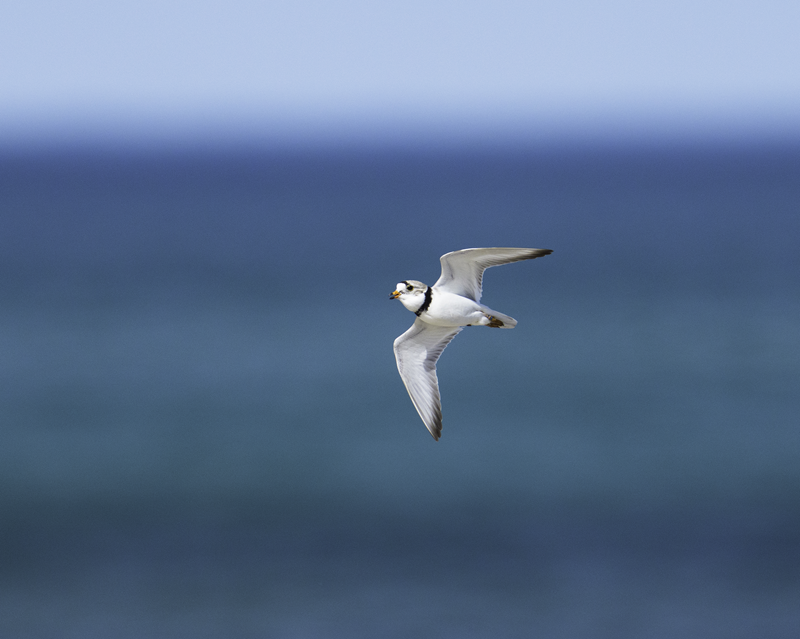
That same day, Pippin’s chick “AC bOO” was observed at Hunting Island, South Carolina by Madilyn Rice.
On September 17, word arrived that shorebird scouting teams had spotted Blaze on her favorite wintering spots near Masonboro Inlet in North Carolina. She had stayed in Waukegan later than usual this year. Producing eight eggs and raising four chicks in one season is exhausting—she definitely earned a little extra beach time to rebuild her strength.
It is reassuring to hear that some of the plovers have had successful migrations. Not all of the plovers overwinter at sites that are accessible to people, and so the winter whereabouts of many of them remain a mystery. But watchers along the southern coasts are always on the lookout for banded plovers. If you’d like to keep up to date with the latest sightings of the Great Lakes piping plovers, be sure to follow these groups on social media:
Rooting for an endangered species is not for the faint of heart. Each year is an emotional roller coaster: Will the eggs hatch? Will the chicks fledge? Will the chicks and adults successfully migrate south? Will they make it back to Illinois next spring? Adults and chicks alike must survive storms, predators, entanglements and habitat loss. Each bird added to the population brings joy. Each loss weighs heavy. Every individual bird matters to the long-term survival of the Great Lakes piping plover population.
The annual breeding season and winter season monitoring efforts are part of a large collaborative effort involving federal and state agencies, conservation organizations, researchers and hundreds of volunteers. If you are a bird watcher headed to southern coastlines this winter, you can contribute, too.
Band sightings help biologists document where these birds spend the winter and learn about the routes the plovers travel along their journeys. Every reported observation helps fill in the knowledge gaps. If you spot a piping plover with leg bands, take photos from a respectful distance, record the location and report the information to plover@umn.edu.
For other ways to get involved and to learn more about these small federally endangered shorebirds check out the Great Lakes Piping Plover website.
Laura Kammin is a Natural Resources Specialist with the National Great Rivers Research and Education Center. She formerly held positions at Illinois-Indiana Sea Grant, University of Illinois Extension, Prairie Rivers Network and the Illinois Natural History Survey. She received her master’s degree in wildlife ecology from the University of Illinois, Urbana-Champaign.





Submit a question for the author