
All photos and drawings by Sima Shah.

All photos and drawings by Sima Shah.
In September, as the landscape turns to shades of orange and brown, I start hearing familiar honks from above. At first the honks are long and stretched out. Hoooonnnk. Hooonnk. Hoooonnk. Then the pace quickens. Honk.Honk.Honk. Finally, there is a moment where it takes on shrill quality. HOOONNNKKK.
I look up to see a V-formation flying pattern of the Canada geese in flight. In the distance, from another direction, I hear more honks, which are getting louder by the second. Suddenly, out of nowhere, the sky is filled with three separate formations. The geese maintain their position. The flying V’s take a life of their own, gracefully coming together then moving apart. It is a choreographed dance. On the other hand, the many calls sound as if different orchestras are playing at the same time at the Chicago Symphony Orchestra. The sound envelops me. Then it all fades and the geese are gone, for now.
The order and chaos is beautiful.
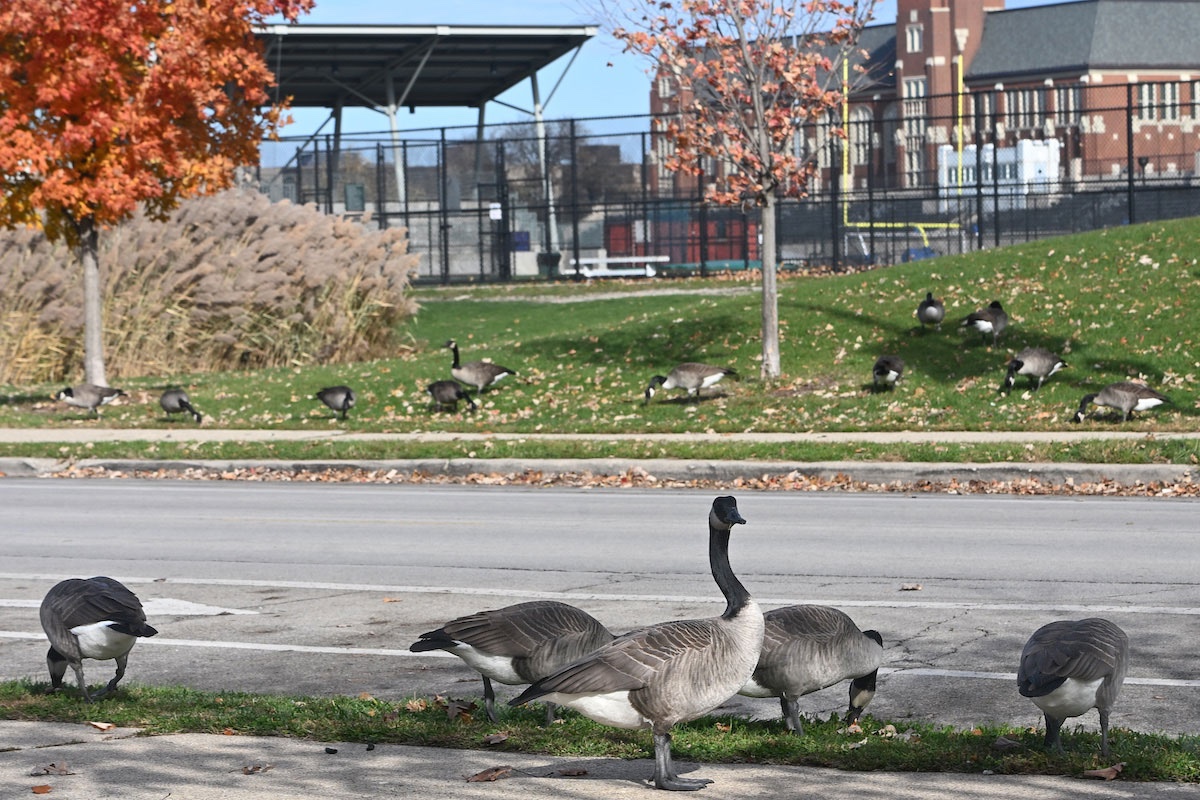
There is no shortage of geese in the Chicagoland area. In early spring, during the breeding season, they move in small family units. At Humboldt Park, tiny yellow goslings march in a single file or swim in straight lines while squeezed between two adult geese. As the goslings lose their yellow fluff, the family units can be found sauntering through a random parking lot and, at times, crossing a busy street. No longer so discreet. Once autumn arrives, however, they are seemingly everywhere, forming progressively larger gaggles, they become vocal. The sky begins to fill with geese.
There it is again. Orderly lines and chaotic groups, both maximize efficiency.
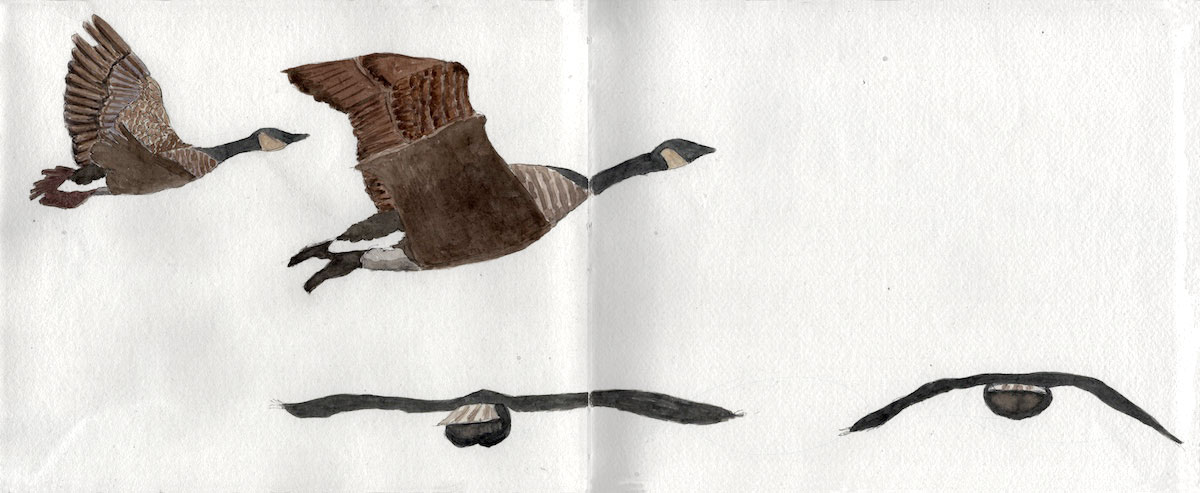
Geese have a sense of space. Most studied by scientists during migration, geese employ the iconic V-shape. In flight, each goose positions itself to be slightly shifted outward from the goose they are flying behind. That space allows them to take advantage of utilizing the “free lift” of being pushed upwards which is provided by the flapping wings from the goose ahead. Conversely, if they flew in a straight line they would be pushed downwards and which requires more energy to overcome the resistance. The V formation reduces wind resistance which in turn conserves their energy. 1 Geese can fly at a speed of 40 miles per hour and under certain conditions can travel up to 70 miles per hour. 2 It is impressive.
Additionally, larger groups translates into to longer V-trains allowing geese to cover more distance. The lead goose will fall back when it starts feeling fatigued, allowing another to take its place. 3 In clear weather, geese can travel 1,500 miles per day. 2 To put that into perspective, Phoenix, Arizona, is 1,494 miles southwest of Chicago. 4
Let that sit for a moment.
Living in the Midwest, I expect to see the Canada goose. This expectation evokes a different feeling than seeing a great blue heron. The heron introduces a moment of surprise and awe whereas, the Canada goose may have worn out its awe. It is an interesting thought. Would I feel the same if I saw great blue herons or my favorite, sandhill cranes, all the time?
The thought made me want to take a closer look at the Canada goose, to see what wonders I might be missing out on precisely because they are so common. I intentionally searched for geese to observe them, read articles and spoke with experts. I wanted to look beyond the perceived chaos.
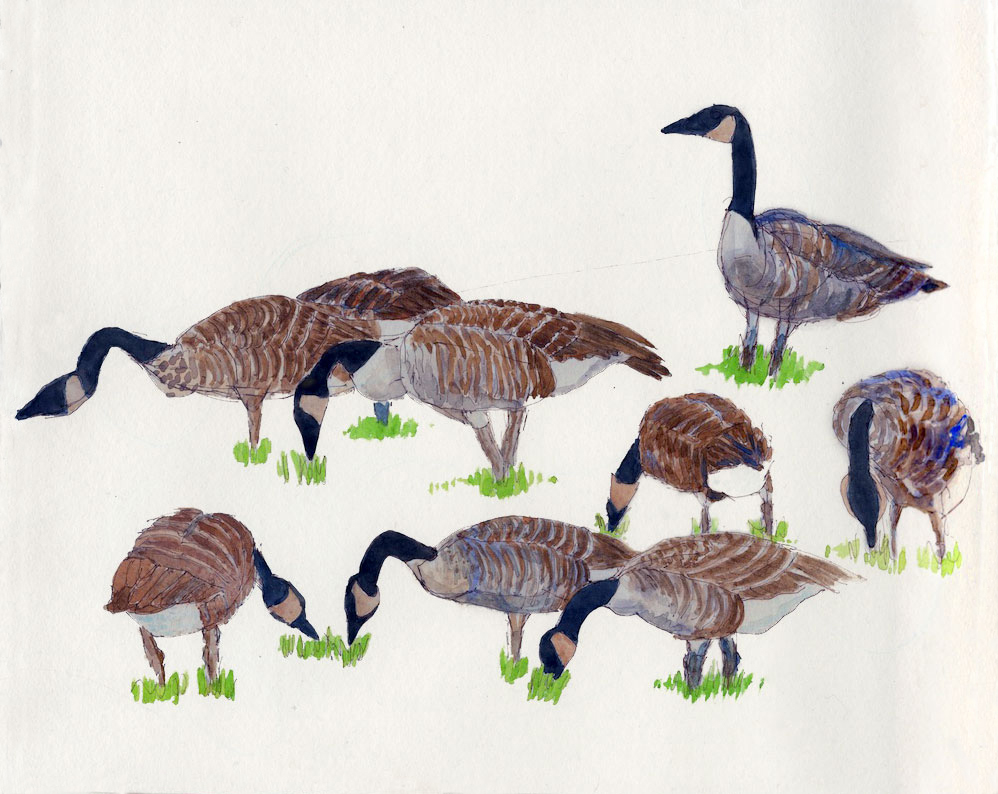
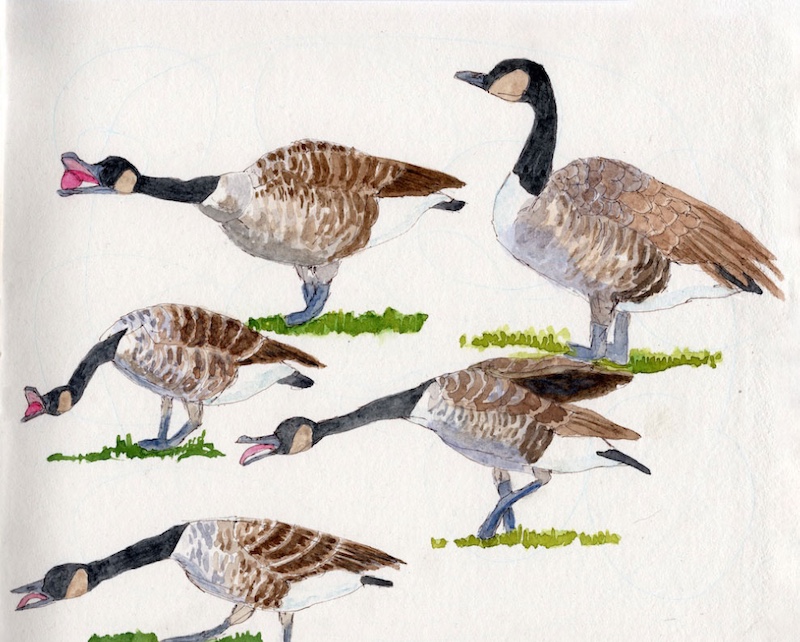
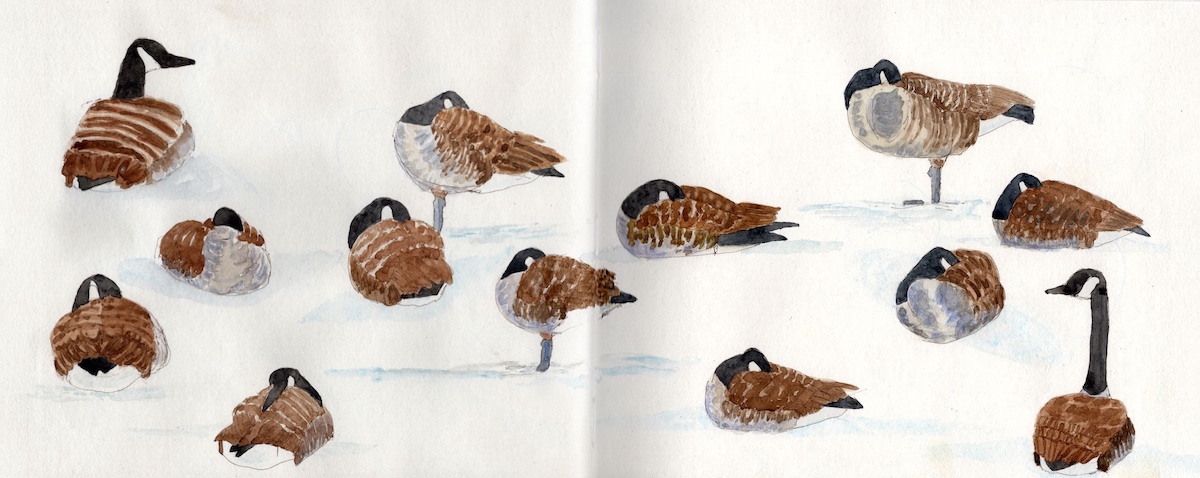
I watched several gaggles of geese as they searched for food and noticed that each goose took on one of two distinct roles. Most were actively searching for food, their long black necks bent over and trademark white chinstrap low to the ground. They moved in a zig-zag motion with their beaks leading the way, never once bumping into another. At the same time, a few geese in the gaggle stood watch. They stood upright and remained stationary. Eventually, the geese would reverse roles. Those on watch would start grazing away, and, as if on cue, another goose would take guard. There did not seem to be one leader, but a sharing of roles.
Of the seven subspecies of Canada geese, two winter in Chicago: the migratory subarctic-nesting population, which breeds along the Hudson Bay, and the non-migratory temperate nesting population, known as the giant Canada goose, which breeds and resides year-round in the Chicagoland area.5 The largest goose in the world, giant Canada geese weigh up to 19 pounds and grow as tall as 3.5 feet.6
There are different theories as to how the resident geese adapted to the city. Some suggest that the resident giant Canada goose was once migratory but changed its behavior. Others believe that the giant Canada goose has always displayed non-migratory behavior.5, 7
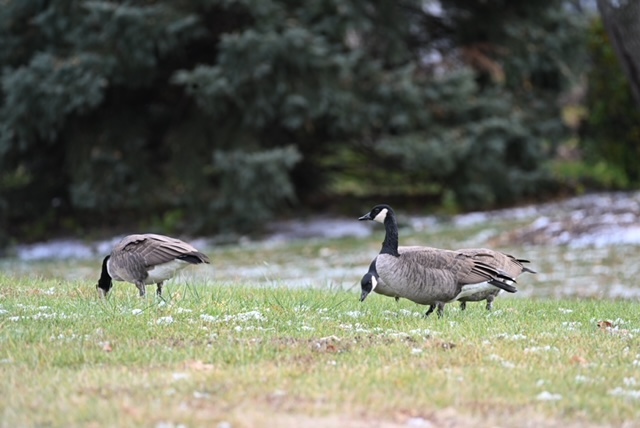
I am not aware of another common Chicago winter bird that has a similar combination of social behavior and physical characteristics. While out observing the geese, I saw other water birds, including wood ducks and red-breasted mergansers. Both species displayed traits of social behavior, but their numbers were small at only 10 to 15 birds per flock.
Near Montrose Dunes, predatory species caught my eye. Unlike the Canada geese, red-tailed hawks, peregrine falcons and kestrels tend to be solitary.
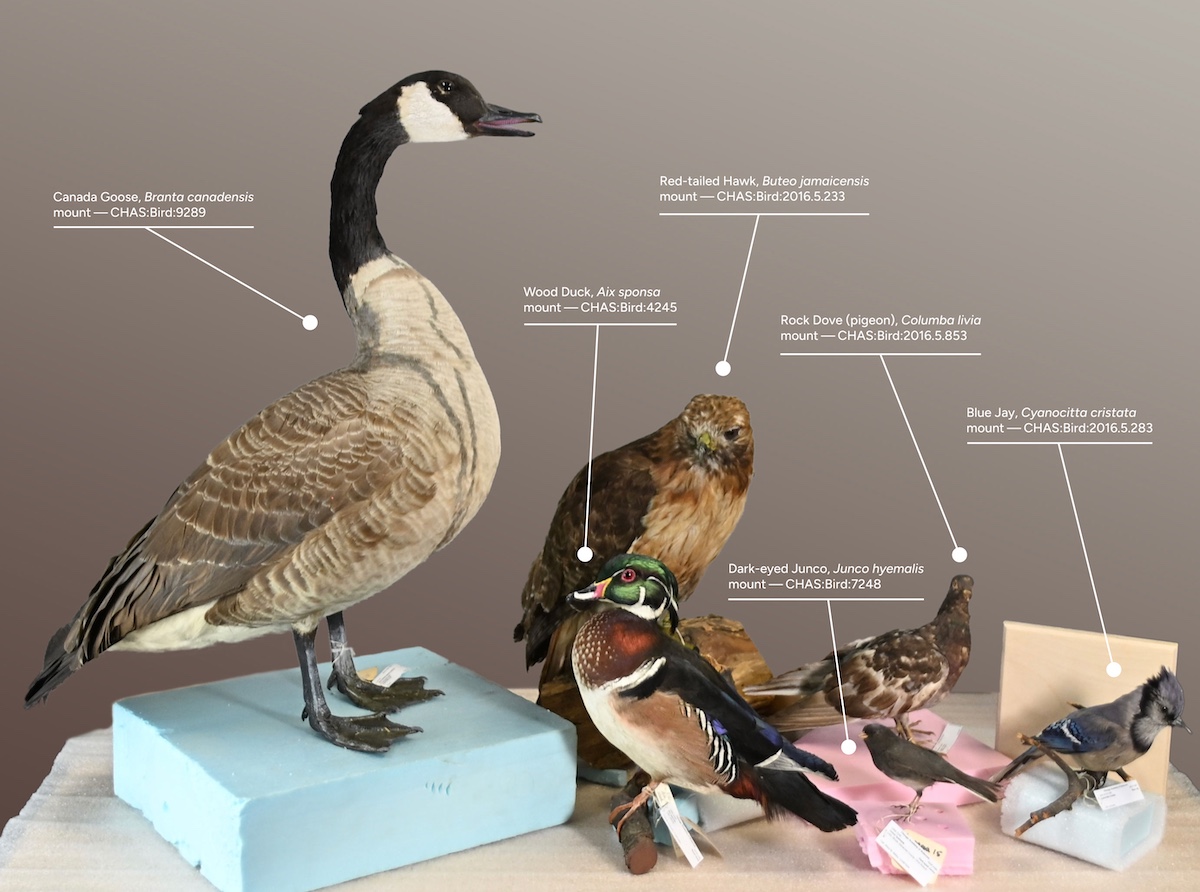
Then there are the songbirds. Blue jays, dark-eyed juncos, black-capped chickadees and brilliant-red cardinals visit my parents’ bird feeder during the colder months. Hopping on the ground for the last of the seeds they flutter to the conifers as my dad approaches, darting branch to branch. These birds have anisodactyly arrangement of toes, where three digits are forward and one is back allowing them to grip tree branches.8 On the other hand, Canada geese have webbed feet, indicative of swimming and key feature of waterfowl.8 And yet, geese are often seen waddling throughout Chicago in the most peculiar places.
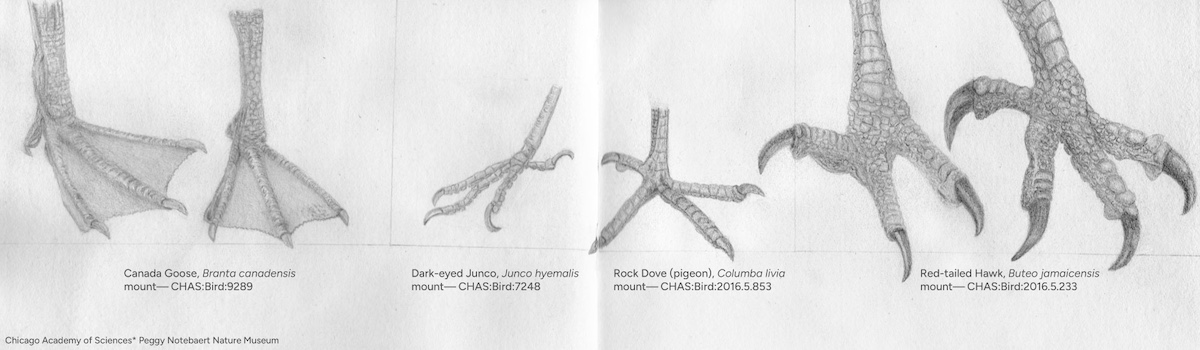
I would be remiss if I did not mention rock doves, aka pigeons, that have earned a reputation by some Chicagoans as “nuisance” birds. They, too, have adapted well to the city, but do not possess the same stature that makes geese remarkable.
Canada geese have not always been ubiquitous. Because of over-hunting and egg collecting, for three decades in the early twentieth century the giant Canada goose was thought to be extirpated. Harold C. Hanson, a professional scientist with the Illinois Natural History Survey, found a flock of 200 near Rochester, Minnesota.9 A reintroduction program was kicked off and the rest is history.10, 11 Nevertheless, there was a moment in time where the fate of the giant Canada goose could have followed that of the passenger pigeon, an extinct species that was once abundant in North America.12 This highlights the resilience of geese and importance of restoration programs.
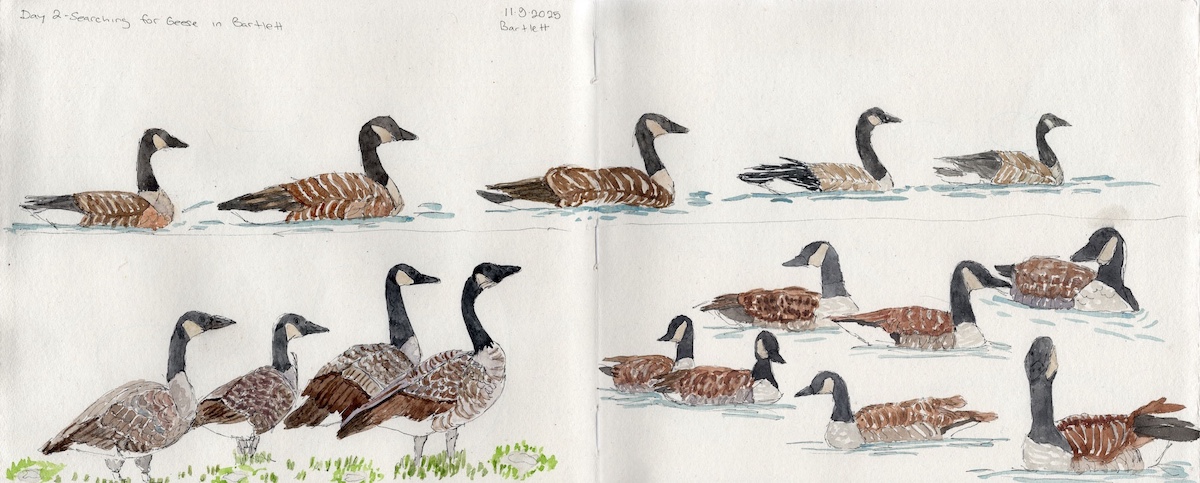
The numbers of Canada geese are increasing in the Chicagoland area with the last counts of the resident geese greater than 30,000.13 Several factors may play a role in the increase. Chicago is part of the Mississippi Flyway where the biannual bird migration that includes geese occurs.14 As weather patterns shift towards warmer winters, fewer geese are migrating.15 Historically, Chicago has created spaces, such as low turf grass, that suit the needs of the Canada geese.16, 17 This, coupled with the ability of geese to adapt to the presence of humans, sets them apart from other birds.17
A study conducted by Dorak et al. placed GPS trackers on 41 geese from the Chicagoland area to assess winter habitats and survival. Their findings were revealing. Geese that remained within the metropolitan boundaries had a greater chance of survival than those that left. Geese in the study utilized open green spaces but as the temperature dropped and, with snow coverage, they moved to deep water and industrial urban habitats.18
Throughout history geese have interacted with humans.19 At the Art Institute of Chicago, as you cross through the first floor to the Modern Wing, there is a display entitled, “Vessel in the Form of a Bird” from 618-907 of the Tang Dynasty. If you continue reading, you learn that the bird may be either a mandarin duck or a wild goose, traditionally symbolizing peace, prosperity and marital love.20 Consider as another clue all the terms within the English language to describe geese: gander (male); dame (female); gaggle of geese (a group on the ground); skein or team or wedge (geese in flight); wedge or plump (geese on the water).21 These nouns add drama and vividness to the language, and make me wonder about their origins.
How do we coexist with these magnificent honkers? Ben Williams, a waterfowl expert at Illinois Department of Natural Resources, suggested land management as an option to deter geese where they create problems. Instead of maintaining a short lawn grass that the geese prefer, establish tall grasses and other vegetation.17 It’s an even bigger win when the plantings focus on native species as they will attract pollinators.22
Chicagoans do not blink twice at the Canada goose; this bird is woven in the fabric of our city. Whether one loves them or hates them there is something to be said about the way we coexist. Closely observing Canada geese, we can appreciate their beauty, skill and resourcefulness. Geese, like Chicagoans, take care of their flock. In a way they may embody the spirit of this city and teach us something about ourselves.
Acknowledgement: I appreciate Ben Williams, a waterfowl expert, from Illinois Department of Natural Resources, and Dawn Roberts, Senior Director of Collections at Chicago Academy of Sciences/ Peggy Notebaert Nature Museum for their time and expertise which greatly informed this article.
Dedication: This article is a tribute to Dr. Jane Goodall who championed hope in the form of action. She sparked curiosity and inspired many to care deeply about the natural world, including myself.
S.D. Shah is an illustrator, printmaker and nature journalist. She resides in Chicago. In 2020, Shah received her certificate in Traditional Botanical Art from the Chicago Botanic Garden. She is a novice but avid birdwatcher, hiker and native plant enthusiast. You can learn more about Sima and her work on her website.




Submit a question for the author