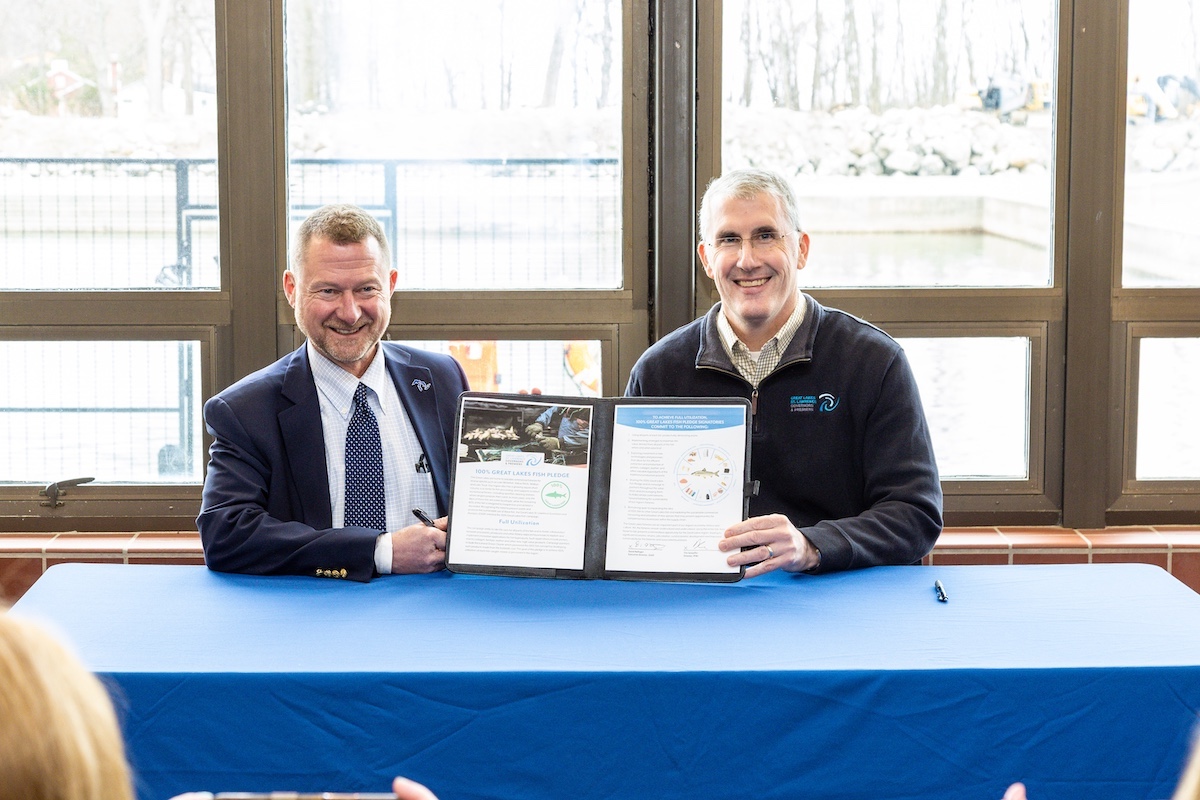
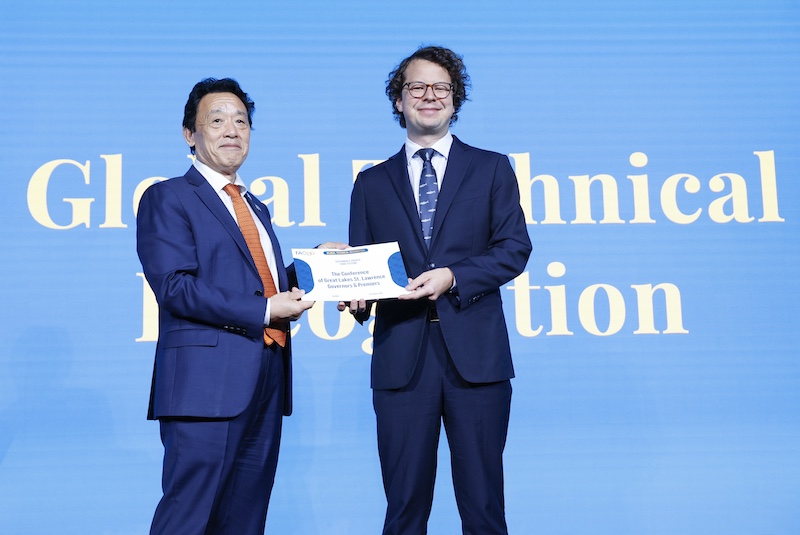
David Naftzger (Executive Director, GSGP) and Tim Schaeffer (Executive Director, Pennsylvania Fish and Boat Commission) sign the 100% Great Lakes Fish Pledge, making Walnut Creek Marina the first sportfish cleaning station to sign on to the Pledge. All photos courtesy of the authors unless otherwise noted.
If you have ever cleaned a fish, you know how much is left after the filets are separated. Heads, frames, skin, bones, scales and guts can add up to more than half the fish. For generations, much of that material has been thrown away. The idea behind the 100% Great Lakes Fish initiative is simple: what if we found better uses for it?
Led by the Great Lakes St. Lawrence Governors & Premiers with the Illinois Department of Natural Resources and other regional partners, 100% Fish is working to create more value from fish caught, raised and processed across our region. That includes fish from the Great Lakes, rivers, inland lakes, ponds, and aquaculture operations throughout Illinois, the other Great Lakes States, Ontario and Québec. The goal is straightforward: reduce waste, create jobs and make better use of a resource that already supports fishing communities across the region.
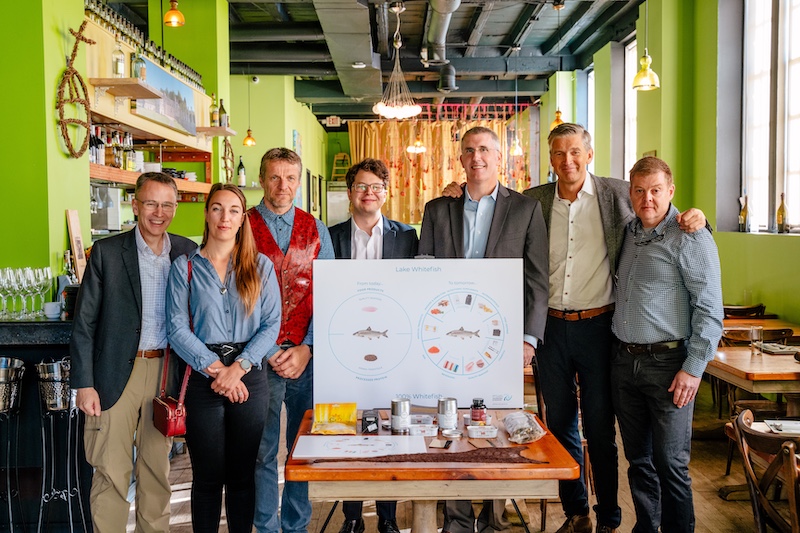
GSGP staff standing with Icelandic partners during the launch event for the 100% Great Lakes Fish Initiative at Chartreuse restaurant in Detroit, Michigan.
When OutdoorIllinois Journal last covered this work, 100% Fish was still a relatively new idea. It came in part from Iceland, where the Iceland Ocean Cluster helped pioneer the concept of “100% Fish” by finding productive uses for nearly every part of the cod. We believed a similar approach could work here, adapted to our own species, industries and markets.
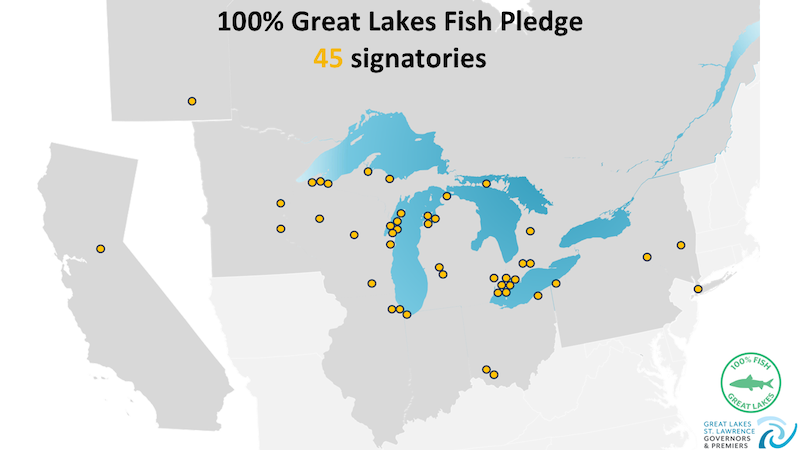
Since then, we have transformed the Great Lakes commercial fisheries and effectively ended the practice of landfilling fish “waste.” Forty-five companies and organizations have signed the 100% Great Lakes Fish Pledge and committed to productively use 100% of the fish they handle. Even more significant, those signatories represent about 90 percent of the Great Lakes commercial catch.
Full utilization of fish in our region could generate more than $3 million a year in direct revenue for processors, support dozens of jobs and help unlock more than $22 million a year in value-added finished goods sold to consumers. It could also annually avoid nearly 8 million pounds of carbon dioxide and 265,000 pounds of methane that results from the landfilling process.
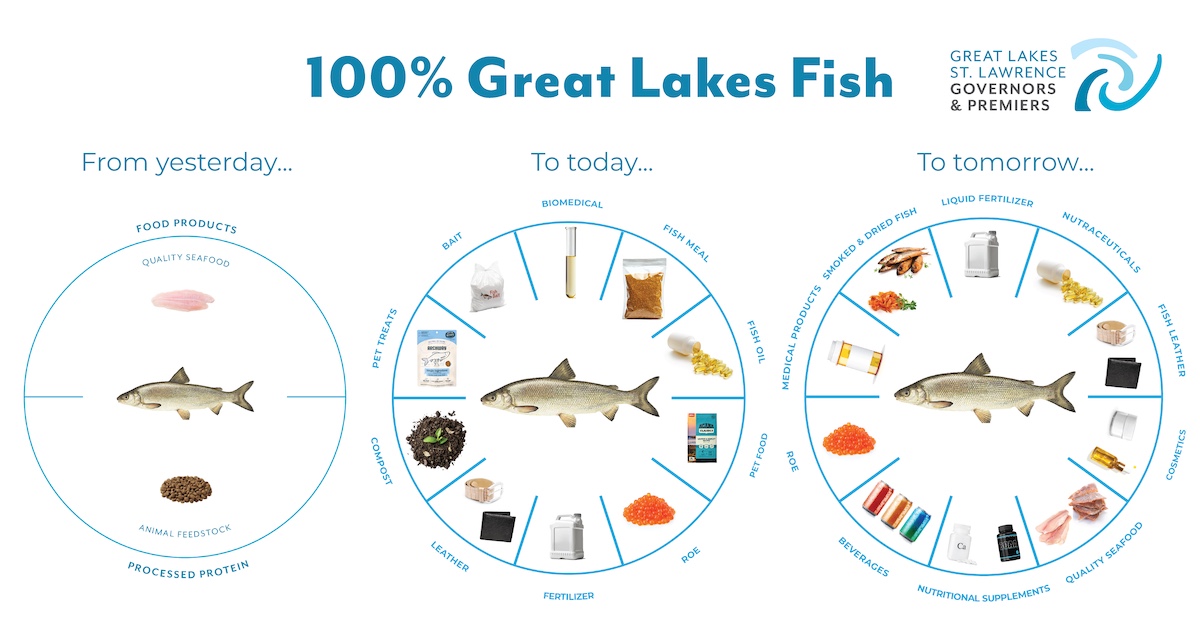
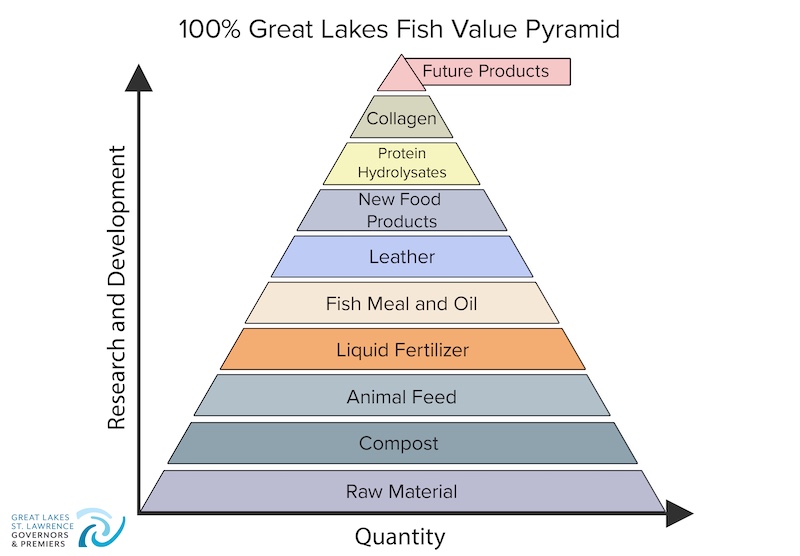
Uses can take many forms. Some are practical, such as compost, fertilizer and ingredients for animal feed. Others are higher value, including pet treats, fish leather, collagen, and protein hydrolysates for food and feed applications. There is no single product that will result, rather, a range of uses, together, make full utilization possible.
Value Pyramid showing relative value of different 100% uses.
100% fish is now working to similarly transform our region’s sport fisheries.
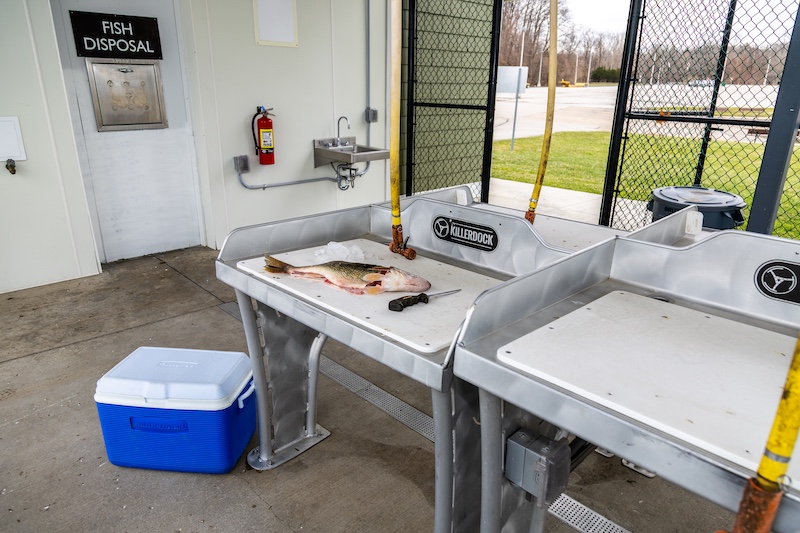
Across the Great Lakes and in river and lake communities throughout the region, anglers clean fish every day at marinas, boat launches and cleaning stations. A lot of usable material is left behind. The question is how to capture it and put it to work.
Walnut Creek Marina is the first sportfish cleaning station to sign on to the 100% Great Lakes Fish Pledge. It has an onsite freezer where material is stored and all “waste” is currently being fully diverted from landfill.
In March, the first fish cleaning station signed onto the 100% Great Lakes Fish Pledge. In coming months, we will expand this work with additional cleaning stations, including in Illinois, to productively use material that is often landfilled or put into a grinder and sent to wastewater treatment plants. These practices are costly, impact our environment and wasteful.
100% fish is similarly working to transform aquaculture in our region. Eight aquaculture companies have already signed on to the 100% Great Lakes Fish Pledge. Because aquaculture offers predictable production volumes and controlled handling, it is especially well suited to 100% fish strategies.
Illinois has been a leader in this work. Three Illinois companies have signed the 100% Great Lakes Fish Pledge: Fortune Fish & Gourmet in Bensenville, and Chicago-based Archway and Farm to Pet. And, the Illinois Department of Natural Resources has been on the project team from the start.
The 100% Great Lakes Fish initiative now includes a broad regional network, extensive research and success in transforming our region’s commercial fisheries. Our long-term goal is to create the first 100% fisheries in the world, where every fish caught, raised or processed in the Great Lakes region is used as fully and productively as possible. It means less waste, more value, stronger fishing communities and a better way of honoring the resource.
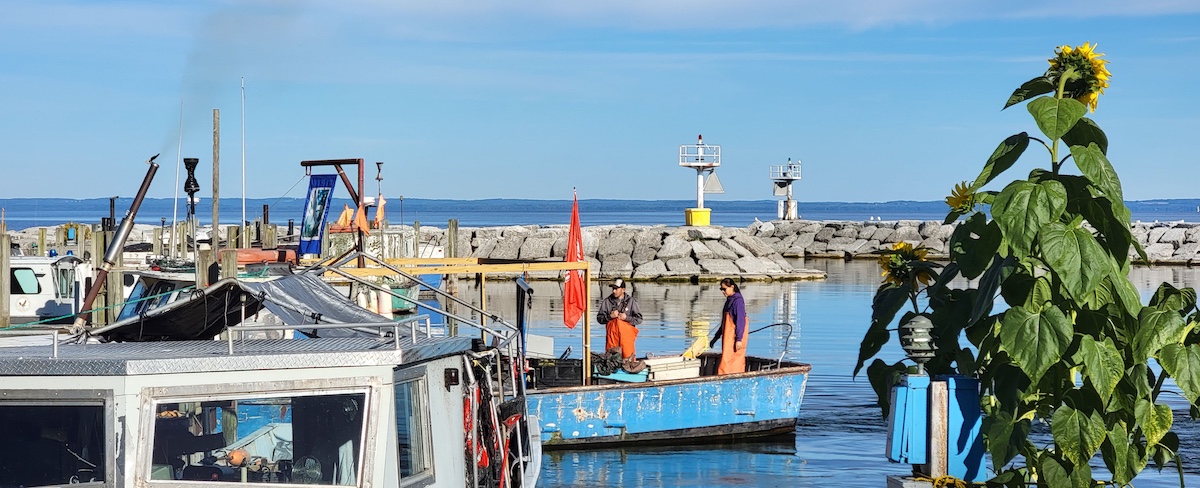
“Fishtown” in Leeland, Michigan.
David Naftzger is Executive Director of the Great Lakes St. Lawrence Governors & Premiers (GSGP). He coordinates the efforts of eight U.S. Governors and two Canadian Premiers to grow the regional economy and protect the Great Lakes St. Lawrence region’s significant freshwater resources. His work includes leadership on initiatives involving impact investment, maritime transportation, export promotion, tourism, and 100% Great Lakes Fish. Naftzger holds a master’s degree from the London School of Economics and a bachelor’s degree from DePauw University, and he also studied at the University of Freiburg in Germany. Click here to learn more about GSGP’s work and to stay updated.
John Schmidt is Program Manager for the Great Lakes St. Lawrence Governors & Premiers, where he leads the 100% Great Lakes Fish Initiative. His work focuses on creating new industries and opportunities from underused fish byproducts so that more of each fish caught, raised, or processed in the region is put to productive use. He also supports GSGP’s Regional Maritime Initiative and Cruise the Great Lakes tourism program. Schmidt holds degrees from William & Mary, the University of Chicago, and Loyola University Chicago.





Submit a question for the author