
A curious coyote in a meadow. Photo by Max Allen.

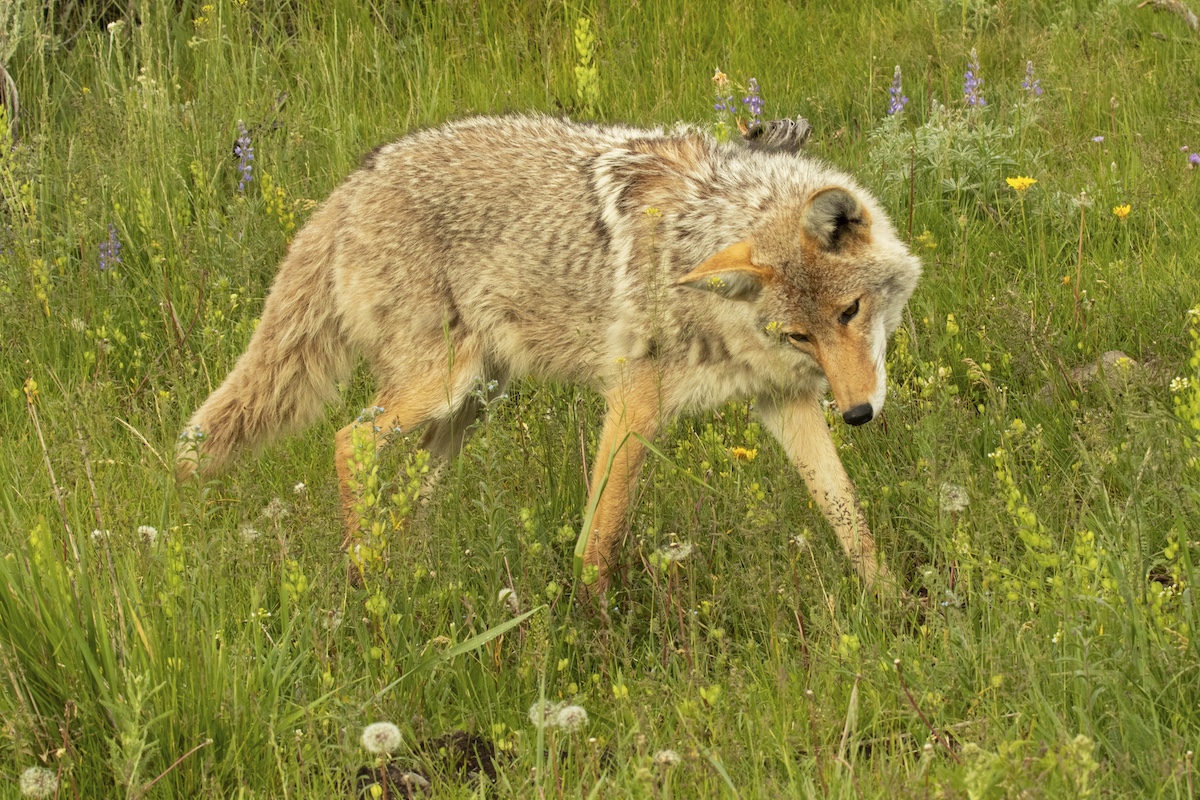
A curious coyote in a meadow. Photo by Max Allen.
Aside from the odd dispersing individual, Illinois hasn’t had a resident population of wolves, cougars or black bears in more than a century. Without large carnivores, a vacancy is left at the top of the food chain for smaller, medium-sized carnivores (called “mesocarnivores” by scientists) to swoop in. Coyotes, a common mesocarnivore throughout the state, have at least partially filled this role. From farm fields to the streets of Chicago, they’ve become Illinois’ de facto apex predator, quietly regulating the ecosystems around them.
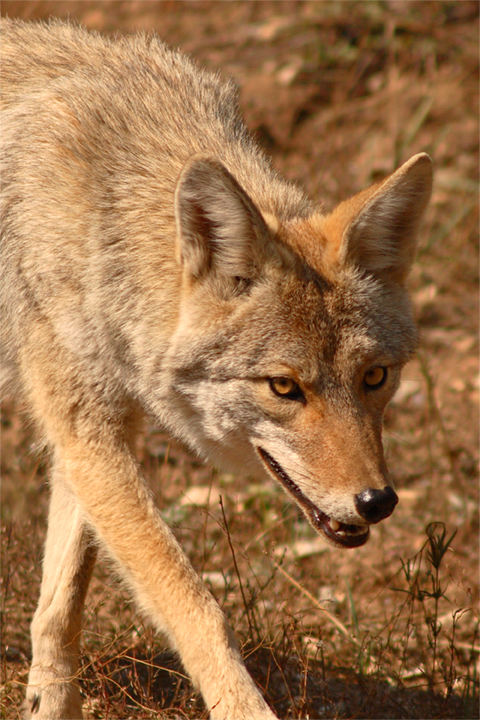
But for an animal this common, we still know surprisingly little about exactly where coyotes spend their time, and why. That matters for understanding their ecological role, and for managing them. In attempt to understand this better, we set out to map coyote activity across the entire state of Illinois.
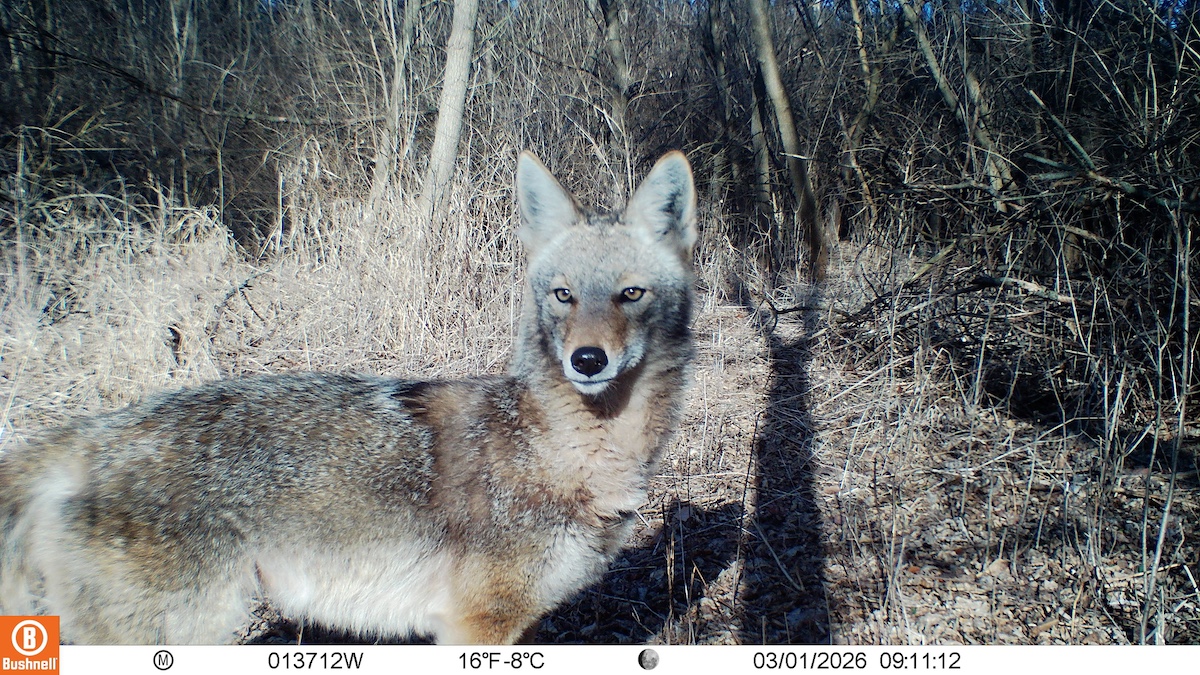
As part of our statewide mammal monitoring program supported by the Illinois Department of Natural Resources (IDNR), we deployed camera traps at 164 locations across the state’s forests, wetlands and grasslands over a three-year period. Coyotes turned out to be nearly impossible to miss; they showed up at all but two of our camera sites, racking up a total of more than 3,300 separate sightings. We paired all that activity with detailed maps of land cover and white-tailed deer abundance (inferred from our camera trap data), to determine the best indicators for how intensely coyotes use a given area.
Spatial scale matters in ecology, and coyotes are no different. A coyote deciding where to raise pups isn’t necessarily thinking in the same way as one deciding where to hunt tonight. So, we examined our spatial variables at different sizes to represent different aspects of how coyotes might make decisions. These included what we called fine-scale foraging choices (a circle with a 109 yard radius), movements within the core area of their home-range (a circle with a 0.62 mile radius), and broader territory selection (a circle with a 3.12 mile radius). This is similar to how we live our lives when making decisions about what we are going to eat next versus the areas we frequently visit, and the areas we typically use over the course of each week. Comparing spatial resolutions lets us separate choices between fine-scale foraging and the the bigger decision of where to settle down.
At the finest spatial resolution, coyotes turned out to be surprisingly choosy: forest, farmland, wetland and developed land all showed a negative association with local coyote activity. But zoom out to the scale of a whole territory, and that pickiness mostly disappears. The same “bad” habitat barely matters once a coyote has already staked out a range that includes it. A single small patch may not offer much to hunt in, but a landscape stitched together from many such patches likely supports more prey overall, and a coyote patrolling a large territory can afford to pass through suboptimal patches on the way to good ones. These results suggest coyotes don’t need every acre of a territory to be prime habitat. As long as the average is good enough, they’ll settle in, including in farmland, forest and neighborhoods they wouldn’t necessarily choose to hunt in.
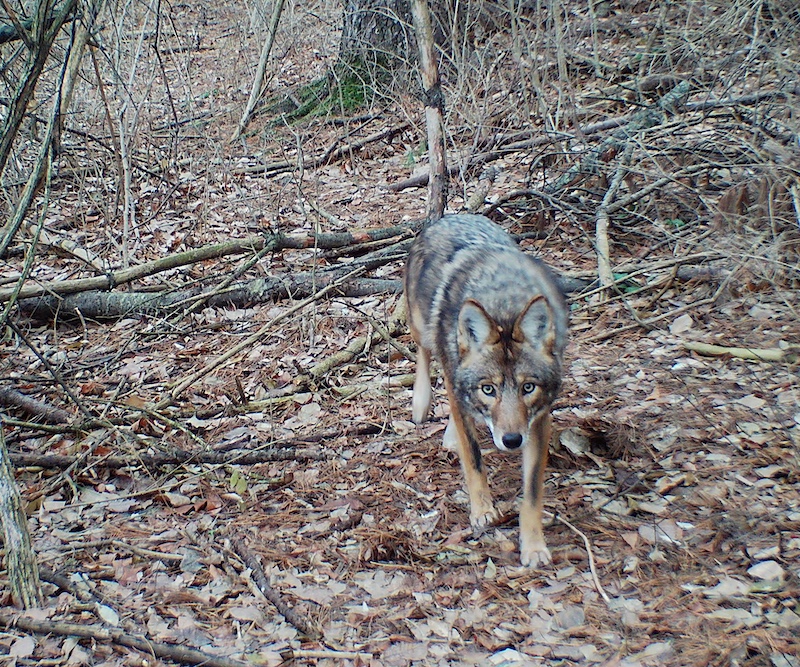
Coyotes were also consistently drawn to water, no surprise for an animal that needs to drink, hunt along edges, and travel the natural corridors that streams and rivers create. We also found white-tailed deer abundance to be positively associated with coyote activity, which can either suggest a shared preference for the same productive habitat, or suggest an important predator-prey link between the two species. Coyotes prey on fawns each spring, and scavenge deer carcasses year-round, so it may pay for them to stick around wherever deer (dead or alive) are abundant.
Using our broadest-scale model, we predicted coyote activity across Illinois. Activity was highest across the western, central and northern parts of the state, with a hotspot along the Illinois River between Peoria and Springfield. Activity was lowest in the heavily forested south and within Chicago’s urban core, though we suspect the low urban numbers say more about how few cameras we’ve had in cities so far than about the coyotes themselves. Other urban coyote studies generally find the opposite, with densities often higher in cities than in the surrounding countryside. We have since added urban cameras to the project, so future years should sharpen this picture considerably.
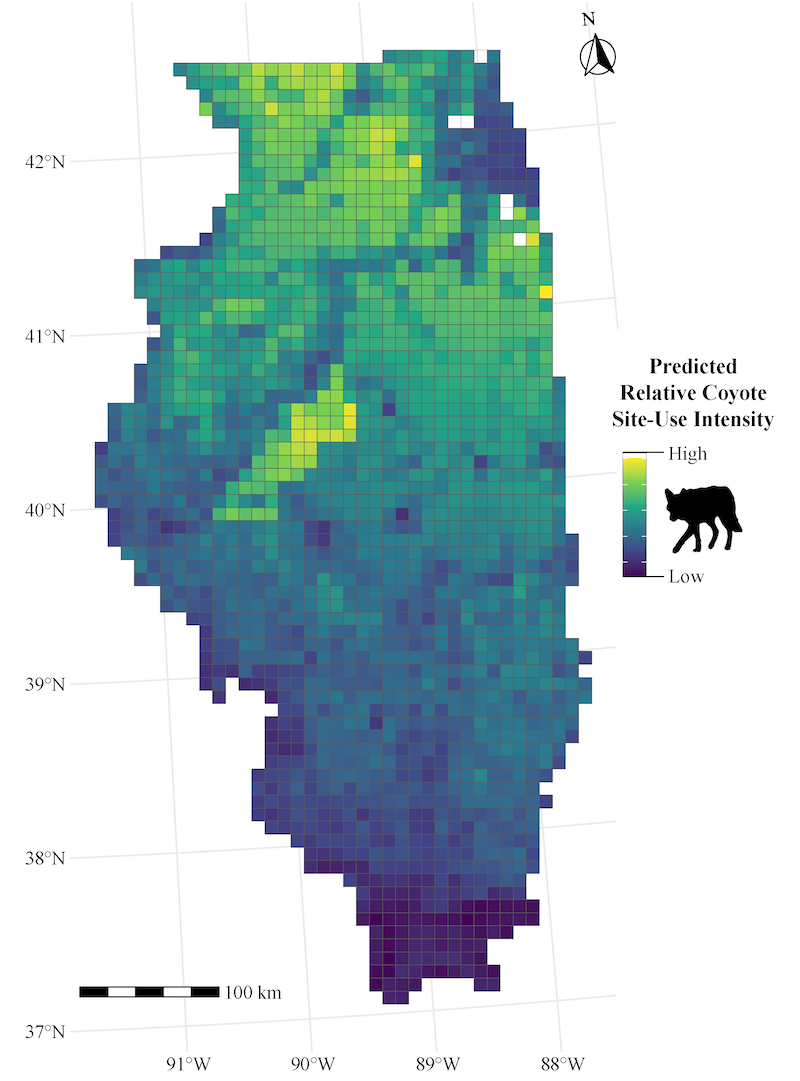
Putting it all together, the Illinois coyote appears an animal built for tolerance, but a tolerance that depends on scale. Up close, coyotes are choosy, and they’ll dodge risky or unproductive habitat patches. Zoom out to the size of their territory, and that pickiness barely matters, since a coyote that has already claimed a range doesn’t need every acre of it to be ideal. Coyotes fill an important ecological role in Illinois, keeping small mammal populations in check, cleaning up carrion and standing in, however imperfectly, for the wolves and cougars that used to patrol the same ground.
Nathan Proudman is a wildlife ecologist currently based in Alaska. He previously served as a Postdoctoral Research Associate at the Illinois Natural History Survey from 2023–2025, leading a statewide mammal monitoring program using camera traps. His research examines how wildlife communities respond to human-driven environmental change and how that information can support wildlife management and conservation.
Max Allen is a carnivore ecologist with the Illinois Natural History Survey, whose research focuses on carnivore ecology, behavior, and conservation.





Submit a question for the author