
Coho salmon. Photo by Roger Tabor, USFWS.

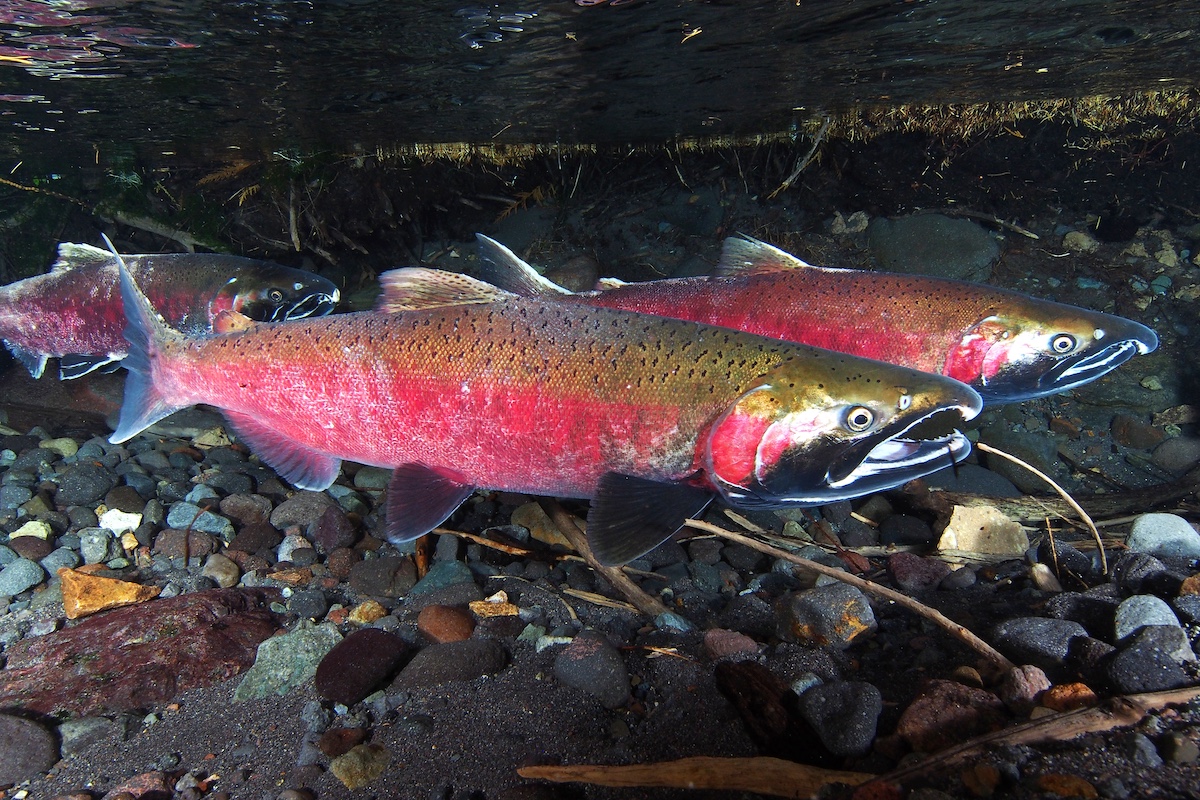

Coho salmon. Photo by Roger Tabor, USFWS.
Many people are surprised to learn that Lake Michigan has a thriving fishery of Pacific salmon. Lake Michigan, after all, is thousands of miles away from the Pacific Ocean, and while these fish are famous for their migrations, there is no direct connection from the largest ocean in the world to the largest freshwater system in the Americas. The introduction and life cycles of coho and chinook salmon have been discussed in articles previously published in OutdoorIllinois Journal (OutdoorIllinois Journal: The Fascinating Journey of Coho Salmon in the Great Lakes and OutdoorIllinois Journal: Hail to The King). These fish now reproduce naturally in streams that feed into Lake Michigan, but support from hatchery reared fish is still necessary to maintain these populations.
Because multiple states have claim to different parts of Lake Michigan, stocking numbers are determined by the Great Lakes Fishery Commission, a multinational commission formed in 1954 to control invasive species, advance science and help agencies collaborate across jurisdictional lines. Illinois, with claim to approximately 7 percent of the total lake area of Lake Michigan, is part of the Lake Michigan Committee, which is comprised of representatives from the Chippewa-Ottawa Resource Authority and four state Departments of Natural Resources (DNR): Illinois, Indiana, Michigan and Wisconsin.
This committee reports on the status of various fish populations in Lake Michigan and advises agencies on stocking plans. Stocking recommendations get adjusted based on, among other things, the availability of prey for these highly predatory salmon. The commission does not have direct authority over state stocking decisions, so these stocking plans are officially interpreted as recommendations. The Lake Michigan Committee members do include the fish biologists who are part of making the final stocking decisions in each state, so the state agencies typically follow the plan recommended by the Great Lakes Fishery Commission.
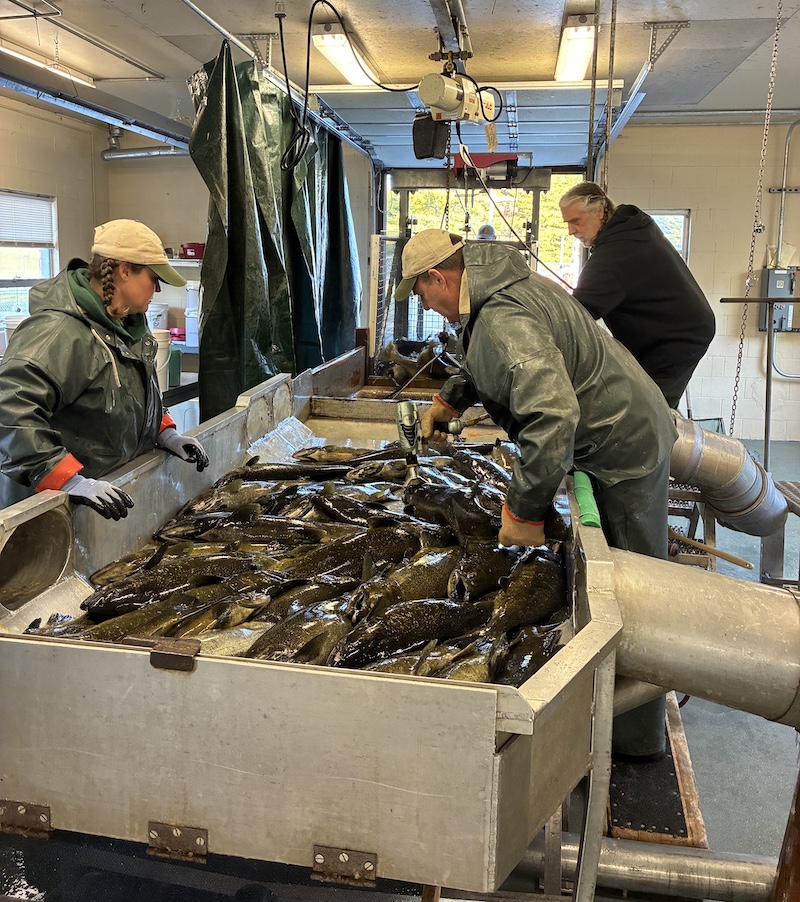
Not every state surrounding Lake Michigan has rivers that salmon return to for spawning. Illinois is one such state. Our largest rivers flow outward from Lake Michigan, with salmon hardwired to swim upstream. Michigan and Wisconsin have many rivers that provide spawning grounds to salmon, and those states have built collection facilities on these rivers to gather some of these salmon each year to rear their eggs in hatcheries.
Each fall, a group of Illinois Department of Natural Resources hatchery employees travel to Michigan or to Wisconsin to collect and fertilize salmon eggs at fish collection facilities in those states. This year, they went to two different hatcheries in Michigan to collect chinook salmon eggs and coho salmon eggs.
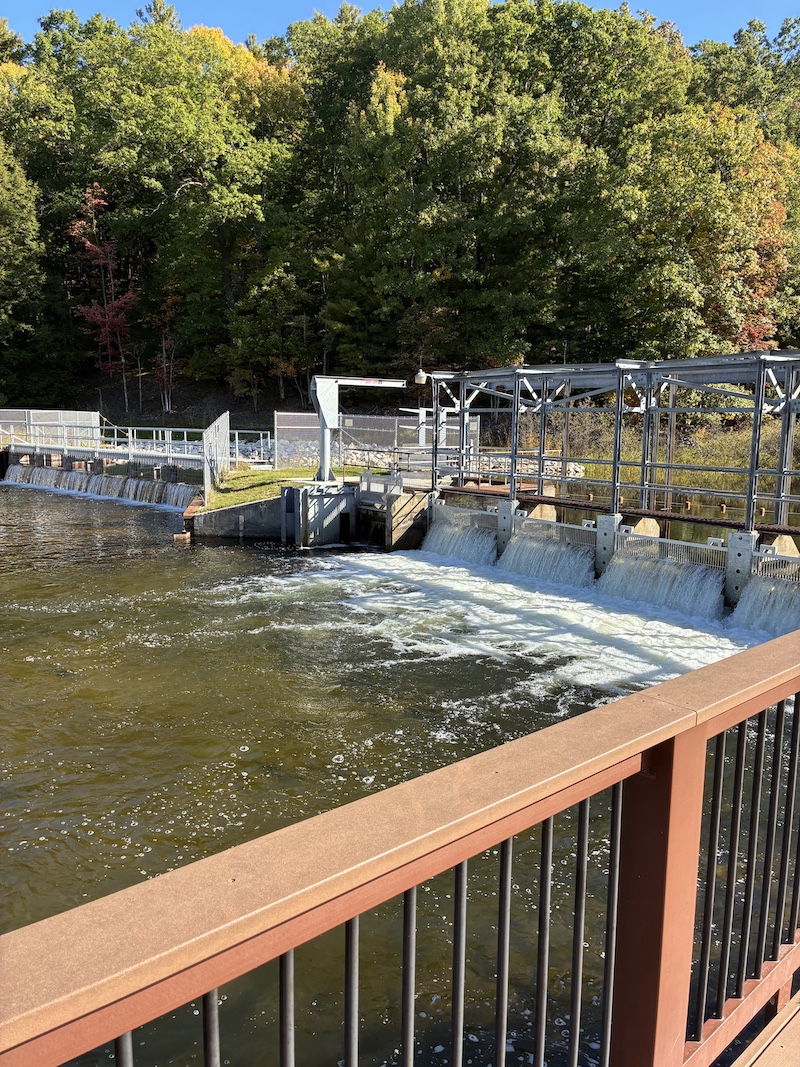
Chinook salmon are the kings of the salmon family. These fish are collected in multiple places in Michigan, but our Illinois folks usually meet up with Michigan DNR at the Little Manistee River Weir. In mid-October, Jake Wolf Memorial Fish Hatchery staff wake up in Manistee, Michigan to start working at the weir at 6 in the morning. Chinook salmon are large fish, with each female producing several thousand eggs, so collecting enough eggs can make for a shorter day than with other species.
Salmon are semelparous organisms, meaning that they only reproduce once in their lifetime. A salmon that commences its upstream trip to spawning grounds has also begun to die. They stop eating, and after wild spawning, typically die due to a combination of stress, immune failure and tissue damage.
The salmon harvest facilities approach the end of a salmon’s life differently. Rather than forcing the fish to die from stress and starvation, they are humanely euthanized. Eggs are expelled from the female salmon using air pressure, and sperm is manually stripped from the males. The eggs and sperm are mixed and then the freshly fertilized eggs are loaded into insulated buckets for the trip to Illinois.
All the eggs that Illinois needs to meet their stocking plan are often collected before noon, but the drive back to Jake Wolf Memorial Fish Hatchery takes several hours. Once at the central Illinois hatchery, the eggs are unloaded into incubation trays and soaked in an iodine solution for 15 minutes to reduce the risk of fungal or bacterial infection. They are then moved to the incubation room where they will remain for two months.
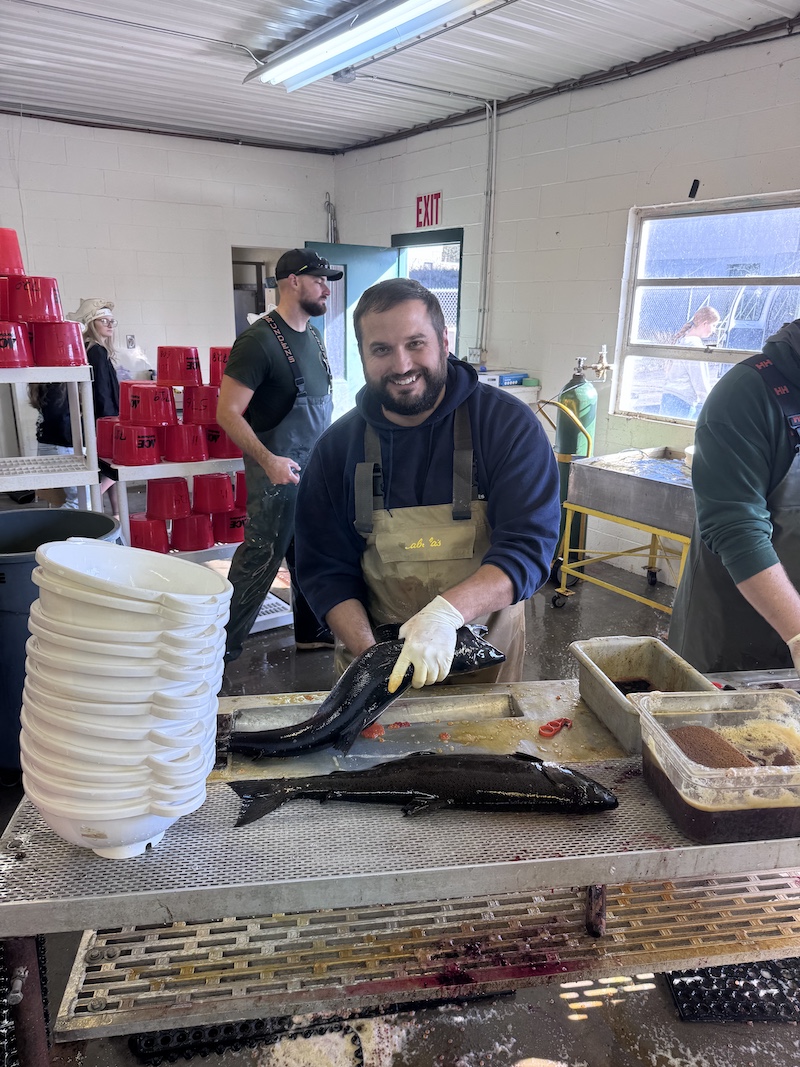
A similar process occurs for the coho salmon a week after the chinook eggs are collected, only this time, hatchery staff work at the Platte River State Fish Hatchery & Weir in Beulah, Michigan.
Coho salmon are smaller than chinook salmon, females produce a couple thousand eggs on average. Illinois stocks more coho salmon than chinook salmon and a lot of eggs are collected from a lot of fish. Coho eggs must be collected manually, without the assistance of air pressure, so extraction takes more time. The day starts at 6 in the morning (Eastern time). By the time hatchery staff finish collecting and fertilizing eggs, drive back to Jake Wolf Memorial Fish Hatchery, unload and disinfect the eggs, then load them in the incubation room, it is well after 2 in the morning (Central time).
When asked about it, one staff member said, “It’s a hard time, but a good time.”
At the time of publication, more than 1.5 million salmon eggs are being incubated at Jake Wolf Memorial Fish Hatchery in Topeka, IL: 1,020,000 coho salmon eggs, and 540,000 chinook salmon eggs. The eggs will hatch in late October and continue growing at the hatchery until they’re released into Lake Michigan in the spring.
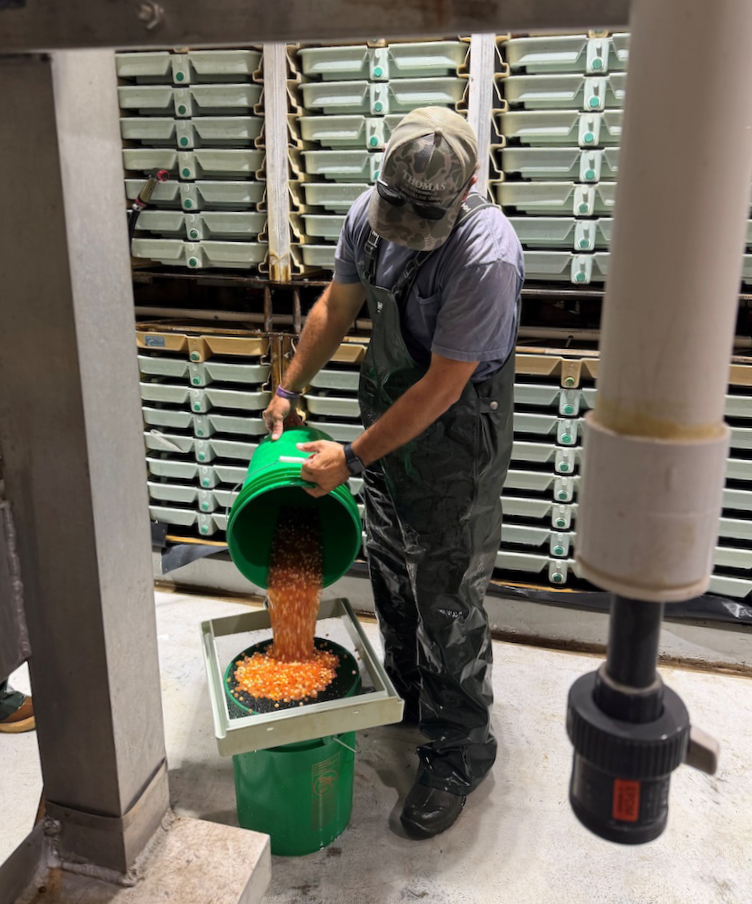
Wild salmon eggs do occur in streams in Michigan and Wisconsin. In the wild, less than 1 percent of those eggs will survive. In the hatcheries, with a steady supply of oxygenated water, safety from predators and disease, and regular feeding after hatching, it’s reasonable to expect about 50 percent of the chinook salmon eggs and anywhere from 30 to 50 percent of the coho salmon eggs to make it to the smolt stage. This is a developmentally appropriate time for those young fish to migrate open water, and that’s when most hatcheries will stock their fish into Lake Michigan.
If you want to see these fish before they’re stocked, call the hatchery (309/968 –7531; open daily from 8:30 a.m. to 3:30 p.m.) to arrange a tour of the work happening there. If you want to see them after they’re stocked, you’ll need a fishing license and a salmon stamp to do that. The fees from those fishing licenses and stamps directly fund this work, which couldn’t be done without continued support from anglers right here in Illinois.
Kayleigh Smith is a Natural Resources Coordinator in the Division of Fisheries, working as the site interpreter at Jake Wolf Memorial Fish Hatchery. While she works full-time at a fish hatchery that is focused on raising sportfish such as salmon, bass, and pike, she has a passion for fish of all shapes and sizes, from the biggest and fiercest muskie to the tiniest minnow.





Submit a question for the author