
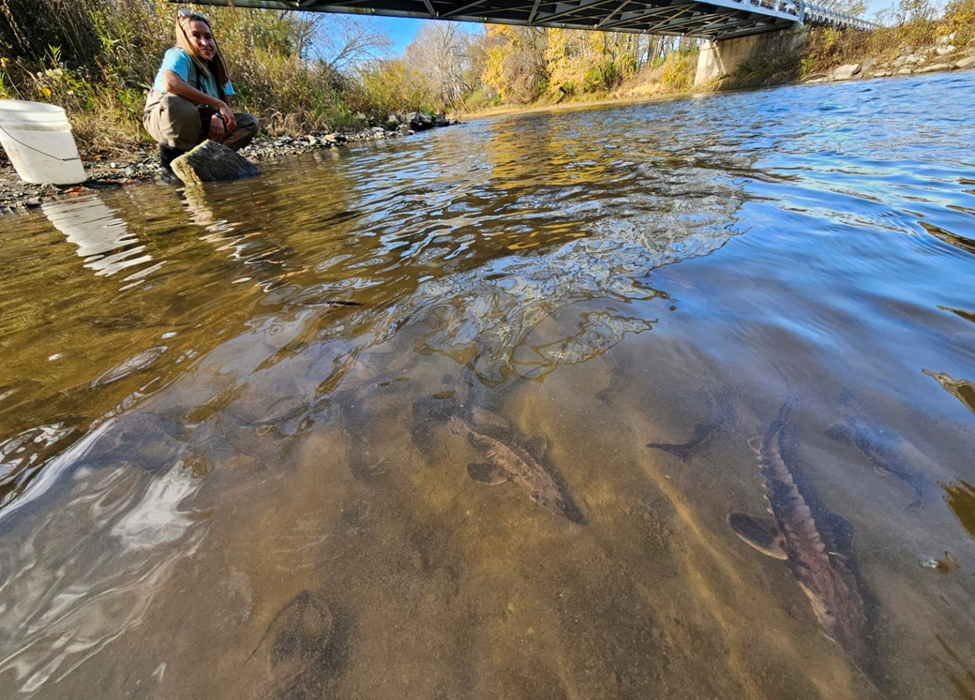
(From left to right) Jeremiah Haas, Jane Leonatti of Constellation and Nerissa McClelland, of the IDNR, with lake sturgeon being stocked at Starved Rock State Park as part of IDNR Lake Sturgeon recovery program. Photo by Rob Hilsabeck.

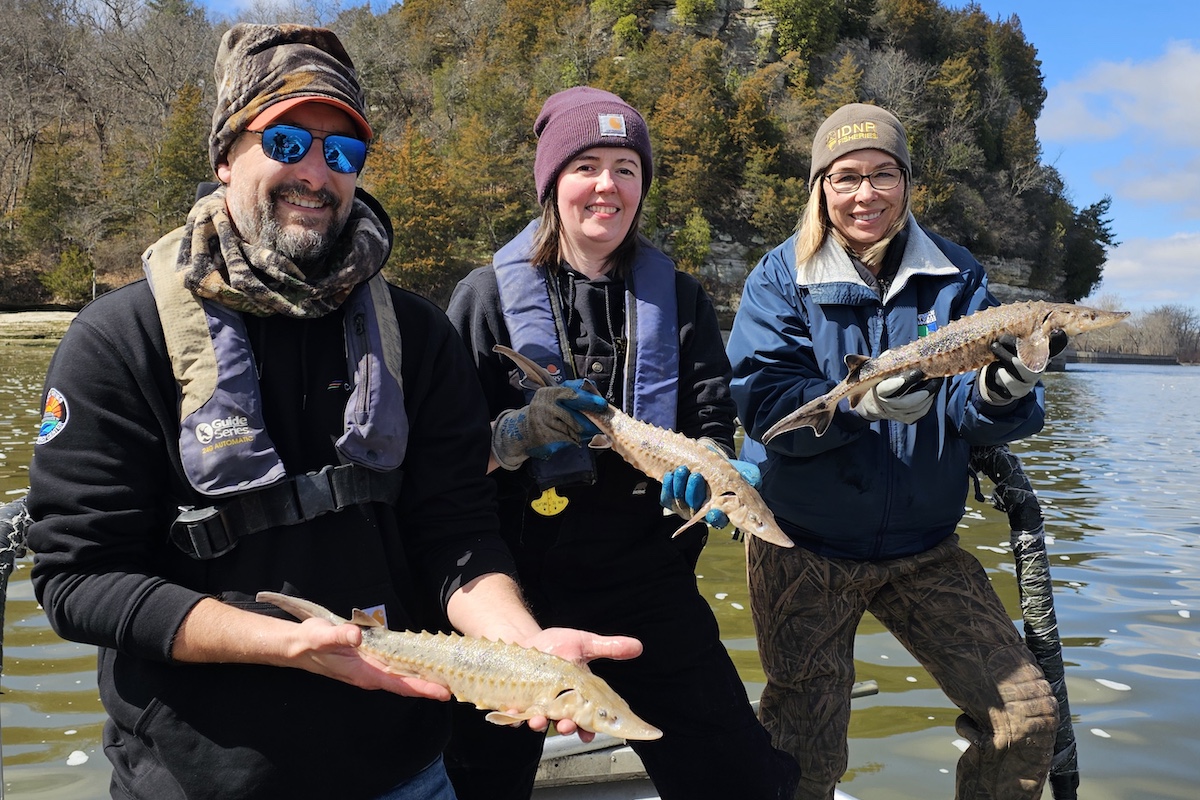
(From left to right) Jeremiah Haas, Jane Leonatti of Constellation and Nerissa McClelland, of the IDNR, with lake sturgeon being stocked at Starved Rock State Park as part of IDNR Lake Sturgeon recovery program. Photo by Rob Hilsabeck.
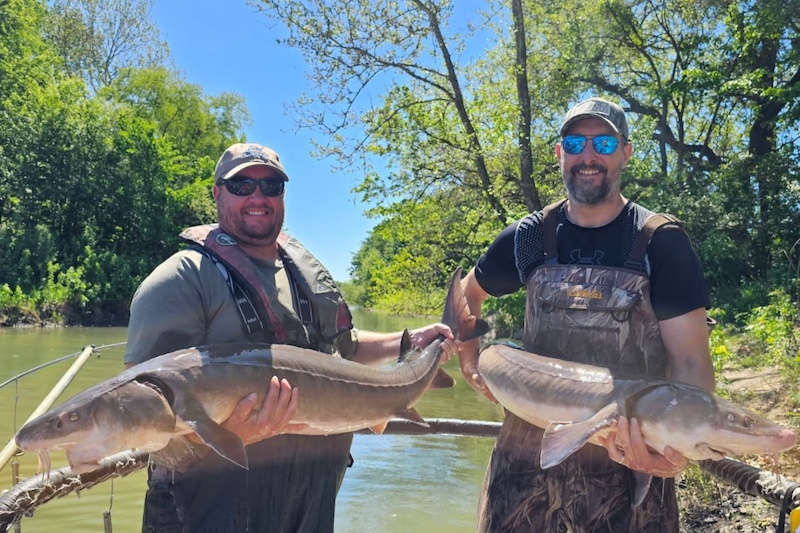
“It was like hauling in a dump truck from the bottom of the river,” wrote Jeremiah Haas, the Principal Aquatic Biologist at the Quad Cities Energy Center’s nuclear plant. “It towed me around for probably 10 minutes.”
Out to catch walleye on the Mississippi River, Haas had not expected to tangle with one of the largest fish in North America, the (somewhat confusingly named) lake sturgeon. Lake sturgeon are not, in fact, limited to lakes, and they are the largest of three sturgeon species found in the Upper Mississippi River, with the others being the shovelnose sturgeon and the pallid sturgeon. Once common in Illinois, lake sturgeon declined dramatically in the early 20th century due to human pressures such as dams, overfishing and habitat destruction. Today they are protected as a state endangered species.
Now, thanks to a cross-state effort, lake sturgeon are on their way back into Illinois waters with the goal of restoring self-sustaining, naturally reproducing lake sturgeon populations in Illinois waters. And in doing so, that will achieve the long-term goal of removing the species from the state endangered list.
That’s good news for anglers and conservationists, but lake sturgeon take up to 27 years to mature, with females spawning only every 4 to 7 years. Giving sturegon a real fin-hold in the state will take decades. Enter the Illinois Department of Natural Resources (IDNR) and the new Lake Sturgeon Recovery Program along with one of its powerful partners, the Quad Cities nuclear power plant that looms above the banks of the Mississippi River with a fish hatchery nestled just outside the razor wire.
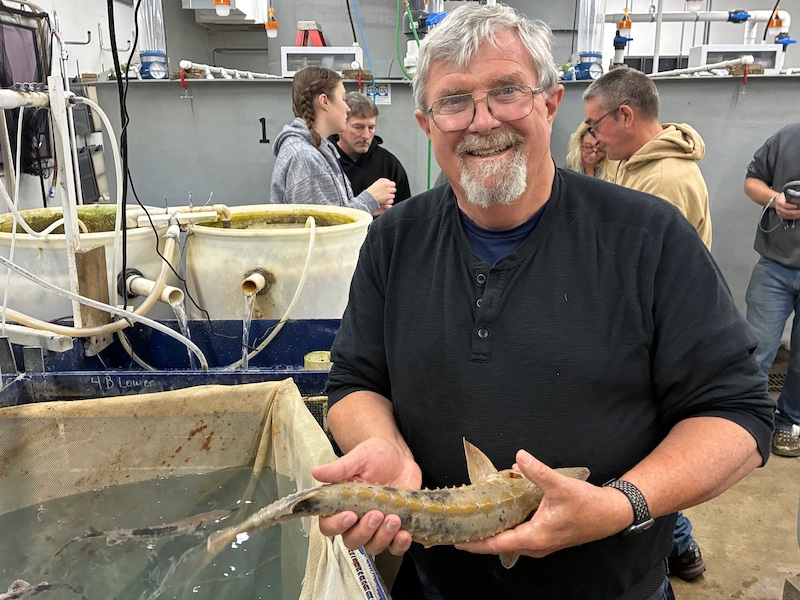
At the Quad Cities plant (officially called the Quad Cities Clean Energy Center) the fish hatchery has been operating since 1984. It was previously located within the grounds of the power plant facility. Then, the September 11th attacks brought increased security around energy infrastructure, and the fisheries buildings were moved outside.
“We can have school groups coming,” Haas said. “Iowa Department of Natural Resources staff do a ton of walleye work with us, so they’re here all the time in the spring. It has really opened us up to be a facility for the public. I talk to 500-1,000 people a year.”
Visitors this past year got to see something extra special, besides the usual walleye reared at the hatchery: baby lake sturgeon. The sturgeon are part of a cross-state collaboration. The Missouri Department of Conservation has been raising lake sturgeon since the 1980s, and over the last few years has shared their precious baby sturgeon with the IDNR for rearing and stocking into Illinois waters. Last fall, IDNR transferred 21 juvenile lake sturgeon to the Quad Cities plant that they had reared throughout the summer at the Jake Wolf Memorial Fish Hatchery in Manito.
“Other states have started to progress to the point where some adult lake sturgeon are attempting to spawn,” explained Nerissa McClelland, the IDNR Fisheries Biologist overseeing the Illinois River. “That has allowed them to collect enough to share.”
After leaving the Jake Wolf Memorial Fish Hatchery, the 8-inch juvenile sturgeon splashed into the pools of the Quad Cities nuclear plant’s hatchery. Haas, the aquatic biologist, along with hatchery manager Dr. David Bergerhouse, who is retired from Southern Illinois University, continue to raise walleye and have also recently raised alligator gar and freshwater mussels. Lake sturgeon were just another fresh challenge for the pair, who have a combined 65 years of experience at the hatchery.
Lake sturgeon, typically raised on a diet of bloodworms and brine shrimp, can be an expensive fish to raise. Often they are released at an 8-inch size, which makes them less vulnerable to predation by bass, birds or even the walleye stocked in the river from years before. However, the larger the fish at stocking, the higher the chances of survival. Haas and Dr. Bergerhouse tried something new.
Dr. Bergerhouse outlined the strategy: “We worked to get the sturgeon accepting a pellet of some sort that would cost less and provide more balanced nutrition. We ended up with 21 fish with an average of about 16 inches in length, and the biggest one about 2.2 pounds and 20 inches. This is a sturgeon that is going to survive out there.”
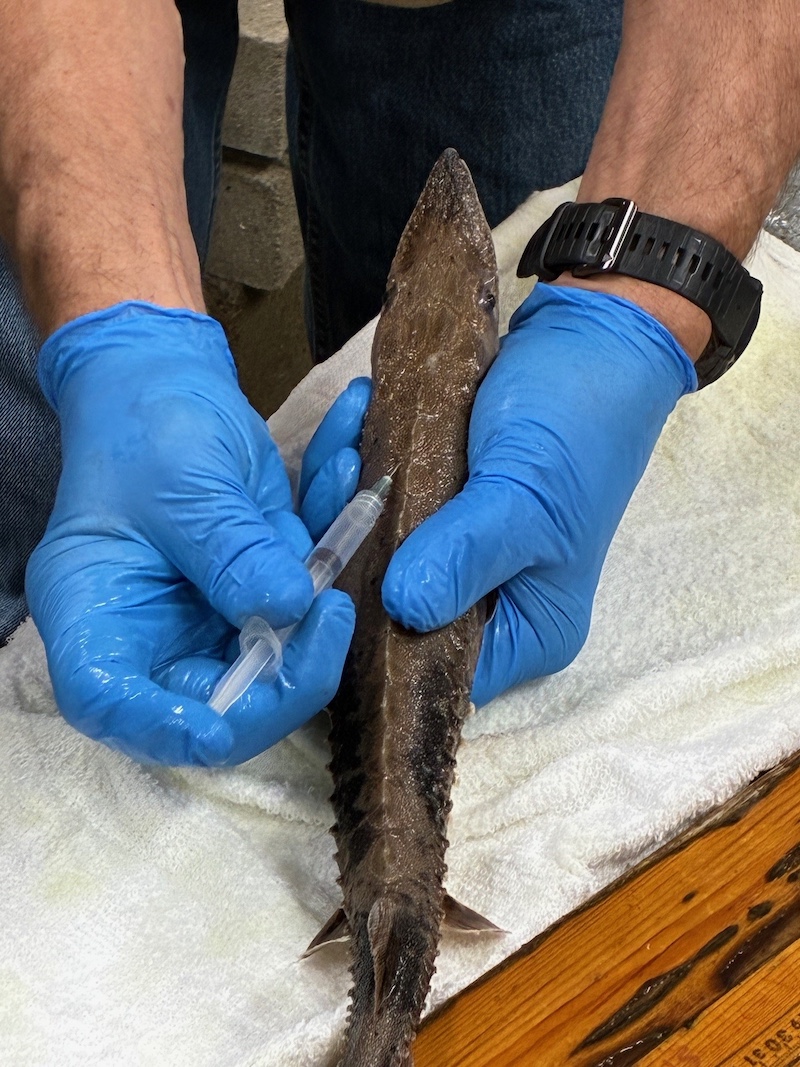
Those 21 hefty sturgeon were released earlier this spring, ready to take their place on the top tier of the food chain. Each sturgeon was also large enough to be fitted with passive internal barcode tags so they can be tracked over their potential hundred-year-plus lifespan. The trackers are similar to the ones given to pets, and just like a lost cat, a lake sturgeon hauled to the surface in 20 years can give scientists a record of where it’s been – and how much it has grown.
The staff at Quad Cities facility are rightfully proud of the fish they have raised and released. Caring for sturgeon, plus alligator gar, mussels, and around 200,000 walleye per year, the hatchery has made a real impact on Illinois waters. The future of the operation, though, is not guaranteed.
The Quad Cities fish hatchery, for all the benefit it brings to Illinois’ fisheries, has a murky undercurrent. Like many power plants, the Quad Cities nuclear plant sits on a river bank so it can more easily intake coolant water. Plentiful water is, of course, essential to the safe operation of the plant, but it carries a cost. Fish are easily caught in the huge intake pipes that run into the plant; the fish then smash against screens. Larger fish, such as walleye or sturgeon, are better equipped to escape the current. But Haas estimates that every year the power plant’s intake pipes kill anywhere from 200,000 to two million gizzard shad, a common fish in the herring family.
That cost is heavy. It is unclear if the stocking program – which emerged from calls to mitigate the damage – fully compensates for the fish lost each year. Sturgeon, walleye and gar are certainly coming out ahead in that equation. The river as a complete ecosystem? It’s harder to say.
A U.S. Environmental Protection Agency (EPA) rule from 2014 may have the final word on the matter. According to the Clean Water Act, facilities that use large amounts of water must use the best technology available to mitigate harm to aquatic wildlife. In 2014, the agency declared that better intake pipe technology was available. Moreover, they ruled that all existing and new facilities with huge intake pipes must make a plan to overhaul their system, installing new screens and pipes that will steer those millions of fish clear of danger.
The 21 sturgeon raised by the Quad Cities hatchery will never read the fine print of the EPA ruling, but with hope they will still be swimming when changes come to how the plant operates, within the next five years or so. The question is: will a private utility company continue to fund the fish hatchery? With the implementation of new technology, it is possible that Constellation Energy will be off the hook for mitigating damage to fisheries.
In that case, it would be up to the public – the thousands of hatchery visitors, the state agencies, the anglers and fish enthusiasts – to advocate for a place that has raised millions of fish over the past 40-plus years.
Lake sturgeon are an ancient species, dating back 150 million years in the fossil record. They can live more than 100 years, grow over 8 feet long, and weigh more than 300 pounds. With their population in Illinois on the brink of a comeback, it will take a continued, concerted effort to bring them home for good.
“We’ll be long retired before there might be natural reproduction of lake sturgeon in Illinois,” McClelland, said. “Natural reproduction is the ultimate goal, to have them be able to sustain their populations, like they once did prior to the 1900s.”
Hugh Gabriel is a writer and occasional herpetologist who calls Minneapolis home. He’s a science communicator for the University of Minnesota, and uses video and print storytelling to bring critical research to the public eye. Gabriel has a special affinity for frogs, prairie flowers and a long day of fishing on a clear lake.






Submit a question for the author