
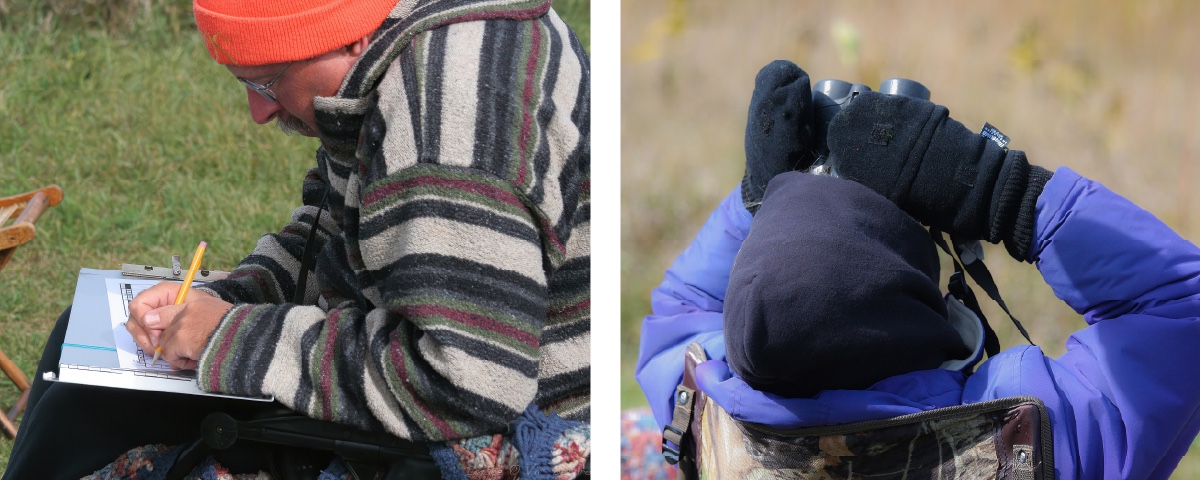
Hawk Watchers of Illinois Beach State Park conduct observations and record migrating raptors they see. Photo by Vic Berardi.

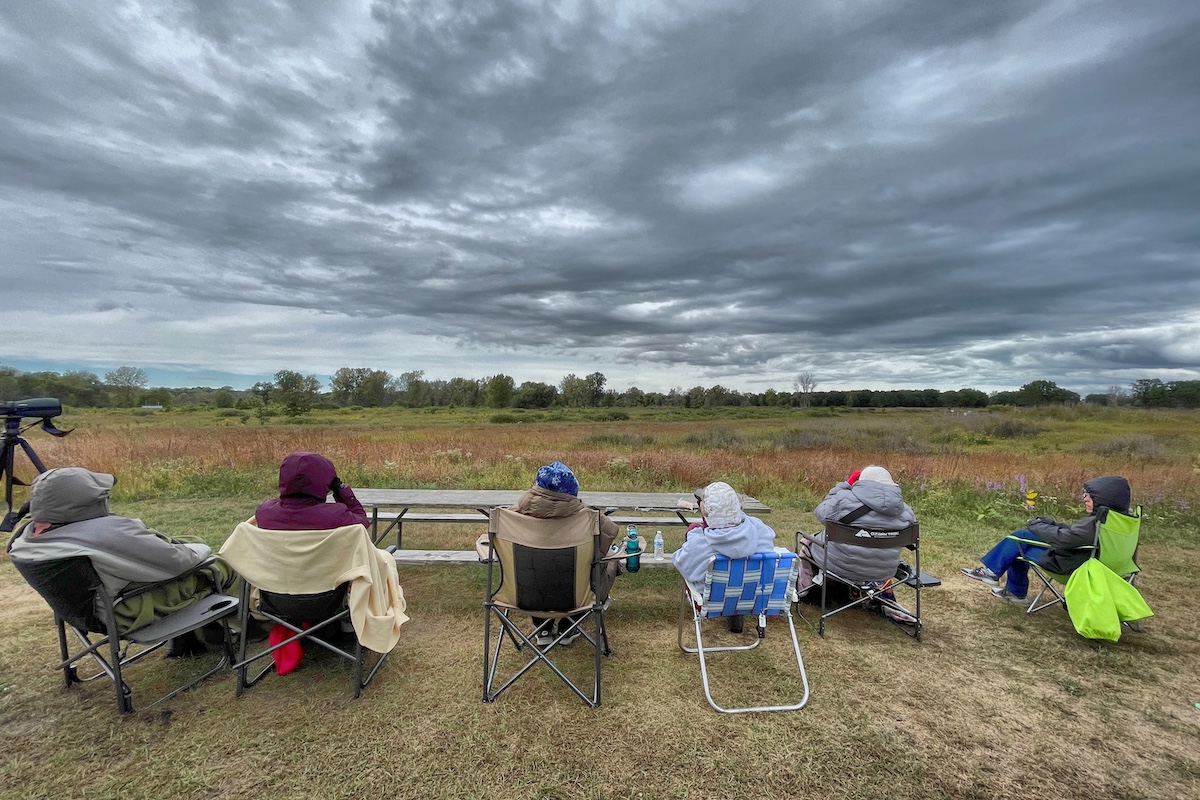
Hawk Watchers of Illinois Beach State Park conduct observations and record migrating raptors they see. Photo by Vic Berardi.
As we approach the end of the year, it’s an ideal time to celebrate some of the people who are taking care of our environment. In the portraits that follow, enjoy reading about a few of the everyday Illinoisans who are protecting our state’s natural resources.
On a chilly November morning, a group of volunteers convenes on a hill in northeast Illinois near the shore of Lake Michigan. Fitted with binoculars and clipboards, but also winter coats and blankets, the volunteers settle in and begin scanning the sky. They are the Hawk Watchers of Illinois Beach State Park (IBSP), and for at least four hours today they will identify and count the migrating raptors they see.
They will conduct these observations every day from August 25 through November 25. Over those 93 days and 600+ hours they will record an average of 5,100 raptors as the birds migrate to their wintering grounds. The data they collect will be shared with the Hawk Migration Association and the Raptor Population Index whose archives are utilized by avian researchers and bird experts all over the world.
This year, the IBSP Hawk Watchers, an all-volunteer group, have been counting raptors on this hilltop for more than 27 years.
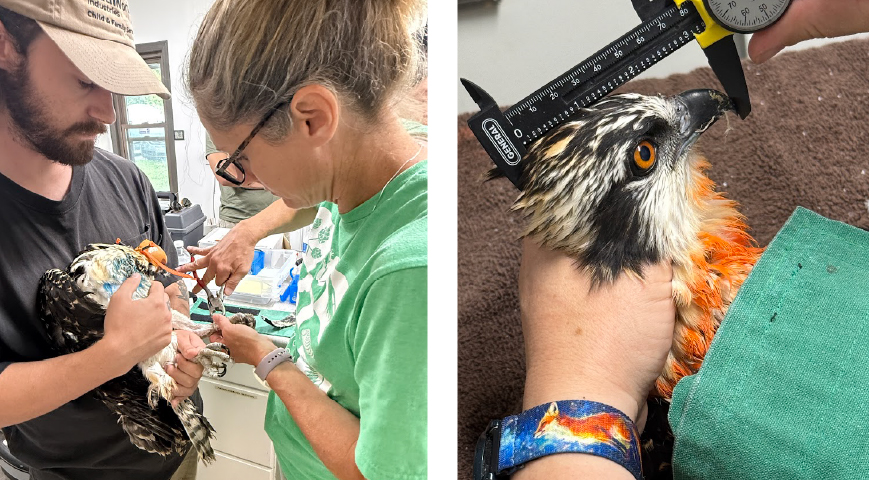
At a wildlife rehabilitation center near Decatur, a dozen agency and university scientists are screening 12 osprey chicks. The young birds have been flown to Illinois from a wildlife sanctuary in Massachusetts and are the newest participants in a project to restore the breeding population of ospreys in Illinois.
At the center, the team will conduct health assessments of the chicks and will attach identifying leg bands before field technicians transport them to their new locations along select Illinois waterways. There the technicians will monitor the chicks daily, all summer, as the young birds learn to fly and hunt.
In the fall, the chicks will migrate, but that won’t be the end of their story. In three to four years, when the ospreys reach maturity, the scientists will watch for their return to Illinois in anticipation that they may bring a mate and raise a family – the outcome the project is designed to accomplish.
Now in its 14th year, the state’s osprey recovery project has yielded promising results. The number of osprey breeding pairs has increased from 16 to 90, and ospreys have been downlisted in Illinois from endangered to threatened.
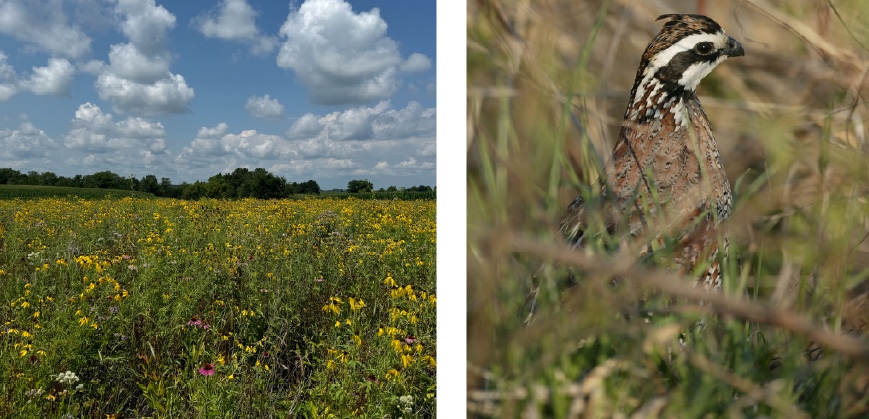
In rural McDonough County, the bobwhite quail transformed a farmer.
Specifically, the absence of the bobwhite quail raised concerns for this conscientious west-central Illinois landowner. Once an abundant grassland game bird in the region, quail were becoming increasingly more difficult for him to find on his property.
Concerned by their flagging numbers, he knew he needed to do something to help the quail. So he reduced his mowing and adjusted its timing to avoid the quails’ nesting season. At the same time, he converted some of his less productive field edges into prairies. In the process, native grasses and forbs emerged offering the quail more cover and a better place to forage.
He knew he was on the right track when he noticed more wildlife and pollinators on his restored acres. Best of all, grassland birds started showing up, including the quail. Where previously he had seen only three or four quail during the entire year, he counted over a dozen during his last harvest season. This fall, he looks forward to seeing even more quail as they flush ahead of his combine.
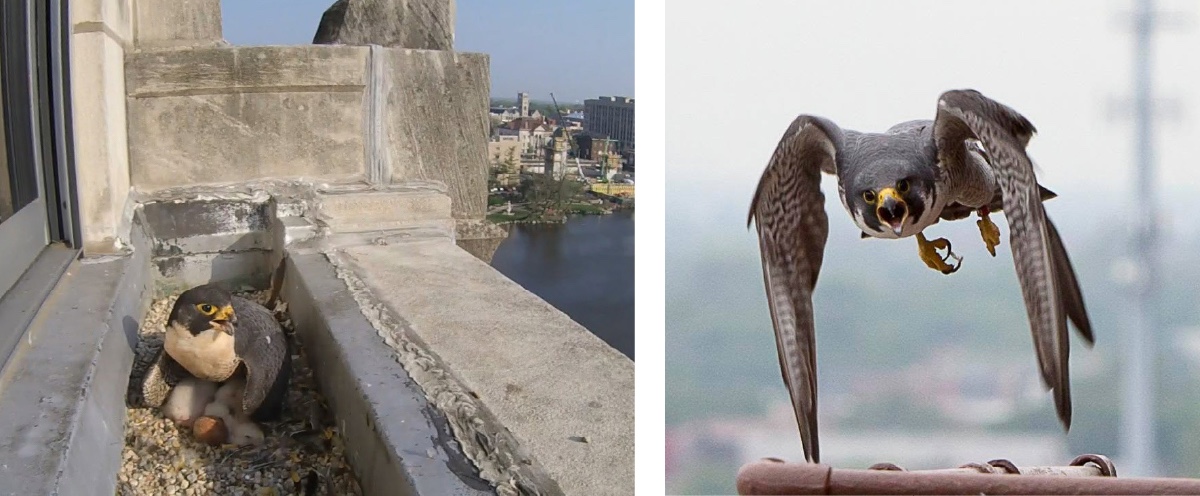
On a skyscraper roof in downtown Chicago, a small band of volunteers with The Field Museum’s Chicago Peregrine Program is armed with inverted brooms. When you’re banding a peregrine falcon chick in its nest, you don’t want to be the object of one of its parents’ bullet-speed, talons-first strikes, so you carry a broom, with bristles up, to discourage aerial assaults.
This crew’s work site travels between several tall buildings in downtown Chicago where peregrines have decided a skyscraper is as good as a cliff when it comes to raising a family on a ledge. They know that any tall structure will work when you need the high ground for defending your brood and attacking your prey.
When the Chicago Peregrine Program started in 1986, the birds were an endangered species in Illinois. But thanks to reintroduction programs that helped restore the population and monitoring initiatives that tracked nesting pairs, peregrines are rebounding throughout the state under the watchful eye of this group.
In 2014, peregrines were removed from the endangered species list in Illinois, and today about 30 breeding pairs of peregrines can be found in the state.
In these stories, we are grateful that Illinoisans are doing remarkable things for nature. They’re providing data to global researchers, creating habitat for wildlife and returning nesting birds to our state.
Yet these individuals represent only a fraction of the people – volunteers and professionals alike – who are rolling up their sleeves to care for and protect our state’s vital natural resources. Even when the conditions may be trying and the outcomes may be distant, their dedication never falters.
During an era of environmental challenges on a global scale, we commend the people who are writing a different story in Illinois. Through their actions, we see the evidence that restoring nature is not some distant dream. It’s within our reach.
Carla Rich Montez is an outdoor writer living in Peoria County. She is a regular contributor to OutdoorIllinois Journal.





Submit a question for the author