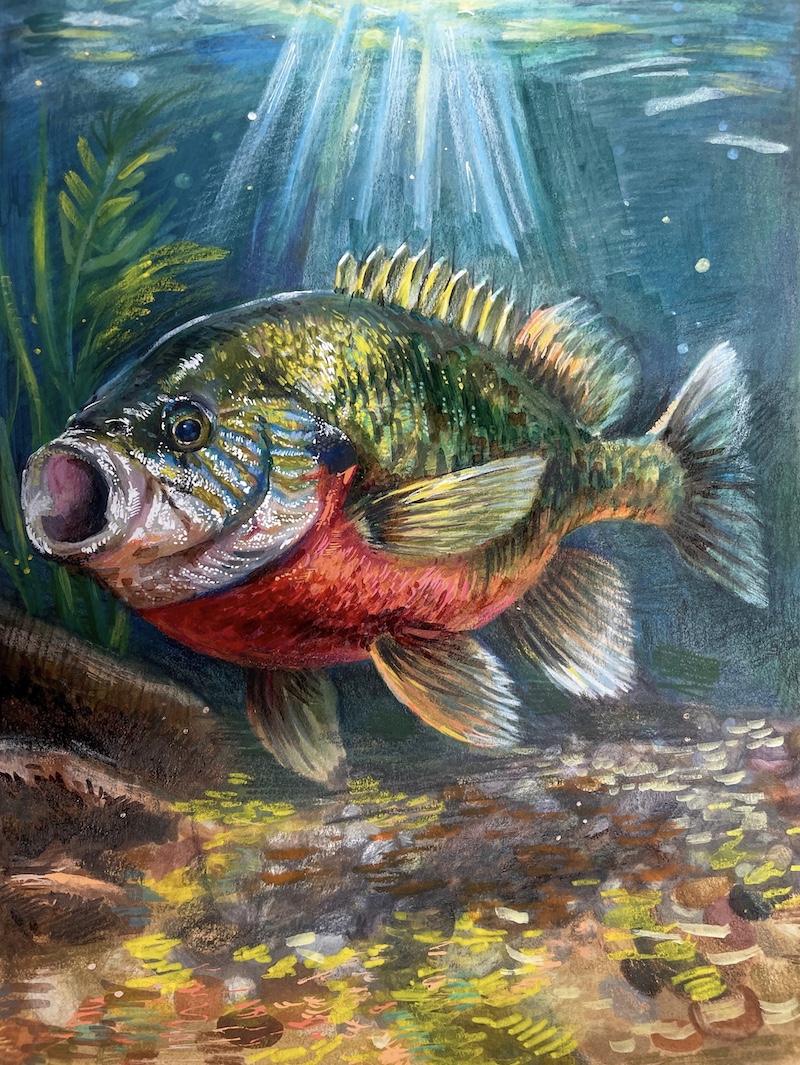
High-schooler Jaewoo Park painted this largemouth bass portrait, winning the Illinois state competition, and placing third in the international competition. Photo courtesy of Jaewoo Park.

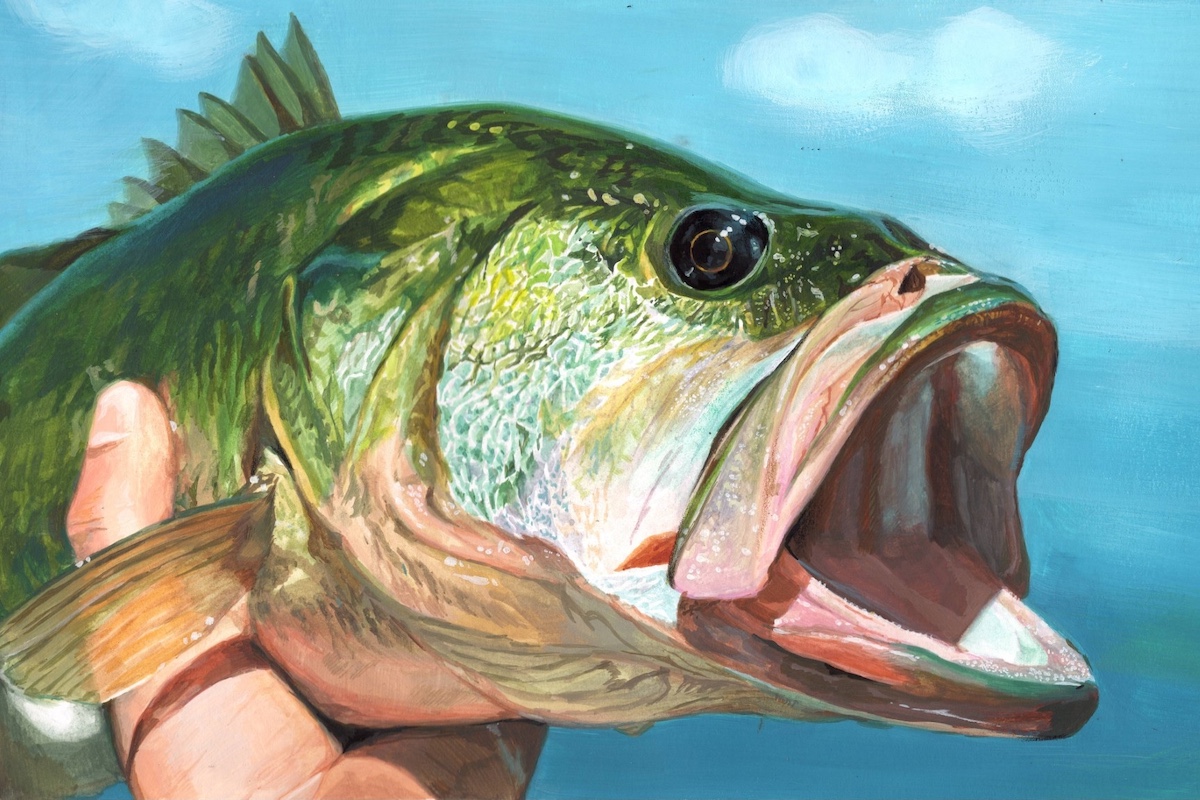
High-schooler Jaewoo Park painted this largemouth bass portrait, winning the Illinois state competition, and placing third in the international competition. Photo courtesy of Jaewoo Park.
Jenny Vaughn, executive director of the Illinois Conservation Foundation (ICF), has a singular mission: “turning screentime into greentime.” Beyond the catchy tagline, getting Illinois youth off the couch and engaged with nature takes an enormous effort – the ICF has more than a dozen different programs — and a little bit of creativity.
That creative spark led Vaughn to Wildlife Forever’s annual fish art contest three years ago. As a partner on the state level, the ICF helps promote fish artwork amongst Illinois youth, and they get to convene a panel of judges and hand out prizes for state winners. Those prizes are usually fish themed: bobbers, fish pins, educational trading cards or exclusive T-shirts; not to mention that state winners are forwarded on to the international contest, administered by conservation nonprofit Wildlife Forever.
In the three years that the ICF has served as a state partner, they have already produced an international podium finish. In 2025, high school student Jaewoo Park painted a realer-than-life largemouth bass, its protective slimy coating shimmering in the sun, its mouth hinged wide open. Park’s artwork won the state contest and went on to take third place at the national level, beating out thousands of other submissions.
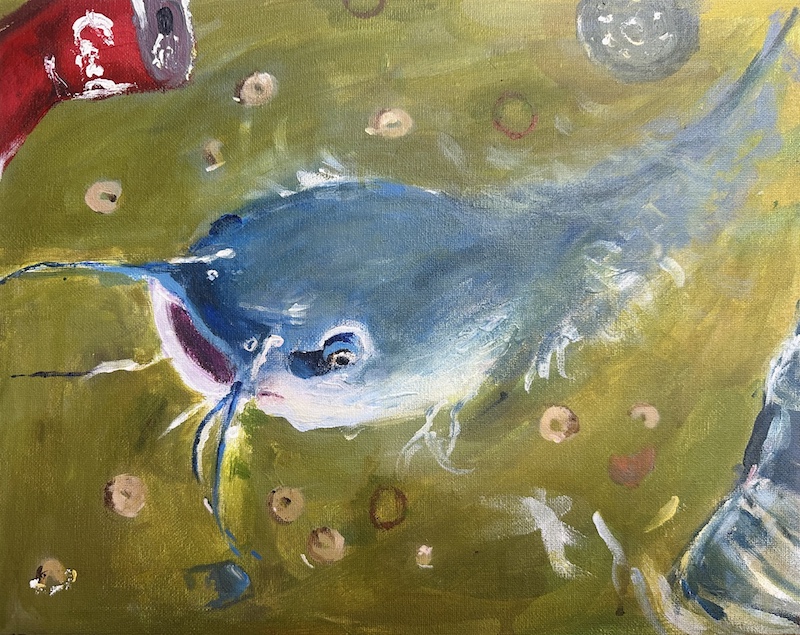
“We like to have a focus on Illinois native fish,” Vaughn emphasized. “[Native fish] aren’t the tropical fish that everybody thinks of, but there’s a lot of Illinois fish out there that are very interesting and beautiful to see.”
Vaughn recalled a poem, submitted for the written portion of the contest, that touched her heart: “[The poet] connected a bottom-dwelling fish to her anxiety, and her emotions in that moment, and it was really lovely to read.”
While 2027 will mark the third year of ICF’s involvement with the contest, Wildlife Forever has been judging fish artwork from around the world since 1997. In 2021, the nonprofit, which also promotes prairie restoration and battles invasive species, added a bird art contest. In a phone conversation, Art of Conservation Program Manager Mandy Nix was overflowing with enthusiasm for the fish art and bird art contests.
“The power of this program is not only that we’re giving voice to wildlife, but we’re also giving voice to the young artists who are quickly becoming the new generation of change-makers,” Nix stated. “Also it’s just really cool and exciting because these kids are immensely talented.”
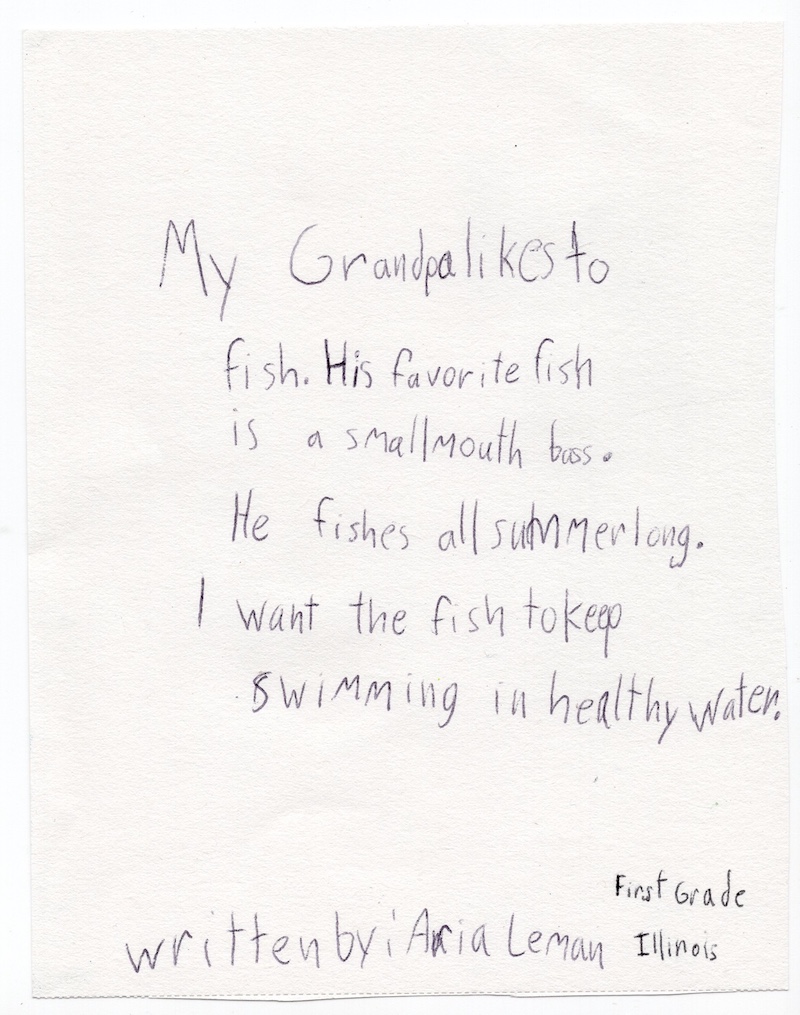
A team of judges selected by Wildlife Forever administer the national contest, but they rely heavily on 17 state partners. Those partners, like the ICF in Illinois, spread the word about the contest, award local prizes and provide a sounding board for ideas on how to make the contest more meaningful for students. Students from states without a state sponsor may still submit to the national contest. Over the years, states have customized their contests, sometimes adding rules about the kinds of fish that can be submitted. At the national level, there is now a Great Lakes fish award and a shark award, giving opportunities for more students to specialize in the fish that inspire them the most.
For Nix, art and conservation have always been intertwined. She recalled heading into the woods as a child to flip rocks and sketch the world around her, finding places of refuge and connection. Bringing that experience to an international audience seems like a natural fit for her.
Nix stated: “The art of conservation is really about the art of care and connection. It is a pathway for students to slow down amidst the hubbub and the hullabaloo of everyday life to more creatively connect with the natural world, and to begin to ask the questions that can only happen when you take a breath and pull out a pen or a pencil or a paintbrush.”
Both Vaughn and Nix mentioned that teacher participation is key to the success of the contest, with many teachers including submission to the contest in their yearly curriculum.
In Northbrook, a northwestern suburb of Chicago, educator and art studio owner Soyoung S. Park has participated in the fish art contest for almost 15 years, predating the involvement of the ICF. Park participates as a way to introduce children living in a more urban environment to animals they may not observe otherwise.
“I thought it was a good thing to study, to protect nature, to understand the ecosystem where I live,” Park wrote over email. “There is a lot to learn not only from the point of view of the children themselves but also for the teacher.”
Students across the state, from kindergarten through 12th grade are encouraged to submit artwork to the 2027 fish art contest, with submissions open online until February 28. Artwork, especially pieces that are multi-dimensional, maybe mailed as well. A full list of guidelines can be found on the ICF website, and potential participants should note that submissions at the state level must portray a species of fish that lives in Illinois waters. Prizes are on the line, as is the potential for state and national recognition, a big deal for young artists who may go on to creative careers. Even more importantly, the fish art contest gives teachers and students a chance to learn more about fish, and to see and paint them in a new light.
Hugh Gabriel is a writer and occasional herpetologist who calls Minneapolis home. He’s a science communicator for the University of Minnesota, and uses video and print storytelling to bring critical research to the public eye. Gabriel has a special affinity for frogs, prairie flowers and a long day of fishing on a clear lake.




Submit a question for the author