
Fish cover structures on the frozen Le-Aqua-Na Lake. All photos by Brennan Caputo.

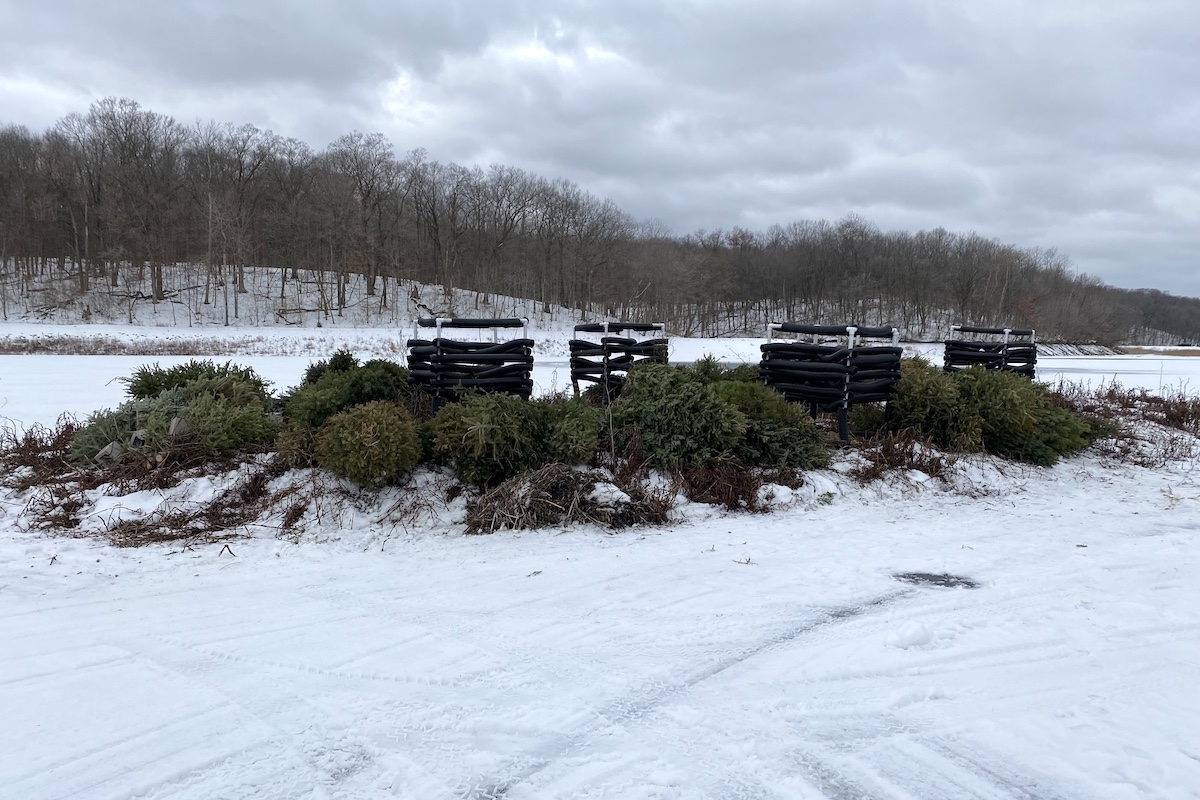
Fish cover structures on the frozen Le-Aqua-Na Lake. All photos by Brennan Caputo.
With the holidays quickly approaching many people are thinking about their holiday decorations, including purchasing a Christmas tree. If your preference is a live tree, consider donating it to an organization accepting trees as an environmentally friendly way to enhance aquatic habitats.
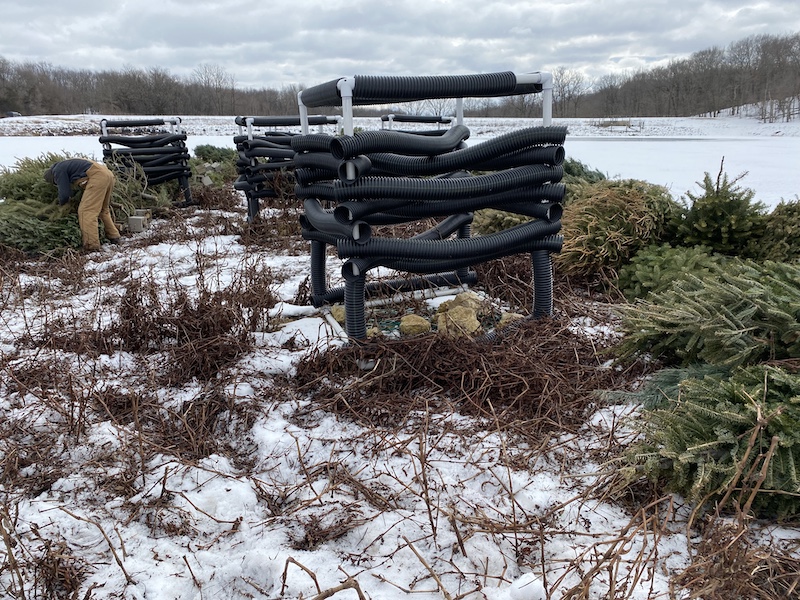
Fish attractors come in a variety of shapes and styles. Natural materials, such as evergreen trees submerged in key locations after the holiday season, are often used to create these structures. Fallen trees, rock piles and heaps of brush also are utilized. Artificial structures, such as industrial PVC and corrugated pipes, are used in some situations.
Underwater structures provide shelter where fish can hide from predators and escape direct exposure to sunlight. These features also create habitats where a variety of organisms can nest and spawn, and a place where many organisms can find food.
As a scuba diver, I can personally attest to what’s taking place on structures composed of former holiday decor. I’ve spent considerable time hovering outside a nearly 20-foot-tall artificial structure, watching foot-long black crappies hang within the recesses of the branches. This fish quickly earned its place as my favorite freshwater fish with its silver color and black or green speckles reminding me of shiny ornaments on a Christmas tree.
But crappie were not alone inside that structure. Sunfish usually hung out near the surface, basking in the warmer water and ready to dart within the upper branches should a predator swim past. I also frequently found trophy-sized bass there, most typically in the coolest waters near the bottom of the lake.
Fish are not the only organisms to benefit from those Christmas tree structures.
“Real trees provide cover for small fish and places for growth of algae that is fed on by aquatic insects,” explained Mike McClelland, Illinois Department of Natural Resources (IDNR) Chief of the Division of Fisheries. “And ultimately, those food sources attract larger fish that can be caught by anglers.”

At this time of the year many organizations, such as local lake associations, friends groups and the IDNR, are organizing conifer donation efforts. In private waters local managers often put a call out announcing the times, dates and locations where trees will be collected. Quite often those organizations also are looking for volunteers to assist in preparing these valuable fish concentrators with anchors and dragging them out on the ice. IDNR also organizes collections for use on state waters, but know that it is illegal for an individual to place any structure in public waters.
To preserve the integrity of the water body and protect the health of aquatic organisms, the only holiday decor accepted for the IDNR program are evergreen trees cut for the season. All such trees must be free of stands, lights, ornaments and tinsel to qualify for donation.
IDNR District Fisheries Biologists and Office of Land Management personnel bundle together collected trees, attach non-toxic weights and transport the bundles to sites around targeted lakes.
“These trees will naturally decompose and need to be replenished every few years,” McClelland continued. “If you miss out on donating your evergreen tree this year, watch for press releases in subsequent years and take note of the sites in your area where tree collections typically occur.”
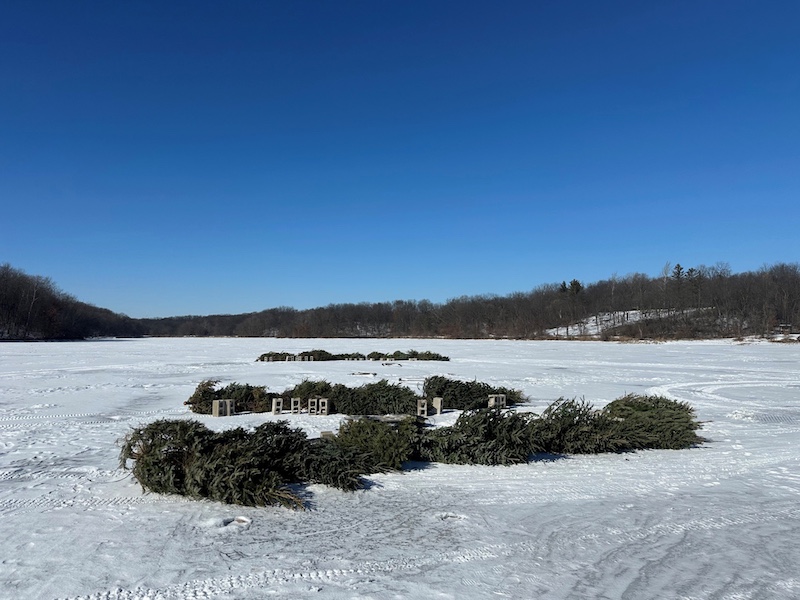
Don’t take it upon yourself to dump trees in IDNR water bodies. Dumping materials—natural or artificial—in state-owned waterbodies is illegal and may earn you a fine from an IDNR Conservation Police Officer.
If you are interested in adding a fish attractor to a private water body, work with the lake manager to obtain permission and their input on how best to undertake such a project. Fish structures can be a navigation (boat) hazard if placed inappropriately or if a tether or anchor comes loose. Structures may lead to health or property damage if done improperly.
Yes, that’s part of the reason why fish attractors are added!
Anglers who are in-the-know about the placement of fish attractors will attest that they work but may not be willing to divulge the locations of prime fishing spots. Invest in a depth finder and you’ll be able to spot some likely structures underwater, either natural or placed specifically as fish attractors.
If you don’t have a fish finder, or considerable time to scan a large body of water, check out the Lakes and Reservoirs page on IFishIllinois.org for a listing of public fishing areas, including lists of fish present, site-specific fishing regulations and maps and coordinates of fish attractors. For instance, check out the brush pile information available for Rend Lake State Fish and Wildlife Area. By the way, many cell phones can act as a GPS locator and might be able to get you close to fish.
If you enjoy fishing, or value the chance to benefit the environment, make this the year your Christmas tree becomes habitat for fish and other aquatic organisms.
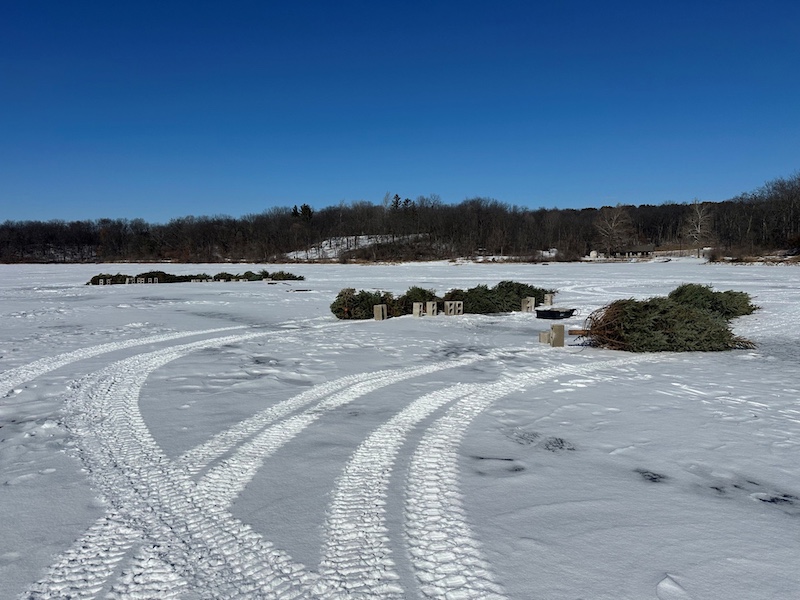
Read more about fish cover here.
Kathy Andrews Wright retired from the Illinois Department of Natural Resources where she was editor of OutdoorIllinois magazine. She is currently the editor of OutdoorIllinois Journal.





Submit a question for the author