
A northern long-eared bat is fitted with a temporary radio transmitter in 2024, with the hope of determining its roosting location. Photo by Sean Obrochta.

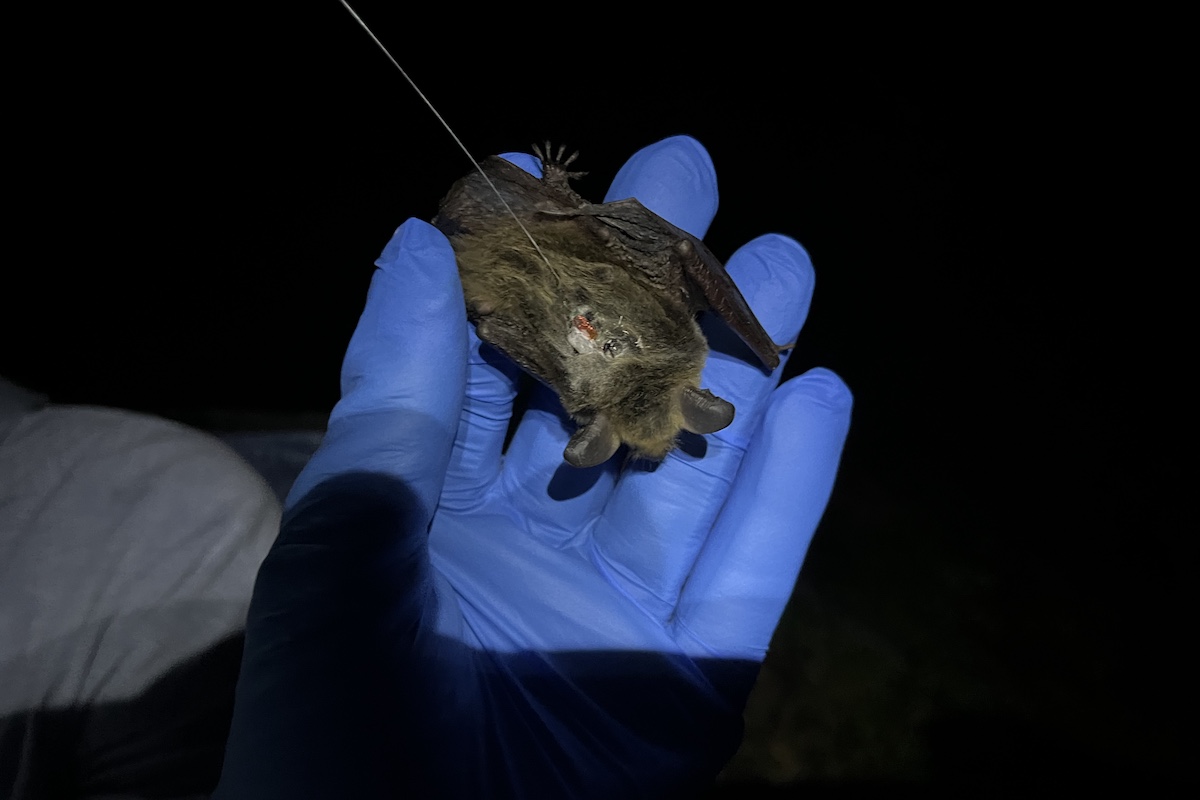
A northern long-eared bat is fitted with a temporary radio transmitter in 2024, with the hope of determining its roosting location. Photo by Sean Obrochta.
It’s a barn swallow – it’s a gargantuan moth – no it’s a bat! Flitting over fields, yards and tree-lined streets, bats are specialists of warm summer evenings across Illinois. Listening closely, you may even hear their faint cheeps and clicks, the lowest of which fall within the range of human hearing. Due to their nocturnal habits and rapid movement, bats are not easy to spot, let alone identify on a species level.
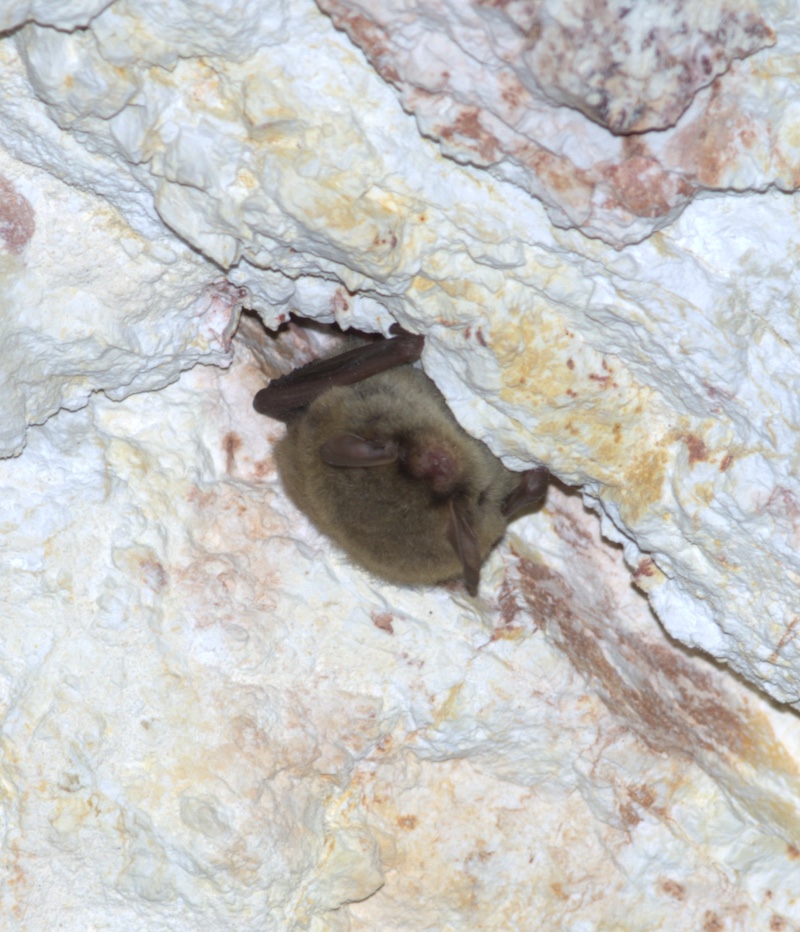
The effort to better identify bats has been 20-plus years in the making. After white-nose syndrome decimated bat populations in Illinois and across the country in the early to mid-2000s, bat scientists scrambled to save them; and to save a species, you have to know a species. Scientists use nets, ultrasonic recorders, GPS tags and follow wildlife handling protocols to document bats, including endangered species like the northern long-eared bat. Across Illinois, scientists with the University of Illinois, Illinois Department of Natural Resources, U. S. Fish & Wildlife Service and beyond work together with citizen scientists who care deeply about these tiny flying mammals.
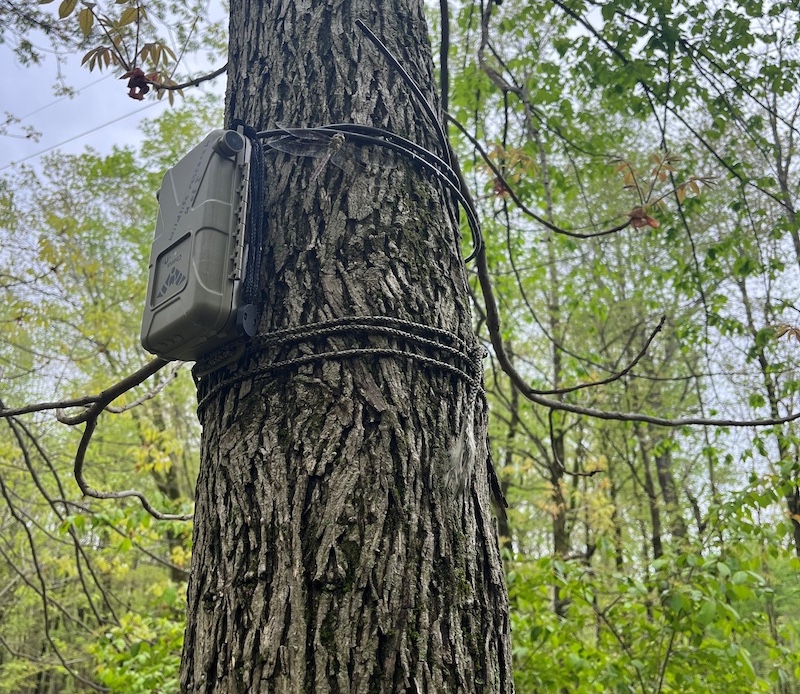
The simplest way to detect bats is to listen for their characteristic pips, blips and squeaks. Sean Obrochta, who earned a Master’s Degree from the University of Illinois in 2024 studying bat biology, made use of several gadgets while searching for bats. One of the most useful to his research was the Chorus Wildlife Recorder, which he set up on 40 different trees bordering streets around Champaign-Urbana. Around the size and shape of a trail camera, the wildlife recorder does not document with photos or videos, but sound.
Obrochta was able to set the parameters of the device to filter out low frequency noises, allowing him to listen exclusively to bat calls — only interrupted by the occasional whining insect or squeaky car brake. What he found was almost unbelievable to pick up in an urban environment: the state and federally endangered northern long-eared bat.
“We first picked them up in 2023 on acoustics,” Obrochta recalled. “When I was reviewing these spectrograms that show the echolocation calls of bats I was finding a few that were pretty strongly diagnostic to the northern long-eared bats.”
If you live in an urban area, it is likely that you have never seen a northern long-eared bat. Not only has their population declined by 90 percent from white-nose syndrome, but they are typically forest-dwellers.
“Clutter-specialists is what they’re thought of, as opposed to more open flyers like the big brown bat,” Obrochta said. “Northern long-eared bats are really adapted to turning on a dime and navigating these more densely vegetated landscapes.”

Obrochta was excited by the possibility of urban-dwelling northern long-eared bats, and he contacted his advisor, Joy O’Keefe, an Associate Professor and Wildlife Extension Specialist at the University of Illinois. O’Keefe, who has been working in bat conservation since before the onset of white-nose syndrome, let Obrochta try and net some bats.
The research team did not go into the woods with butterfly or trout nets though. Bat nets are often at least 20 feet tall, stretching across a trail, watercourse or other bat thoroughfare. To catch northern long-eared bats, O’Keefe has a couple of tricks up her sleeve. First, she rigs up three nets on top of each other with ropes on a pulley system, creating a 60 foot tall trap. In front of that net goes the single 20 foot “trick net.”
O’Keefe went on to describe the effects of this bat race-course.
“What happens is the bat is flying down the trail and they see the single-high net and they go: ‘Ope! that is in my way!’ And they go up and they go over it, and then they go down, and 5 or 6 meters later is the triple-high net. The bat starts to go up again — but there’s no way they can go over the net because they came down from the first one.”
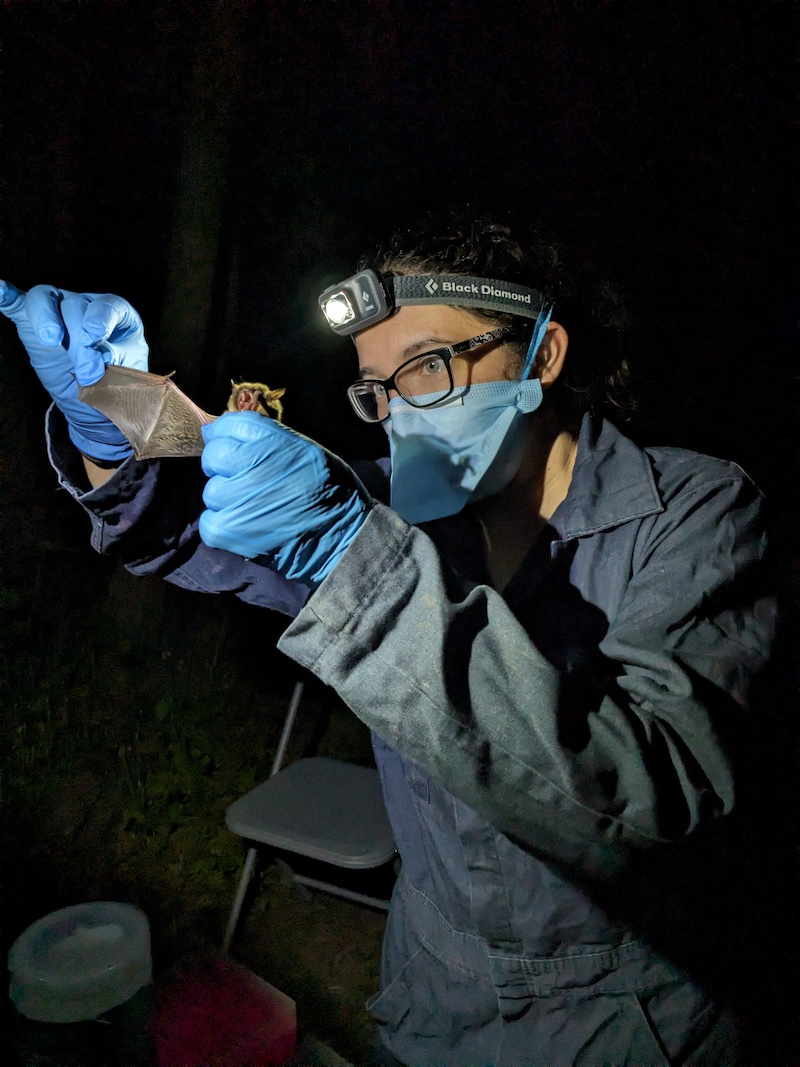
The tricked bat is safely plucked from the mesh, measured and released. This past fall, O’Keefe caught five northern long-eared bats in a park in Urbana, the most to date. Two of these bats were especially chunky, weighing in at over 9 grams, which is a little lighter than a tablespoon of butter. Fat bats are a signal that they may be hibernating in the area; a juvenile northern long-eared bat, collected in 2022, suggested to O’Keefe and Obrochta that the population is successfully reproducing.
That juvenile northern long-eared bat did not end up on the bat investigators’ radar by accident — or by echolocation. In Illinois, roughly 1,500 bats are euthanized each year after being found in human homes. Like all mammals, bats can carry rabies, and while their rate of rabies infection in the wild is around 1 percent, the percentage of bats collected from homes that test positive hovers around 3 to 6 percent.
Illinois Natural History Survey Associate Mammologist Jean Mengelkoch attributes this discrepancy to the erratic behavior triggered by rabies. Bats that are spotted by humans, flying around in the daytime or moving clumsily through a house, are a more rabies-prone sample than those tucked away in the trunk of a tree. Once a bat is found in an area where it could have come in contact with people, the recommendation from the Illinois Department of Public Health is to euthanize the bat and test it for rabies. After all, without preventative shots, infection from rabies is extraordinarily deadly for humans.
But what happens to bats taken by local animal control departments and tested to protect humans from a disease? For 20-plus years they arrived at the Illinois Natural History Survey. There, Associate Mammologist Jean Mengelkoch would identify them and log them into a database, alongside their location and the date of capture.
The system — which lapsed in 2023 due to lack of funding — turned rabies-tested bats from tragic by-products of the health system into scientific data points, where their presence could be mapped and studied by researchers such as Obrochta and O’Keefe

For three years in a row, including the 2025 record, northern long-eared bats have been successfully documented in Urbana, a task made easier by location data from tiny radio tags attached with surgical glue to captured bats. The glue is nontoxic and falls off after a couple of weeks. It is just one more strategy used to follow the habits of an incredibly elusive animal.
“Sometimes you have to be really tricky with them, they are really wily little guys,” O’Keefe said with a chuckle.
As it turns out, you do not need a PhD in bat biology to become a bat investigator. Volunteers conducting surveys as part of the Midwest Bat Hub have acoustically monitored dozens of sites across the state since the program began in 2021. In the Chicago area, the Lincoln Park Zoo leads efforts to track urban bats through their Bat Tracker program.
Bats are still struggling in Illinois and beyond. But with new technology and endless dedication from scientists and volunteers, there is still hope for these apparitions of the night.
Hugh Gabriel is a writer and occasional herpetologist who calls Minneapolis home. He’s a science communicator for the University of Minnesota, and uses video and print storytelling to bring critical research to the public eye. Gabriel has a special affinity for frogs, prairie flowers and a long day of fishing on a clear lake.











Prześlij pytanie do autora