
Photo by Courtney Celley, USFWS.

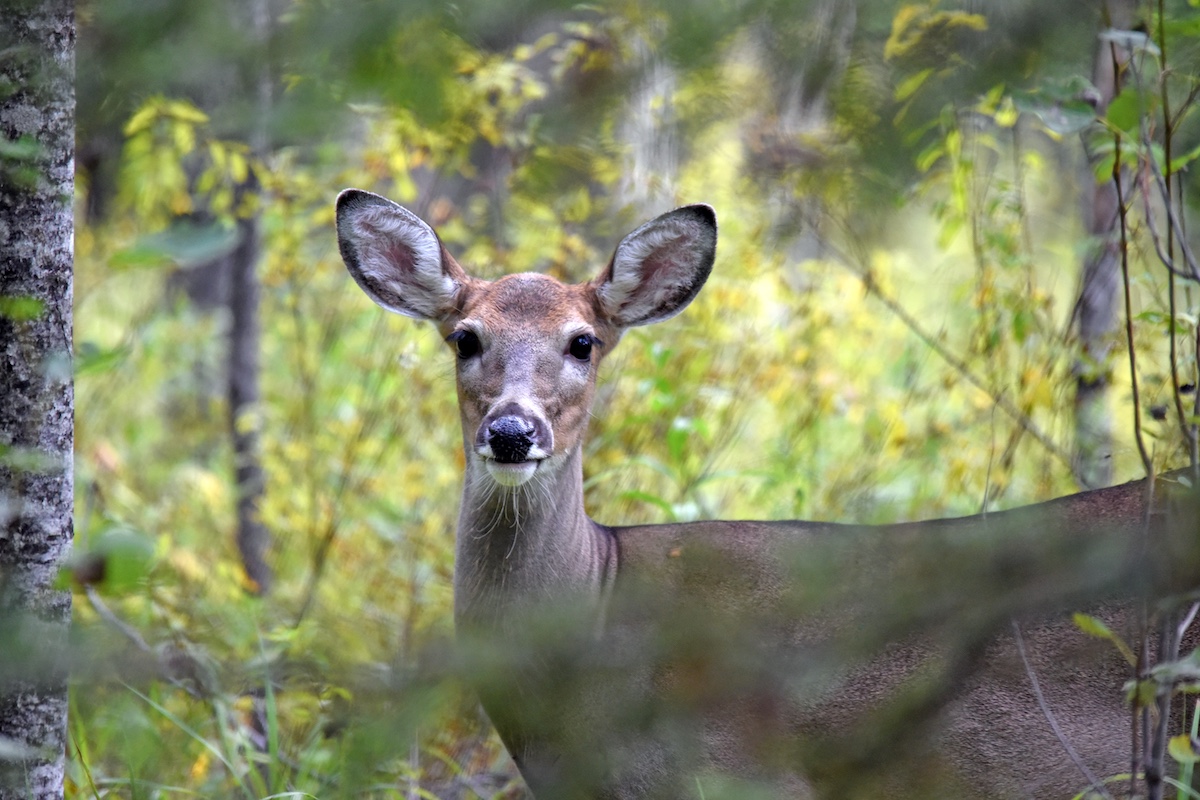
Photo by Courtney Celley, USFWS.
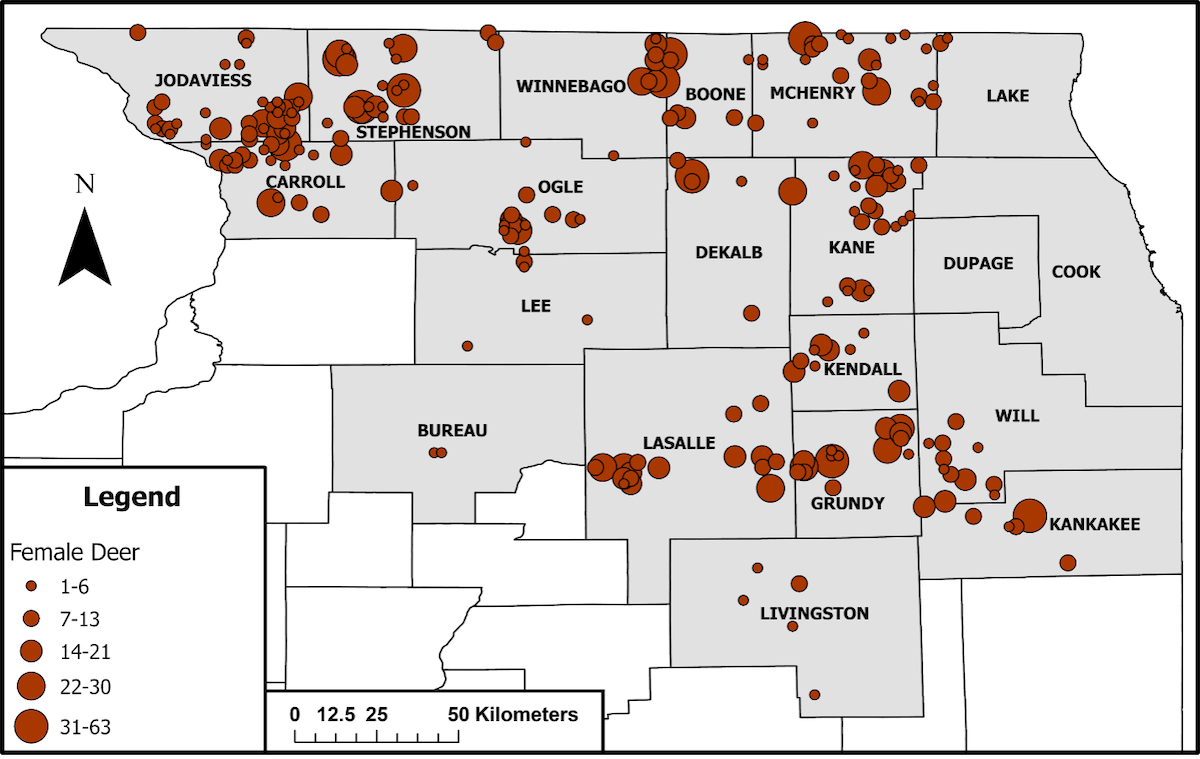
Chronic wasting disease (CWD) is a fatal neurological disease of cervids caused by an infectious protein (prion) that has been detected in Illinois’ wild white-tailed deer herd since 20021. Transmission of CWD is usually through direct contact with an infected animal and its bodily fluids2. Still, consumption of prion-contaminated plants3, water4, or soil5 or vertical transmission from mother to fetus may also cause infection6. That means a fawn could be born infected with CWD, but even if infection does not occur in utero, CWD impacts an animal’s ability to eat, thus a CWD-positive female deer may suffer from nutritional deficiencies7 before the onset of visible signs and the characteristic wasting (weight loss). This raises the question of whether fetal growth is impacted by CWD, particularly the brain and other neurological tissues. To explore this possibility, we used data collected from 18 counties in Illinois (Figure 1) to examine the impact of maternal CWD infection and other variables on fetal head size8, which is directly proportional to brain size9.
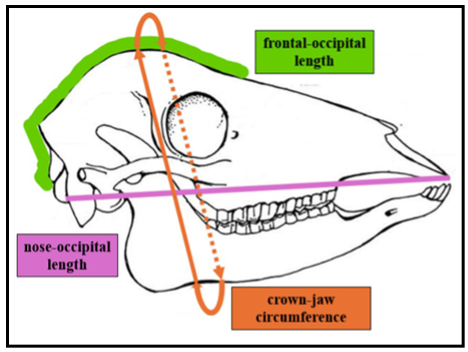
We selected fetuses from known CWD-positive and CWD-negative deer. It should be noted that whether the fetuses were infected was unknown due to difficulties with detecting low prion concentrations at early stages of disease. Three different head measurements were examined in this study: (1) distance between the tip of the nose and the occipital bone, (2) distance from the frontal to the occipital bone, and (3) the circumference of the head from the crown (top) to the jaw (bottom) (Figure 2).
The first step in the analysis was identifying factors that may impact fetal head size, and selecting eight variables: (1) fetal weight, (2) fetal body length, (3) fetal sex, (4) maternal age, (5) maternal weight, (6) number of fetuses in the litter, (7) deer habitat quality and quantity (land cover utility score)10, and (8) the day of the year the female deer died. We also included a ninth variable to account for CWD status. A regression model used the eight variables as the “control variables” to account for differences in head sizes between fetuses (due to fetal, maternal, and environmental characteristics) other than maternal CWD status, isolating the effect of the ninth variable (maternal CWD infection). The results of the model showed that fetal head size increased with fetal body size, and when maternal age and weight increased. Fetal head size also increased with deer habitat quality and quantity, but decreased with larger litters. The model also found that fetuses of CWD-positive female deer had smaller heads than those of CWD-negative deer. Specifically, fetuses of CWD-infected females had nose-occipital lengths and crown-jaw circumferences smaller (6.76% and 11.31% respectively) than their CWD-negative counterparts8.
This finding could have serious implications for fawn survival and success after birth. Though no studies have evaluated the impact of smaller brains on cervids, studies in humans have found delayed and/or impaired cognitive development and problems with vision and hearing11,12. A study of prion diseases in non-human primates suggests that, because smaller brains have less neural tissue, prion-infected animals with smaller brains may die faster13; which may shorten the lifespan of fawns born with CWD or infected soon after birth. This study demonstrates an additional impact of CWD infection, suggesting long-term consequences for the newborn and the herd.
El Dr. Jameson Mori es investigador postdoctoral en los Laboratorios Colaborativos de la Enfermedad Crónica del Desgaste Mateus & Novakofski. Su investigación se centra en el uso de datos y modelos para determinar el impacto de la enfermedad crónica del desgaste en los ciervos de cola blanca en Illinois y la efectividad de los esfuerzos de manejo para controlar la enfermedad. Obtuvo su licenciatura (B.S.) en la Universidad de Massachusetts Dartmouth y su doctorado (Ph.D.) en la Universidad de Illinois en Urbana-Champaign.
La Dra. Nelda Rivera centra su investigación en la ecología y evolución de enfermedades infecciosas nuevas y reemergentes, así como en la epidemiología de enfermedades infecciosas, la vigilancia epidemiológica y la determinación de hospedadores reservorios. Es miembro del Laboratorio de Epidemiología Veterinaria de Vida Silvestre y de los Laboratorios Colaborativos de la Enfermedad Crónica del Desgaste Novakofski & Mateus. Obtuvo su maestría (M.S.) en la Universidad de Illinois en Urbana-Champaign y su doctorado en Medicina Veterinaria (D.V.M.) en la Universidad de Panamá, República de Panamá.
La Dra. Nohra Mateus-Pinilla es epidemióloga veterinaria especializada en enfermedades de fauna silvestre, conservación y zoonosis. Estudia la transmisión de la enfermedad de desgaste crónico (Chronic Wasting Disease – CWD) y estrategias de control para proteger la salud del venado de cola blanca en vida libre. Trabaja en la Encuesta de Historia Natural de Illinois (Illinois Natural History Survey) – Universidad de Illinois. Obtuvo su M.S. y Ph.D. en la Universidad de Illinois Urbana-Champaign.








Envíe una pregunta para el autor