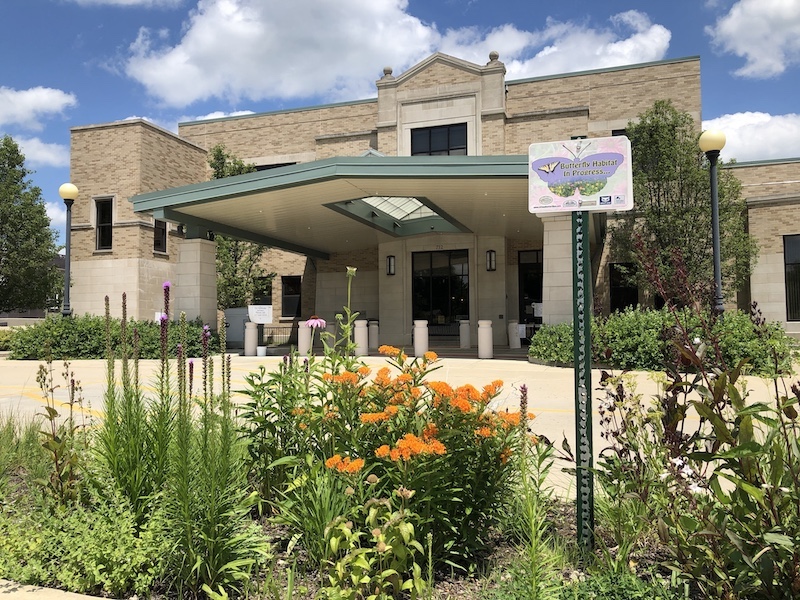
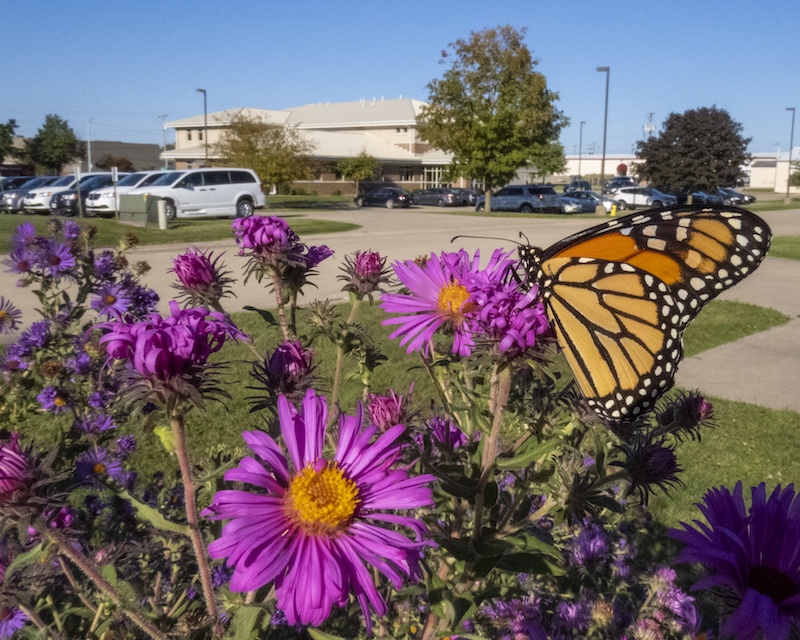
Butterfly habitat in parking lot island at the Lake Charleston Pavilion UBI Butterfly Hotspot. All photos by Paul V. Switzer.

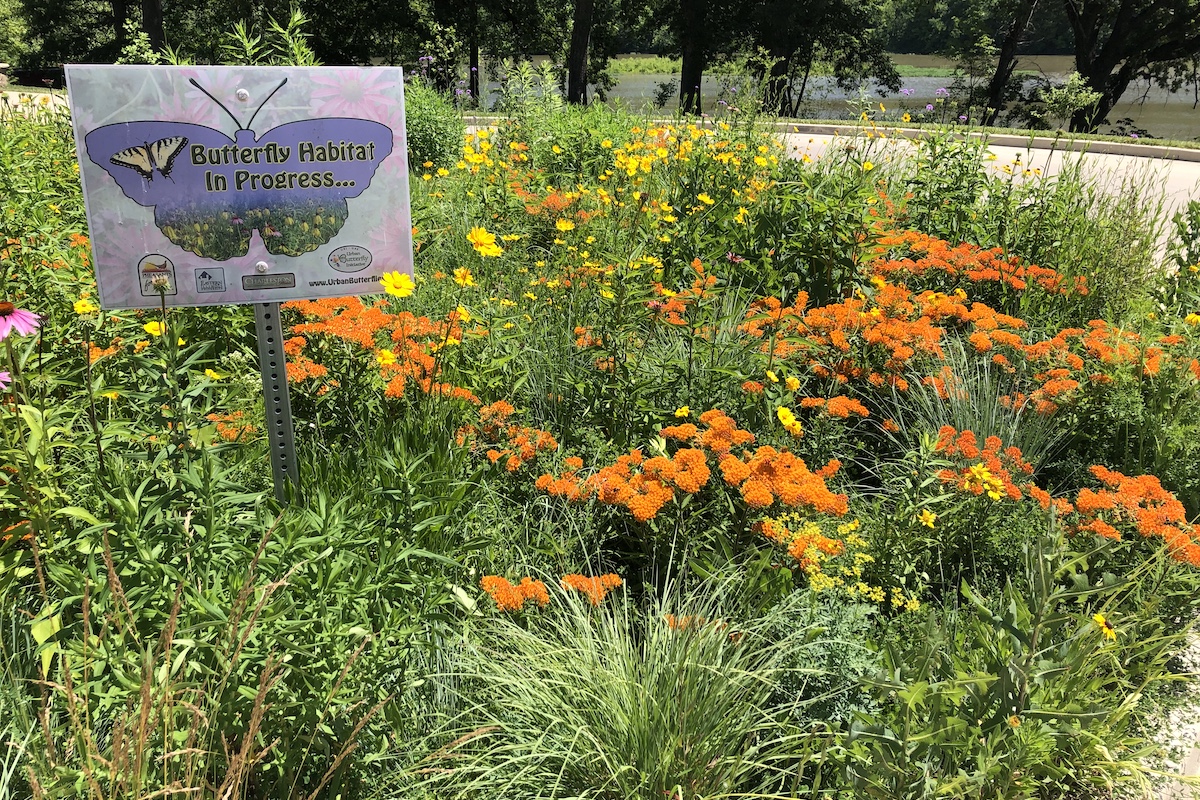
Butterfly habitat in parking lot island at the Lake Charleston Pavilion UBI Butterfly Hotspot. All photos by Paul V. Switzer.
Picture driving through virtually any town in Illinois…turf grass lawns and rights-of-way with foundation plantings of shrubs from Europe and Asia…huge expanses of lawn in front of hospitals, churches, and businesses, all plants bred and treated to be “pest-free.” Now imagine the thousands of hours of upkeep and thousands of pounds of fertilizers and pesticides used to keep those landscapes “tidy,” many of which require fossil fuels to create and apply, and many that are known to cause health problems in people and pets.
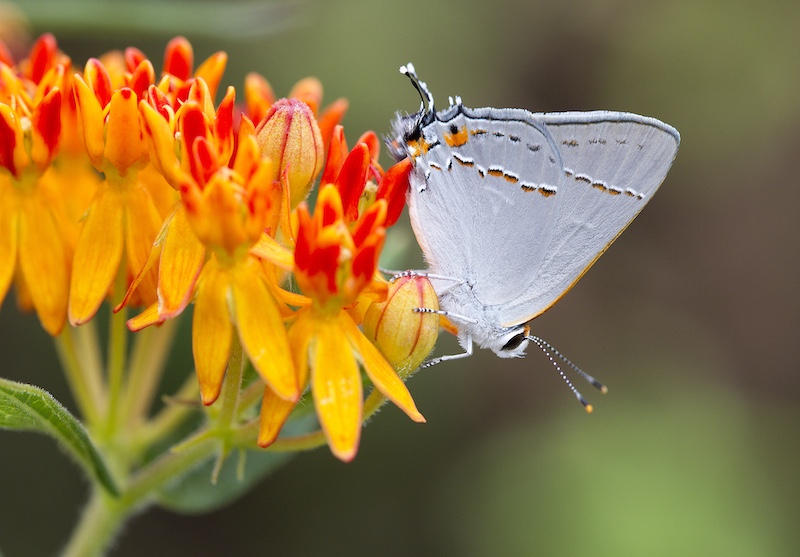
And now pay attention not to what IS there, but what IS NOT there. Where are the butterflies? Where are the birds? The answer is simple: there’s nothing for them to eat. The non-native and often invasive turf grasses, flowers, shrubs and trees did not evolve with our local insects, which means that they have no connection to the local food webs. “Pest free plant” is another way of saying “useless plant,” at least from an ecological perspective. If a plant isn’t getting chewed on by an insect, then it’s not connected to the local ecology. And without those insects, the birds don’t have food to feed their nestlings.
Although the answer is simple, the solution is challenging teaching people to think differently about our landscapes, to make them want to change our traditional practices and instead view landscapes as a celebration of our local ecological heritage, connecting our human landscapes to the local food webs. To take that step, people and the communities they live in need to have a reason to change their mindset about what a desirable landscape looks like. Enter the butterflies.
In 2018, a small group of concerned biologists started the Urban Butterfly Initiative (UBI), a 501(c)(3) community service nonprofit organization established to promote changes in urban greenspaces, educate communities about nature and science, and encourage people to spend time in nature. UBI’s mission has three facets: Biodiversity & Conservation, Education & Outreach, and Science & Research. UBI harnesses the charisma and popularity of butterflies, which most people view as beautiful, approachable, harmless and desirable, to encourage landscape changes in communities. Everyone loves butterflies! And butterfly landscaping results in increased health for both nature and humans, all while bringing people together and saving communities money. It’s a win-win-win-win.
To meet our Biodiversity & Conservation goal, UBI partners with cities, local organizations and businesses who want to create butterfly habitat in urban areas. We serve as free consultants, helping with design, plant choices, seed/plant sourcing, and offering long term management instructions and advice. In some cases, we help with site preparation and habitat installation, but our partners must be willing to be involved in (or help organize) the labor aspects of the project.
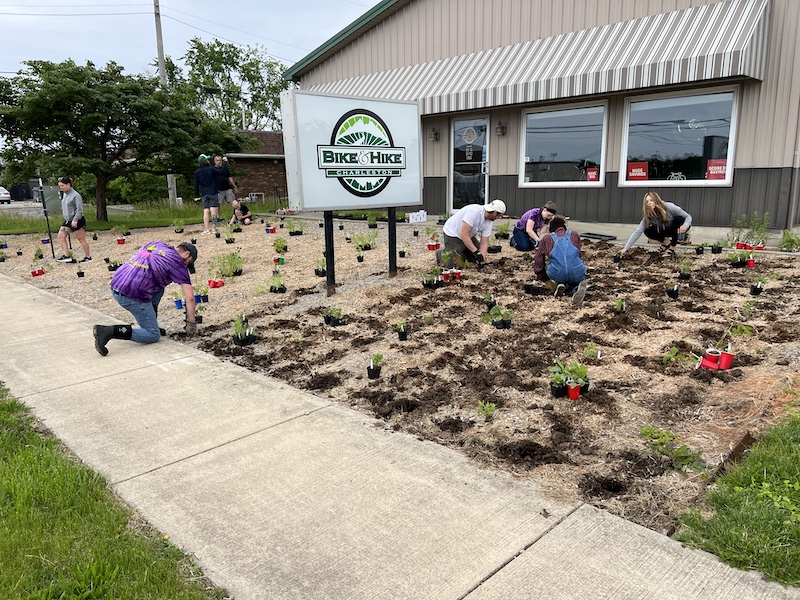
To create landscapes that will benefit biodiversity and require less maintenance, we focus on using native plants and creating areas completely filled with grasses and flowering plants, not scattered plants existing in mulch – think ‘meadow’ instead of ‘garden.’ This leaves fewer gaps for unwanted plants to grow and eliminates the need to replace mulch each year. But it does create a different aesthetic, and for people who are used to more traditional, high-maintenance “garden” approaches or manicured lawns, that can be off-putting. However, by using shorter plants, ‘signs of intentionality’ such as edging, paths, and informational signage, and marketing the project so people are more aware of the goals (see below), naturalistic landscapes can become more acceptable to most people. Other important considerations are creating a habitat that provides various blooms all season long and including host plants for immature stages of insects as well as the nectar plants for the adults.
Our butterfly landscapes have included unused lots that had previously been turfgrass, foundation plantings, beds in front of buildings and parking lot islands. Instead of thinking of our projects as isolated butterfly gardens, our goal for communities is to create ‘butterfly cities,’ in which native host and nectar plants are found throughout a city. Taking advantage of the fact that butterflies can fly, this approach creates a connected patchwork of suitable plants so a city will function more like one large habitat. The landscapes we create with our partners serve as ‘butterfly hotspots’ which people can visit to see the beautiful flowers and butterflies that the whole city is producing. Most cities have a landscaping budget, and luckily it’s usually not more expensive (and may often be cheaper) to create that connected patchwork; it’s just a matter of choosing the right species of plants to put in public spaces.
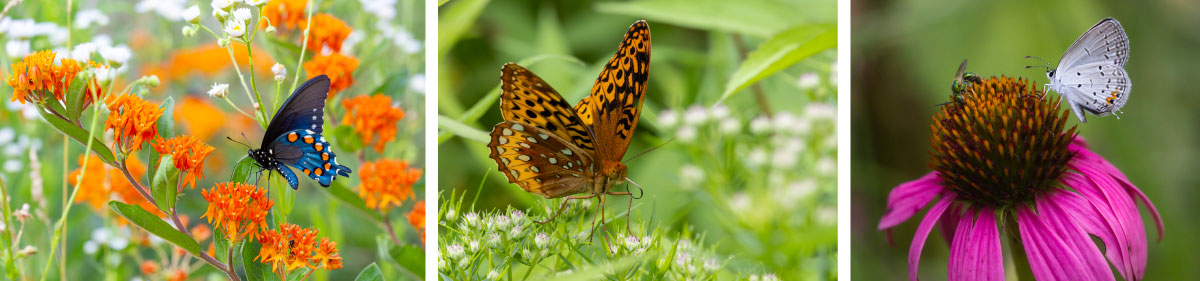
We spend a great deal of time and effort helping our partners and our communities understand why we are doing what we are doing while spreading knowledge about nature and science. Our hope is that having a greater understanding and appreciation of, and feeling more connected to, nature will lead to larger changes in caring about the environment.
Our education efforts are wide-ranging: we use social media (primarily Facebook and Instagram, @urbanbutterflies) to advertise our work, to provide information about butterflies, other pollinators and plants, and to share findings of interesting new research. We have an interactive Facebook group (Grand Prairie Butterfly Club) in which people can share photos, their excitement at finding beautiful tiny creatures, and their own personal habitat successes. We have butterfly walks in our hotspots and we hold ‘Night Bugs!’ events with black lights so people can learn about and enjoy the creatures that often go unseen during the night. We also hold events such as the Charleston Butterfly Blitz, a 9-day event at the end of July in which we encourage people to submit photos of butterflies they find in Coles County to iNaturalist. The Blitz not only encourages people to spend time in nature, visit our habitats, and notice butterflies, but also builds excitement around the idea of urban butterfly habitats. Each year, we have documented over 40 species of butterflies in those nine days. Comparing the submissions of species from year-to-year yields some interesting patterns. We also have helpful resources on our website (urbanbutterflies.org), including gardening guides, sources for native plants and butterfly identification information (including a free, downloadable e-guide to common butterflies).
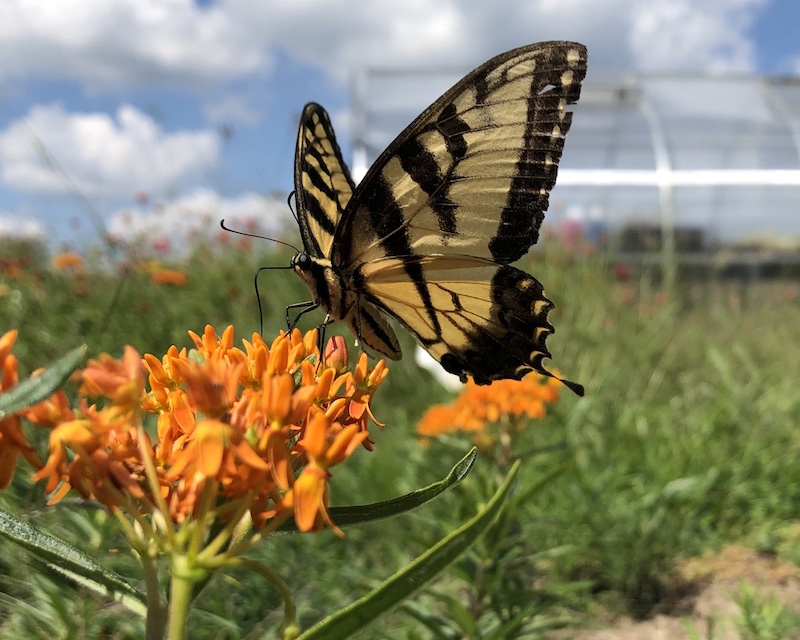
UBI also organizes data collection as part of scientific research. When we establish our habitats, we also create an iNaturalist “project” for each site, which allows us and our partners to track biodiversity at individual sites and in total. By encouraging people to use iNaturalist all year, we have harnessed the power of community science to gather biodiversity data at our butterfly hotspots as well as in the community at large. At the time of writing, our hotspot sites have more than 16,000 submissions of 1,000+ species of animals, plants and fungi, including 60 species of butterflies. We have also conducted studies with students at Eastern Illinois University on topics such as patterns of mimicry and behavior in eastern tiger swallowtails and differences in butterfly presence at our hotspots versus nearby lawns.
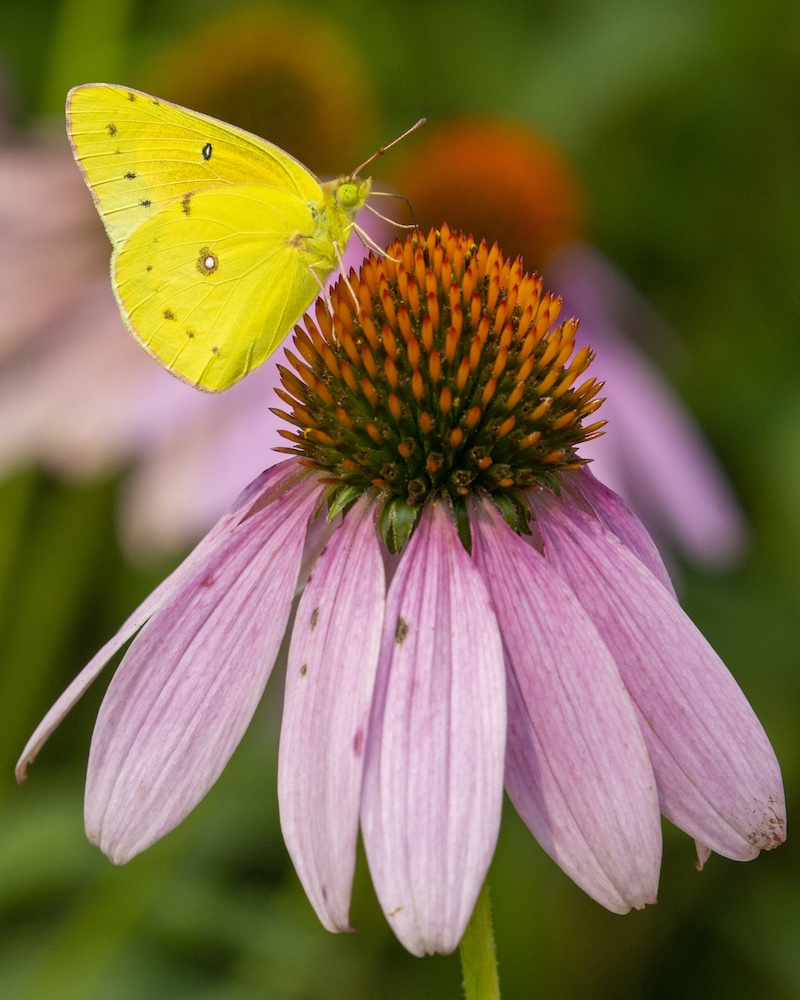
We currently have created or modified more than 50 acres at more than 30 sites in central Illinois. As a result of the efforts of UBI and our partners, the city of Charleston has adopted the moniker ‘Butterfly Capital of Illinois’ and has also achieved the ‘Monarch Champion’ level of the National Wildlife Federation’s (NWF) Mayors’ Monarch Pledge. Charleston was even highlighted in one of NWF’s video features for that program. In 2024, the city started an annual ‘Charleston Butterfly Festival’ at the end of Blitz week, which serves as a celebration of butterflies, UBI’s work in the community and the many aspects of outdoor recreation that the city of Charleston has worked to encourage.
We are also excited about the development of three new ventures.
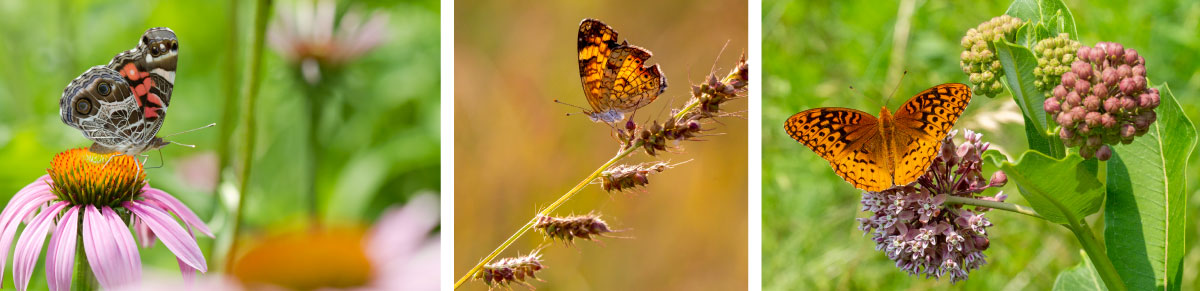
None of what the Urban Butterfly Initiative has accomplished would be possible without the support and help of our many community partners. As our efforts continue to expand into other communities in Illinois, we hope that our mission will continue to gain momentum so that eventually, when driving around Illinois communities, instead of acres of ecological wasteland, one will see beautiful native flowers and grasses, teeming with butterflies and birds and other wonderful creatures. We hope that you join us in helping switch urban greenspaces from causing environmental problems to becoming flourishing native landscapes that contribute to the solution.
Paul V. Switzer, PhD, jest dyrektorem Urban Butterfly Initiative oraz profesorem na Wydziale Nauk Biologicznych Eastern Illinois University. Lubi spędzać czas na łonie natury, fotografować owady, inne zwierzęta, rośliny i grzyby oraz dokumentować swoje obserwacje w iNaturalist.
Annalisa M. Switzer, MS, DVM, z wykształcenia biolog, jest skarbnikiem, webmasterem oraz członkiem zarządu Urban Butterfly Initiative. Uwielbia znajdować nowe obserwacje do zgłaszania w iNaturalist i szczególnie cieszy się, gdy widzi wyjątkowo efektowne ćmy — w tym te pretensjonalne ćmy, które nazywamy motylami.



Prześlij pytanie do autora